What Does ANC Mean on Headphones? (2026 Guide)

You unbox a new pair of headphones, spot a button marked ANC, and press it. The room goes a little quieter. A soft hiss fades in. And you wonder what you just turned on — and whether it was worth the extra money.
Those three letters show up on almost every wireless pair now, from cheap earbuds to $400 flagships. They promise quiet. They don't promise silence. The gap between those two words is the whole story.
This guide explains what ANC means in plain words, how it works, what it blocks and what it can't, and when paying extra for it makes sense.
The short version: ANC means active noise cancellation — your headphones listen to the noise around you and play an opposite sound that cancels much of it out. It is brilliant on planes, trains and buses, weak against voices and sudden sounds, and it costs you a little battery. If you commute or work in a noisy room, it is worth paying for. If you mostly listen at home in the quiet, skip it.
What Does ANC Mean on Headphones?
ANC means active noise cancellation. It is a feature that uses tiny microphones to listen to the noise around you, then plays an opposite sound wave that cancels much of it out before it reaches your ears. You hear less engine hum, less office drone, and more of your music.
ANC stands for active noise cancellation, and it means your headphones use microphones and a processor to cut background noise before it reaches your ears. According to Wikipedia, the system builds a sound wave that is the mirror image of the noise around you, so the two cancel each other out. The result is a quieter listen, not total silence.
ANC on headphones means the pair can lower steady background noise on its own, without you doing anything. According to How-To Geek, the headphones listen with outside microphones, then play an inverted copy of the noise that wipes out much of it. Voices and sudden sounds still get through, so ANC is a filter, not a wall.
Three letters. One job: make the world quieter.
ANC stands for "active noise cancellation" — though you will also see "active noise control" and "active noise reduction", which mean the same thing. The word "active" is the clue: the headphones do something, using power and processing, instead of just blocking sound with padding. That doing-something is what separates ANC from the passive seal of the earcups, which works with no power at all.
You'll find ANC on over-ear headphones and in-ear buds alike. On the box it may appear as "ANC", "active noise cancelling", "noise cancelling", or a brand name like Sony's "noise cancelling" or Apple's "Active Noise Cancellation". Same idea, different label — check the spec sheet, not the marketing line.
How Does ANC Actually Work?
Microphones hear the noise, a chip flips it upside down, and your headphones play the flipped sound. The two waves cancel each other out — and the hum drops away.
Active noise cancellation works by turning sound against itself. Tiny microphones on the outside of the headphones pick up the noise around you, a chip flips that sound wave upside down, and the driver plays the flipped wave into your ear. When the two waves meet, they partly cancel each other out — and the hum drops away.
Here's the thing: the trick is timing. The chip has to hear the noise, flip it, and play the anti-noise in a fraction of a millisecond — before the real noise reaches your ear. That is why ANC works best on steady, predictable sounds like engine drone. A sudden shout changes too fast for the system to catch.
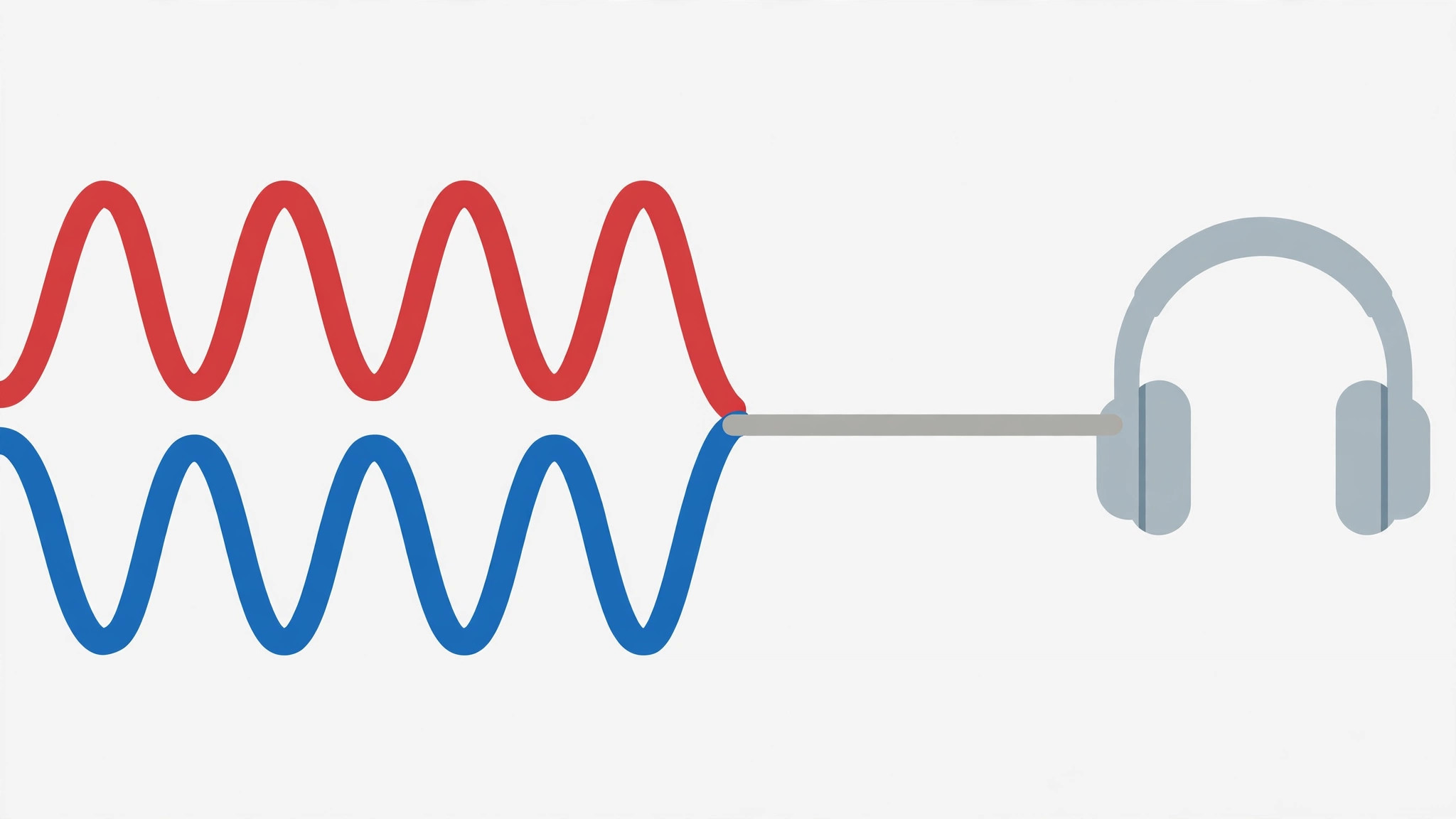
Or maybe I should say it this way: ANC doesn't remove noise from the room. It removes it from your ears. The plane is just as loud. Your music just doesn't have to fight it.
Most pairs use one of three setups. Feedforward ANC puts the microphones outside the earcup, so it hears noise early but can miss what leaks in. Feedback ANC puts them inside, so it hears what you hear but reacts a touch later. Hybrid ANC uses both, and it is the setup on most good pairs today — Sony, Bose and Apple all use it on their flagships. If you want the engineering detail, our active noise cancellation technology guide goes deeper.
One pair. One flipped wave. Less hum.
How Do I Turn ANC On?
Press the ANC button on the earcup or earbud, or flip the toggle in the headphone app. A soft hiss tells you it is working.
To turn on ANC, follow these steps: 1. Find the ANC button on your earcup or earbud, or open the headphone app. 2. Press the button or switch the ANC toggle on. 3. Listen for a soft hiss — that is the system working. 4. Switch to transparency mode when you need to hear traffic or announcements.
- Find the ANC control. Look for a button marked ANC or NC on the earcup or earbud, or open the headphone app.
- Switch ANC on. Press the button once or flip the ANC toggle in the app until you hear a soft hiss.
- Check the mode. Most pairs cycle through ANC on, transparency mode and ANC off with each press — stop on the mode you want.
- Adjust the level. If your app offers ANC levels, try a lower level first and raise it only if the noise is still distracting.
- Turn it off when you need to hear. Switch to transparency mode or turn ANC off near traffic, on a windy walk, or when you want to save battery.
Most pairs cycle through three modes with each press: ANC on, transparency (outside sound let in), and ANC off. If your pair has no button, the app holds the switch — Sony calls it "Noise cancelling", Bose lists it under Modes, and Apple puts it in Control Centre when AirPods are connected.
Quick note: ANC only works with power. If the battery dies, the headphones go quiet — or keep playing through the cable on over-ears, with no cancellation at all.
ANC vs Passive Noise Cancelling: What's the Difference?
ANC cancels noise with sound. Passive cancelling blocks it with material. You need both — they cover different sounds.
ANC vs passive noise cancelling: ANC is better suited for steady low sounds like engines and fans because it cancels them with an opposite sound wave. Passive cancelling works better when you need to block sharp sounds like voices and keyboard clicks. The key difference is that ANC uses power and processing, while passive cancelling uses only the physical seal.
Passive noise cancelling is the plain physical seal: thick earcups, foam tips, a snug fit. It needs no battery and it never glitches. It is also better than ANC at cutting sharp, high sounds — voices, keyboard clicks, a clattering dish. ANC wins on low, steady sounds — engines, fans, road rumble.
Here's a simple way to think about it. Put your hands over your ears. That muffling is passive cancelling. Now imagine your hands could also hum the exact opposite of the noise around you. That second part is ANC. Good headphones do both at once, which is why fit matters so much — a loose seal lets noise in faster than the chip can cancel it.
Look — if you're buying for the daily train, here's what actually works: try the fit first, then the ANC button. If you've got cheap earbuds that don't seal, you're paying for a feature that can't do its job.
What Kind of Noise Does ANC Block Best?
Steady low sounds: engines, fans, road rumble, air conditioning. Sudden and high sounds — voices, horns, barking — mostly get through.
ANC is at its best on a plane. The cabin drone is low, steady and predictable — exactly the sound the system was built for. The same goes for trains, buses, and the hum of an office air conditioner. That is why travellers swear by it.
Voices are the weak spot. Speech jumps up and down in pitch and volume too fast for the anti-noise to track, so a chatty office stays chatty — just a little softer. The same goes for a crying baby, a car horn, or a door slamming. ANC turns the volume of the world down. It doesn't switch it off.
Wind is the other enemy. On a windy walk, the microphones pick up the airflow itself and turn it into a rushing hiss. Most good pairs now have a wind-reduction setting — if yours sounds worse outside, try switching ANC off or to a lower level.
Steady hum, yes. Chatty humans, no.
Does ANC Drain the Battery?
Yes, a little. ANC needs power for its microphones and chip, so turning it on shortens battery life — usually by a few hours on a full charge.
How much depends on the pair. Big over-ears with large batteries barely notice it. Small earbuds feel it more, because their batteries are tiny to begin with. Some makers quote two battery figures — one with ANC on, one with it off — and the gap is the honest answer for that model.
If battery life matters more than quiet on a given day, turn ANC off and rely on the seal alone. On most pairs the toggle is one press away, and you can flip it back on when the noise starts.
A few hours. Not half the battery.
Is ANC Bad for Your Ears?
No — ANC itself is not harmful. The "pressure" some people feel is your brain reacting to sudden quiet, not real pressure in your ear.
That full or "suction" feeling is the most common complaint about ANC, and it puts some people off. There is no extra air pressure being pumped into your ear — the feeling comes from low background sound dropping away all at once, which your brain reads as a change in pressure. Most people get used to it within a few days. If it bothers you, try a lower ANC level or switch to transparency mode for a while.
I've seen conflicting data — some makers quote a 20-decibel cut, others claim 40 for a similar pair. My read is the number says more about the test room than your ears, so treat it as a rough guide, not a promise.
One real safety note: ANC is not hearing protection. It lowers the noise you hear, but it is not certified to protect your hearing at a building site or a concert — for that you need proper ear protection with a noise reduction rating. Our guide to Bluetooth headphone safety and whether Bluetooth headphones cause hearing loss cover the details.
Safe for daily use. Not a substitute for ear defenders.
Should You Pay Extra for ANC Headphones?
If you commute, fly, or work in a noisy room, yes. If you mostly listen at home in the quiet, save the money.
A good seal beats budget ANC every time — that is the opinion plenty of people will push back on, but it holds up. A $50 pair that fits well will sound quieter than a $150 pair with weak ANC and a loose seal. Spend on fit first, ANC second.
When ANC is worth it: daily train or bus rides, frequent flights, open-plan offices, a noisy flat. When it is not: quiet home listening, short walks, or a tight budget where the same money buys better sound or comfort instead.
Anyway, the test is simple. Borrow a pair, press the button on your normal commute, and see if the world drops away. If it does, you will know within a minute — and you will miss it the moment you take them off.
Try it on your commute. Then decide.
Frequently Asked Questions
What's the fastest way to tell if my headphones have ANC?
Look for "ANC" or "noise cancelling" on the box or spec sheet, or a button marked ANC on the earcup. If neither appears, they don't have it.
Does ANC block voices?
Not well. Voices change pitch and volume too fast for the anti-noise to track, so speech stays audible — just softer.
Why does ANC make my ears feel weird?
That pressure feeling comes from low background sound dropping away suddenly, not from real air pressure. Most people get used to it within a few days.
Can I use ANC without playing music?
Yes. ANC works on its own, so you can switch it on with no music playing and enjoy the quiet — handy on a plane when you want to sleep.
Does ANC work when the battery dies?
No. ANC needs power for its microphones and chip. With a dead battery, over-ear headphones may still play through a cable, but with no cancellation.
When should I turn ANC off?
Turn it off in wind, when you need to hear traffic or announcements, or when you want to save battery. Transparency mode is the middle ground.
Is ANC the same as noise cancelling?
"Noise cancelling" is the broad term — it covers both ANC and passive cancelling. ANC is the electronic half: microphones plus processing. The passive half is the physical seal.