Are Bluetooth Headphones Safe? (2026 Guide)

You wear earbuds for hours a day — on the commute, at the gym, on calls. Then a headline says Bluetooth "cooks your brain" or causes cancer, and suddenly the little buds in your ears feel less friendly. If you've read the scary headlines, you're not alone — we've all seen them, and they don't tell the full story.
Bluetooth headphones are safe for most people because they use low-power, non-ionizing radio waves that cannot damage DNA. They run at 2.4 GHz with a maximum output of 2.5 milliwatts — far below a mobile phone. The real risk is volume, not radiation.
The short version: yes, Bluetooth headphones are safe for most people. The radio waves they give off are weak, non-ionizing, and far below every safety limit. The proven danger is loud volume over long hours — that can damage your hearing for good, so keep it at 60% or below and take breaks.
Are Bluetooth Headphones Safe?
Yes — for most people, Bluetooth headphones are safe to use every day. Health organisations around the world have looked at the evidence for decades and found no proven harm from the low-power radio waves involved.
Bluetooth headphones are safe to wear all day for most people, as long as the volume stays sensible. According to the World Health Organization, current evidence does not confirm health effects from low-level electromagnetic fields. The radio waves are weak, the power is tiny, and decades of use have shown no clear harm.
Bluetooth headphones do not cause cancer, according to current research. According to the National Cancer Institute, brain cancer rates have not risen in the United States, Australia or Europe since mobile phones arrived. No study has tied the low-power radio waves in earbuds to tumours, and health agencies keep watching the evidence.
Look — if you're the person who wears earbuds from the morning commute to the last call of the day, this guide is for you. The fear is fair. The buds sit right next to your brain, and "radiation" sounds bad. But the word covers everything from sunlight to X-rays, and the kind matters far more than the label.
Short answer first, details next.
What Kind of Radiation Do Bluetooth Headphones Give Off?
Bluetooth headphones give off non-ionizing radiofrequency radiation — low-energy radio waves that cannot knock electrons off atoms or damage DNA. That single fact is why the safety picture looks so different from X-rays or UV light.
Bluetooth headphones give off non-ionizing radiofrequency radiation, the low-energy kind that cannot break DNA apart. The signal runs at 2.4 GHz, the same band as Wi-Fi, but at a maximum of 2.5 milliwatts — a tiny fraction of a phone's output. It warms nothing and ionizes nothing.
Radiation splits into two kinds. Ionizing radiation — X-rays, gamma rays, strong UV — carries enough energy to damage DNA, and that damage can lead to cancer. Non-ionizing radiation — radio waves, visible light, the heat from a hob — does not carry that energy. Bluetooth sits at the low end of the non-ionizing scale, below even visible light.
Power is the other half of the story. A kitchen microwave runs at 700 watts or more, but it is sealed inside a metal box. A mobile phone can put out far more radio energy than your earbuds — a 2019 California study found Bluetooth devices emit 10 to 400 times less radiofrequency radiation than mobile phones. Your earbuds top out at 2.5 milliwatts, and most of the time they run well below that.
| Device | Typical power | How close it sits | What it means |
|---|---|---|---|
| Bluetooth headphones | Up to 2.5 mW | In or on your ear | The weakest signal on this list |
| Mobile phone | 10–400× more than Bluetooth | Against your head on calls | The phone dwarfs the earbuds |
| Wi-Fi router | About 100 mW | Across the room | Stronger, but far away from you |
| Microwave oven | 700 W or more | Sealed in a metal box | Powerful, but the energy stays inside |
Bluetooth vs wired headphones: Bluetooth is better suited for movement, workouts and calls because there is no cable to snag. Wired headphones work better when you want zero radio exposure or the lowest possible delay. The key difference is convenience versus a cable — the sound and the hearing risk are much the same.
Or maybe I should put it this way: the question isn't whether Bluetooth gives off radiation — it does — but whether that radiation can hurt you. On the physics alone, the answer leans no.
Can Bluetooth Headphones Cause Cancer?
No study has linked Bluetooth headphones to cancer. The radio waves are too weak to damage DNA, and the large studies that tracked mobile phone users for years found no rise in brain tumours.
This is the question that drives most of the worry, so it deserves a straight answer. The National Cancer Institute reports that brain cancer rates have not risen in the United States, Australia or Europe since mobile phones arrived. If low-level radio waves caused brain tumours at any common rate, the numbers would have moved by now.
The World Health Organization's position is plain: "current evidence does not confirm the existence of any health consequences from exposure to low-level electromagnetic fields." The US Food and Drug Administration and the Centers for Disease Control say the same about mobile phone use, and Bluetooth runs far below phone levels.
Two facts keep the debate alive, and you should know both. First, the International Agency for Research on Cancer classifies radiofrequency radiation as "possibly carcinogenic" — Group 2B, the same group as coffee and pickled vegetables. That label rests on limited evidence from heavy mobile phone use, not on Bluetooth, and it means "we can't fully rule it out", not "it causes cancer". Second, in 2015 more than 200 scientists signed an appeal to the WHO and the UN asking for tighter limits, and a 2019 study in Frontiers in Public Health advised warning consumers even though, in the researchers' own words, the "epidemiological evidence does not suggest increased brain tumor risk".
I've seen conflicting data — one small 2024 study of 600 people reported a link between wearing a Bluetooth headset for three or more hours a day and more thyroid nodules, while the big health agencies find no link at all. My read is the honest one is boring: no proven harm so far, but research on decades of daily use is still young, and one small study proves nothing on its own.
Cancer Research UK puts it simply: there is no good evidence that radiofrequency radiation from mobile phones, Wi-Fi or Bluetooth devices causes cancer. That is the consensus today.
Are Bluetooth Headphones Safe for Your Brain?
Yes, as far as the evidence goes. The earbuds sit close to your head, but the signal is so weak that it barely reaches past the skin — and no study has tied it to brain damage, memory loss or tumours.
The worry makes sense: the buds sit millimetres from your skull, for hours at a time. But closeness alone doesn't create risk — power does. Bluetooth's maximum of 2.5 milliwatts is a tiny fraction of what a phone puts out during a call, and the signal drops off fast with distance. Even the antenna in AirPods sits outside the ear canal, in the stem below the ear, not inside it.
Doctors who study brain tumours say the same thing. Jefferson Health's neuro-oncology team notes there is "currently no significant evidence that would lead us to believe these devices — or any other non-ionizing radiation sources — have adverse effects". The only proven cause of brain cancer they name is prior radiation therapy — high-dose ionizing radiation, the kind Bluetooth never produces.
Here's the thing: the risk people picture — a slow tumour growing over twenty years — has no evidence behind it. The risk that is real, common and proven is hearing loss, and it comes from volume, not radio waves. That's the next section.
Are Bluetooth Headphones Safe for Kids?
Yes, at sensible volumes. Kids' thinner skulls absorb more radio waves than adults', which is why experts advise extra care — but the radio exposure from Bluetooth is still far below safety limits, and volume is the bigger concern by far.
Children's skulls are thinner and their brains still developing, so they absorb more radiofrequency energy than adults from the same device. That fact drives most of the caution around kids and wireless tech. The American Academy of Pediatrics has issued no specific warning against Bluetooth headphones, and the WHO's 2022 review recommended no restrictions on children's Bluetooth use.
What matters most for kids is volume. A child's ears are more sensitive, and hearing damage in childhood lasts a lifetime. Volume-limited headphones capped at 85 dB take the guesswork out — the cap does the parenting for you. If your child uses regular earbuds, set the phone's volume limit in settings and check it stays set.
For younger kids, over-ear headphones fit better and stay put more easily than tiny earbuds. Our headphones for teens guide covers safe picks with volume limits built in.
Keep it simple: cap the volume, keep sessions short, and the radio question takes care of itself.
What's the Real Risk to Your Hearing?
Volume. Loud listening over long hours is the one proven, common danger from headphones — and unlike the radiation debate, this one is settled. Hearing damage from noise does not heal.
Health experts recommend the 60/60 rule: listen at 60% volume or below, for no more than 60 minutes at a time, then take a break. Health.com's medical reviewers suggest capping daily use at 60 to 90 minutes at 60–80% volume. If someone standing next to you can hear your music, or your ears ring after a session, the volume is too high.
Noise cancelling helps more than most people realise. With outside noise blocked, you can hear clearly at a much lower volume — so a good pair of noise cancelling earbuds is also a hearing-protection tool. Turn the ANC on in loud places instead of turning the volume up.
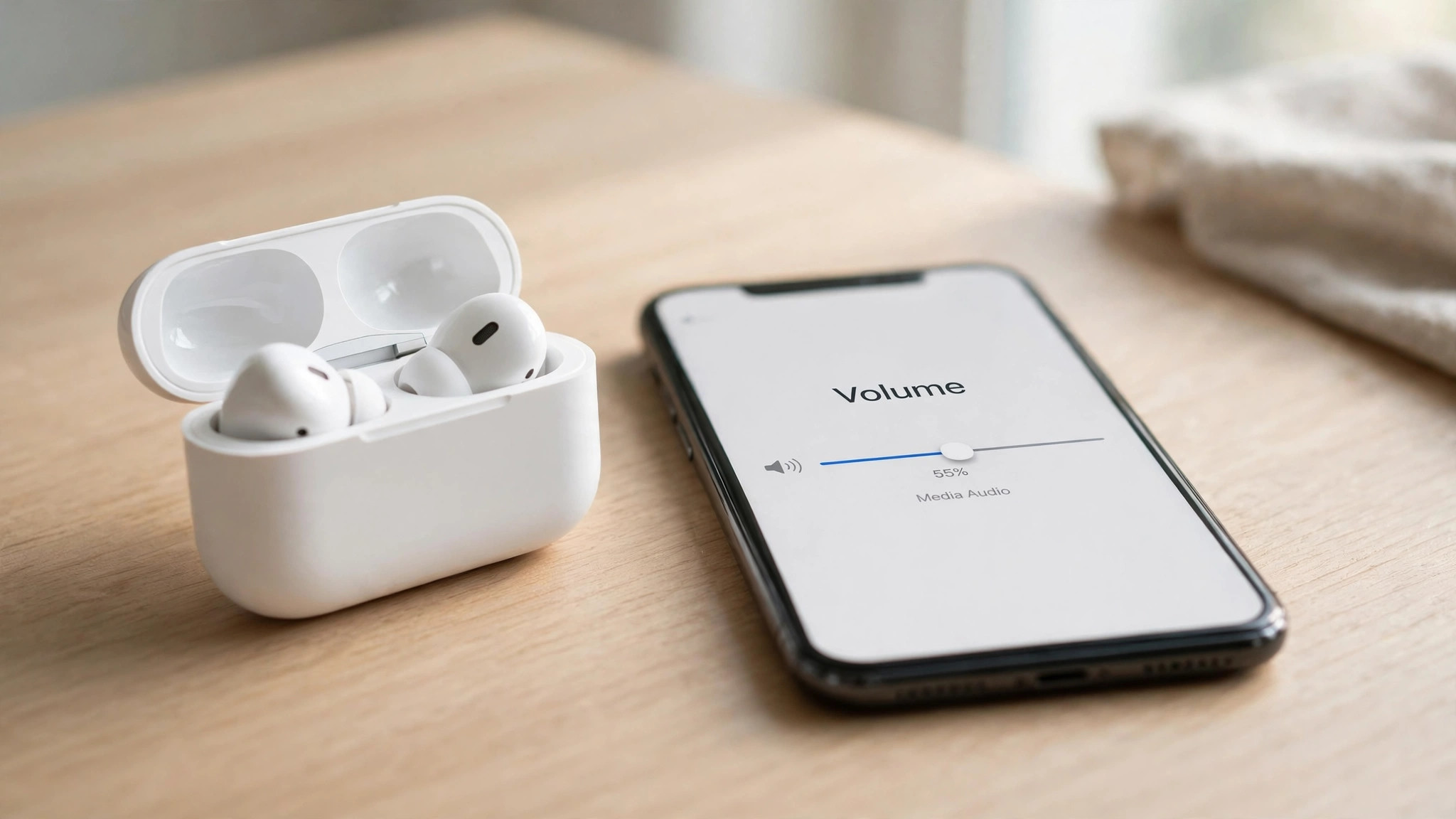
Here's an opinion that might get pushback: if you blast earbuds at full volume for six hours a day, worrying about Bluetooth radiation is guarding the wrong door. Hearing damage is proven, common and permanent. Radiation harm from earbuds is not.
Dirty earbuds carry a smaller risk too. Tips that never get cleaned can harbour bacteria and trigger ear infections, so wipe them with a dry cloth once a week and never share earbuds with someone else.
Volume is the risk.
Is It Safe to Sleep With Bluetooth Headphones?
Short naps at low volume are fine. Sleeping all night with earbuds in is a different habit — the risk is volume and ear irritation, not radiation.
Sleep earbuds exist for a reason: they sit flat, so they don't press into your ear when you roll onto your side. Standard earbuds can ache after an hour on a pillow, and waking up with sore ears is the most common complaint. Keep the volume low enough that you can still hear an alarm, and set a sleep timer so the sound stops after an hour.
All-night listening at high volume is the real problem. Eight hours of sound, even at moderate levels, adds up — your ears never get a rest. If you need sound to fall asleep, try a sleep timer plus a pillow speaker, or one earbud only, so the other ear gets a break.
One more caution: don't sleep with earbuds in if you have an ear infection or a cut inside the ear. Trapped moisture and bacteria make it worse.
Who Should Take Extra Care?
Most people need no special caution. Three groups should think a little harder: people with pacemakers, drivers, and anyone who feels unwell around wireless tech.
If you use a pacemaker or defibrillator, the earbuds themselves are low risk — but the magnets in the charging case are not. Apple warns that the magnets in AirPods and their case can interfere with medical devices if held within 15 cm (6 inches) of the chest. Keep the case in a bag or pocket away from your chest, and don't sleep with it on your chest.
Drivers should know the law where they live. Most US states allow hands-free calls with one earbud, but several states ban earbuds in both ears while driving — and for good reason. Two earbuds block sirens, horns and everything else you need to hear. One earbud in, one ear open, is the safe split.
A small number of people report headaches, tingling or fatigue they blame on wireless signals — sometimes called electromagnetic hypersensitivity. Health agencies have not found a link between low-level radio waves and those symptoms, and blinded tests show people can't tell when a signal is on or off. If you feel unwell, see a doctor first — and wired headphones are a simple way to remove the question entirely.
Everyone else: the standard advice covers you.
How Can I Use Bluetooth Headphones More Safely?
Six small habits cover almost everything: cap the volume, take breaks, use noise cancelling, clean the tips, take the buds out when you stop listening, and keep the case away from your chest if you use a pacemaker.
To use Bluetooth headphones more safely, follow these steps: 1. Keep the volume at 60% or below. 2. Take a break every hour. 3. Switch noise cancelling on in loud places. 4. Clean the ear tips each week. 5. Take the earbuds out when you stop listening. 6. Keep the case away from your chest if you use a pacemaker.
- Keep the volume at 60% or below. Set the phone's maximum-volume cap in settings so a stray swipe can't blast your ears.
- Take a break every hour. Take the earbuds out for a few minutes after each hour of listening — your ears recover fast with short rests.
- Use noise cancelling in loud places. Switch ANC on in loud places so you can hear clearly at a lower volume instead of fighting the noise.
- Clean the ear tips weekly. Wipe the tips and the case with a dry cloth once a week to stop bacteria building up.
- Take them out when you stop listening. Don't wear the buds all day out of habit — out of your ears means zero exposure and zero volume.
- Keep the case away from your chest. If you use a pacemaker or defibrillator, keep the charging case and its magnets away from your chest.
If radiation still worries you after all that, wired headphones are the honest answer: zero radio exposure, lower cost, and no battery to charge. The volume rules still apply, though — a wire doesn't make loud safe.
Small habits. Big difference.
Frequently Asked Questions
What's the safest way to use Bluetooth headphones every day?
Keep the volume at 60% or below, take a short break each hour, and take the earbuds out when you stop listening. Clean the ear tips each week, and use noise cancelling so you can listen quieter.
Do Bluetooth headphones cause cancer?
No study has linked Bluetooth headphones to cancer. They use low-power, non-ionizing radio waves that cannot damage DNA, and brain cancer rates have not risen since mobile phones arrived.
Are wireless earbuds safe for kids?
Yes, at sensible volumes. Kids' thinner skulls absorb more radio waves than adults', so volume-limited headphones capped at 85 dB are the smart pick for children.
How do I know if my headphones are too loud?
If someone next to you can hear your music, or your ears ring after a session, turn the volume down. The 60/60 rule — 60% volume for 60 minutes, then a break — is a good guide.
Should I sleep with Bluetooth headphones on?
Short naps are fine with sleep earbuds at low volume. Wearing earbuds all night at high volume can hurt your hearing and irritate your ears, so keep it quiet and take breaks.
Can Bluetooth headphones affect a pacemaker?
The earbuds themselves are low risk, but the magnets in the charging case can interfere with a pacemaker or defibrillator within 15 cm (6 inches). Keep the case away from your chest.
Is it better to switch back to wired headphones?
Wired headphones cut radio exposure to zero and usually cost less. If radiation worries you, wired is the simple answer — but volume still matters more than the wire.