On-Ear vs Over-Ear Headphones: Which to Buy? (2026)

You have picked a budget. You may have picked a brand. Then the shop asks the question nobody warns you about: on-ear or over-ear? The photos look alike, the prices overlap, and every listing promises comfort.
The wrong pick costs you twice — once at the till, and again when the pair starts to ache an hour into a workday. This guide settles it: what each style really does to your ears, your sound and your day, and a five-minute test that picks the winner for you.
The short version: Over-ear headphones win for most people — better comfort over long sessions, stronger noise cancelling, fuller sound. On-ear headphones win when you run hot, travel light, need to hear the room, or want a lighter pair for short sessions. If you listen more than an hour a day, buy over-ear. If your sessions are short and your bag is small, on-ear is the smarter buy.
What Is the Difference Between On-Ear and Over-Ear Headphones?
On-ear headphones rest their pads on your ears. Over-ear headphones wrap their cups around your ears and seal against your head. That one difference in where the pressure lands decides comfort, sound, noise cancelling and heat.
On-ear vs over-ear headphones refers to where the ear cups sit: on-ear pads (supra-aural) rest on the ear, while over-ear cups (circumaural) enclose it. The fit changes the seal, and the seal changes almost everything else.
On-ear vs over-ear headphones differ mainly in fit and isolation. According to What Hi-Fi, on-ear cups sit on the ear while over-ear cups enclose it completely, which gives over-ears a physical barrier against outside noise. The same fit difference explains why on-ears run cooler and pack smaller, and why over-ears sound fuller.
The best on-ear vs over-ear choice depends on how long you listen. According to MakeUseOf, over-ear headphones suit long sessions because the pressure spreads around the ear instead of pressing on it, while on-ear pairs suit short trips and commutes. Most buyers who wear headphones all day land on over-ear.
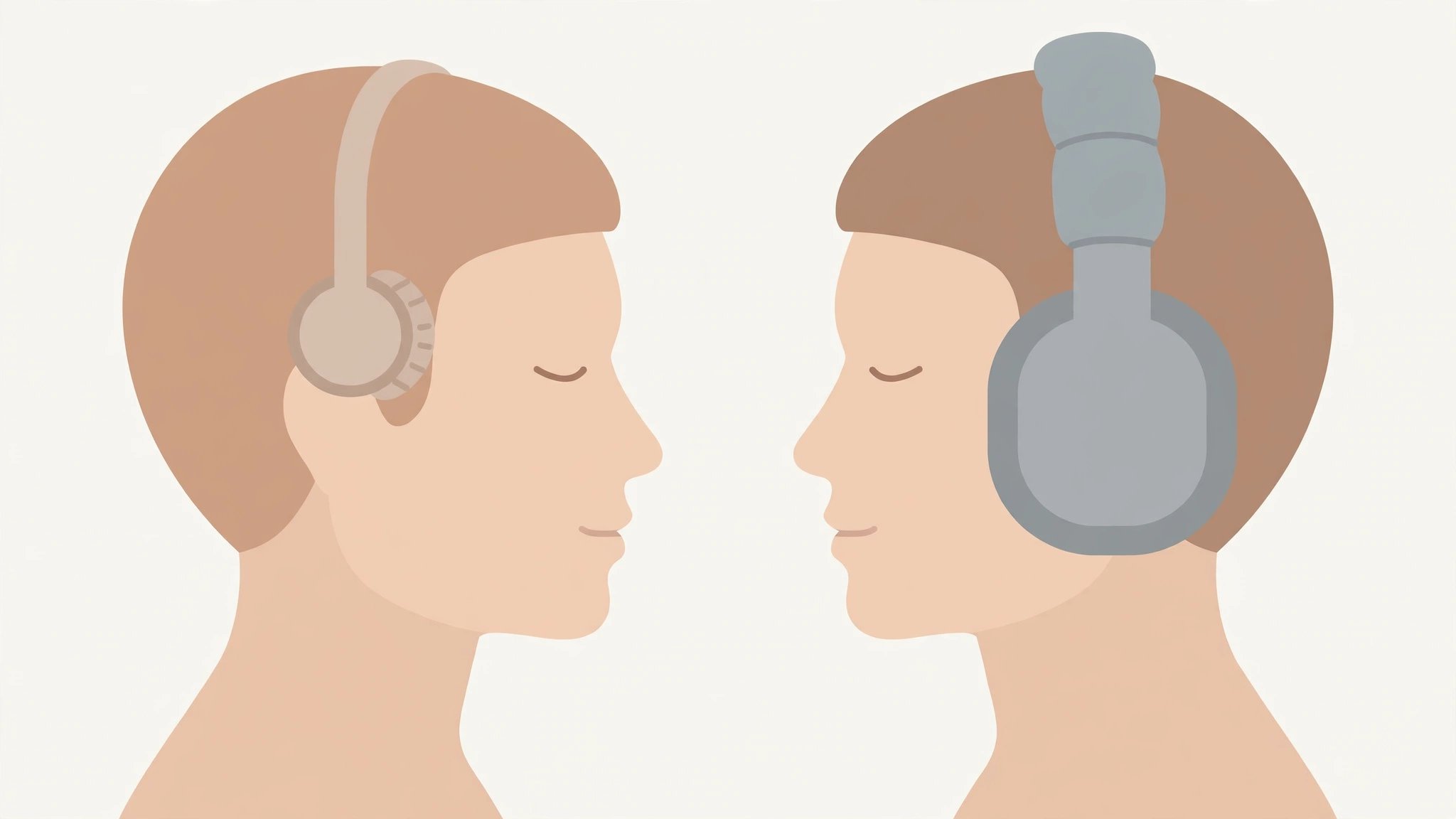
There is a quick way to tell them apart in a photo. If you can see the person's ears, the pair is on-ear. If the ears vanish behind the cups, it is over-ear. Some on-ear pairs swap the headband for a neckband that rests behind the neck, but the pads still sit on the ear — same style, different band.
Fit is the whole story.
Which Is More Comfortable: On-Ear or Over-Ear?
Over-ear, for long sessions. On-ear, for short ones. Over-ear cups spread the clamping force around your ear, across the side of your head. On-ear pads press the same force straight onto your ear cartilage — a small, sensitive structure that was not built to be squeezed for hours.
On-ear headphones are comfortable for short sessions but press on the ear cartilage, which aches after an hour or two for many people. Over-ear headphones spread the same clamping force around the ear, so most people wear them for a full workday. Weight matters too — a 147-gram on-ear pair feels lighter than a 254-gram over-ear, until the pressure wins.
Weight cuts both ways. The lightest on-ears, like the Sony WH-CH520 at 147 grams, almost disappear on your head. Flagship over-ears like the Sony WH-1000XM6 and the Bose QuietComfort Ultra weigh 254 grams each — heavier, but the load spreads over a wide pad instead of one small spot. After two hours, most people feel the pressure, not the weight.
Heat is the other comfort factor nobody lists on the box. Over-ear cups trap warmth around your ears, which gets old in summer or a warm office. On-ear pads leave more of the ear open to the air, so they run cooler. If you run hot, that alone can flip the choice.
Look — if you wear headphones for a full workday, here's what actually works: over-ear with deep memory-foam pads. If your sessions are 30 minutes on a train, on-ear is fine, and the lighter pair wins.
Hours decide it.
Which Sounds Better, On-Ear or Over-Ear?
Over-ear, most of the time — fuller bass, wider soundstage. But the gap is smaller than the marketing suggests, and a good on-ear beats a cheap over-ear every time.
On-ear vs over-ear sound: over-ear headphones are better suited for immersive listening because their larger drivers and sealed cups deliver deeper bass and a wider soundstage. On-ear headphones work better when you want a direct, upfront sound and don't mind some leakage. The key difference is the seal — it is what makes the bass feel full.
The seal does most of the work. A closed over-ear cup traps the low end against your ear, so bass sounds deep and full. An on-ear pad leaks bass out the sides, so the same track sounds thinner and more direct. That is also why over-ears feel more spacious: the enclosed cup gives the sound room to breathe, while on-ears put the driver right against your ear.
There is one exception worth knowing. Some on-ear pairs are open-backed — the Grado SR80x is the classic example — and they sound wide and airy, closer to speakers than to headphones. The trade-off is real: open backs leak sound in both directions, so they are home-listening pairs, not train pairs. What Hi-Fi makes the same point — at each price point, the best sound for your money usually sits with over-ear, but a good open-back on-ear is the exception that proves it.
Here's my take, and plenty of people will push back on it: the style matters less than the specific pair. A well-tuned on-ear will outplay a muddy over-ear at the same price. Buy the sound, not the shape — and if you can, listen before you pay.
The seal does the heavy lifting.
Which Is Better for Noise Cancelling?
Over-ear, clearly. The seal gives active noise cancelling a head start that no chip can make up for on its own.
Noise cancelling has two halves: the passive seal and the active electronics. Over-ear cups win the first half before the electronics even switch on — the closed cup blocks a real chunk of engine drone, office chatter and street noise on its own. On-ear pads sit on the ear with gaps at the edges, so noise slips straight past them. Our ANC explainer covers how the electronic half works, and our noise cancellation technology guide goes deeper on the physics.
That matters twice over. First, ANC works best on steady low sounds, and it needs a decent seal to do its job — a loose seal lets noise in faster than the chip can cancel it. Second, most on-ear pairs skip ANC entirely. The Beats Solo 4, for example, has no ANC at all — it relies on its passive fit. A few on-ear pairs do offer ANC, but with a weaker seal the result is weaker too.
There is a knock-on effect on your hearing. Because on-ear pairs leak, people turn the volume up to cover the noise around them — louder listening, longer exposure. Over-ear pairs let you hear the same track at a lower volume, because the seal does the quieting for you. Our hearing loss guide explains why that volume difference matters over years of listening.
Quick note: if silence is the whole point of the purchase — flights, open offices, a noisy commute — over-ear is not a close call. It is the answer.
No seal, no silence.
Can You Wear On-Ear Headphones With Glasses?
Yes — but over-ear is usually the kinder pick for glasses wearers. The pressure lands around your ear, not on the arms of your frames.
I've seen conflicting data here. What Hi-Fi notes that slim on-ear cups are less likely to snag on frames, while a 2021 SoundGuys survey found 68% of glasses wearers prefer over-ear for comfort. My read is that both are true: on-ears snag less, over-ears press less. The frame arm sits between the pad and your head either way — the question is how hard it gets squeezed.
With on-ear pairs, the pad presses the frame arm straight into the side of your head, right where the ear is most sensitive. With over-ear pairs, the pad spreads that same pressure over a wide ring, and deep memory-foam pads mould around the arm instead of crushing it. Thick plastic frames feel the difference most; thin wire frames work fine with either style.
Three things help if you wear glasses: deep, soft pads that give around the arms; a headband with moderate clamp, not a vice grip; and trying the pair on with your own frames, not the shop's demo pair. The five-minute test in the next section covers exactly this.
Thin frames, either works.
Which Is Better for the Gym, Travel and Work?
It depends on the day, not the spec sheet. On-ear wins where heat, weight and awareness matter. Over-ear wins where quiet and long wear matter.
Match the pair to the day:
- Gym and workouts: on-ear. Cooler ears, lighter weight, and you can still hear someone warn you about the bench. Sweat will wear the pads out faster, though — and for hard sessions, our sport earbuds guide is often the better call.
- Flights and travel: over-ear, no contest. The seal plus ANC turns a roaring cabin into background hum, and the comfort holds for a six-hour flight. Our plane guide covers the rules and the adapters.
- Work and calls: over-ear for all-day wear, on-ear for short calls. If calls are the job, our wireless headset guide picks pairs built for microphones and multipoint, not just music.
- Open offices: over-ear. The seal keeps your music in and the chatter out — your neighbours will thank you, and so will your focus.
- Hot weather and summer: on-ear. Less trapped heat, less sweat, and a pair you can wear on a walk without cooking your ears.
- Kids: on-ear, usually. Lighter on small heads, and most volume-limited kids' pairs are on-ear by design. Pick one capped at 85 dB — our kids' headphones guide lists the safe ones.
Or maybe I should say it this way: buy for the day you have most often, not the day you imagine. A commuter who buys for the gym ends up with the wrong pair twice a week.
Match the pair to the day.
How Do I Choose Between On-Ear and Over-Ear?
Try them on your own head, with your own glasses, for five minutes. No review can tell you how a pair will feel on your ears — the test below can.
To choose between on-ear and over-ear headphones, follow these steps: 1. Wear each pair for five minutes with your glasses on. 2. Press the cups gently and listen for the seal. 3. Walk around the shop and shake your head. 4. Play a bass-heavy track at your normal volume. 5. Check the weight on your neck after a minute.
- Wear each pair for five minutes with your glasses on. Comfort shows up fast — if the pads pinch in five minutes, they will hurt in an hour.
- Press the cups gently and listen for the seal. Over-ear cups should hush the room when they close around your ears. On-ear pads will always let some sound through.
- Walk around the shop and shake your head. A pair that slides when you move will slide all day. The headband should hold without squeezing.
- Play a bass-heavy track at your normal volume. Bass shows the seal. If the low end sounds thin on the on-ear pair and full on the over-ear, the seal is doing its job.
- Check the weight on your neck after a minute. Hold still and notice the weight. A 250-gram pair feels fine for a minute — the question is hour three.
Five minutes in the shop beats five hours of reviews. And if you buy online, check the return window first — a 30-day return is the home version of the same test.
Test it on your head.
On-Ear vs Over-Ear: Example Models Compared
Four real pairs, two of each style, show the trade-offs in numbers. Prices are list prices — street prices often run lower.
The pattern is plain: the on-ear pairs are lighter and cheaper, the over-ear pairs seal better and cancel noise. The JBL Tune 510BT at 160 grams is the lightest pair here, and the Sony WH-CH520 is lighter still at 147 grams with the same 50-hour battery — both cost a fraction of the flagships.
| Model | Style | Weight | Battery | Noise cancelling | List price |
|---|---|---|---|---|---|
| JBL Tune 510BT | On-ear | 160 g | 40 hours | No | $49.95 |
| Beats Solo 4 | On-ear | 217 g | 50 hours | No | $199.99 |
| Sony WH-1000XM6 | Over-ear | 254 g | 30 hours (ANC on) | Yes | $449.99 |
| Bose QuietComfort Ultra | Over-ear | 254 g | 24 hours (ANC on) | Yes | $429 |
Two notes before you shop. First, the Bose QuietComfort Ultra has a newer sibling — the Gen 2, with 30 hours of battery and a $449 list price — so check which generation a listing is selling. Second, street prices move fast: the Solo 4 has sold for $129.95 and the XM6 for around $378, so the list price is a ceiling, not the price you will pay.
Numbers help. Your ears decide.
Frequently Asked Questions
What's better, on-ear or over-ear headphones?
Over-ear for most people — better comfort, noise cancelling and sound over long sessions. On-ear wins if you run hot, travel light, or listen in short bursts.
Are on-ear headphones comfortable?
For short sessions, yes. The pads press on your ear cartilage, so many people feel an ache after an hour or two. Try before you buy if you listen for hours.
Do on-ear headphones hurt your ears?
They can, after a while — the clamp force lands on the ear itself. Looser pairs and thicker pads help, but over-ear spreads the same force around the ear instead.
Are over-ear headphones too hot?
They can be in summer — the sealed cups trap warmth. On-ear pairs run cooler and breathe better, which is why many people pick them for workouts and hot rooms.
Do on-ear headphones leak sound?
Yes, more than over-ear. The pads don't seal, so people nearby hear your music and you hear them. Keep the volume down on trains and in offices.
Which headphones are best for glasses wearers?
Usually over-ear — the pressure lands around the ear, not on the frame arms. A 2021 SoundGuys survey found 68% of glasses wearers prefer them. Thin frames work with either style.
Are on-ear headphones good for kids?
Often yes — they're lighter and fit smaller heads. Pick a volume-limited pair capped at 85 dB, like the ones in our kids' headphones guide, to protect young ears.