Best Kids Volume Limited Headphones 2026: 6 Safe Picks

Kids volume limited headphones are headphones built for children with a hardware cap on how loud they can play — usually 85 decibels. The cap sits inside the headphones, so it holds even when a child turns the tablet or phone volume all the way up.
Look — if your kid has already worked out how to slide the volume to max, here's what actually works: a cap built into the headphones themselves. A tablet's volume limit is a setting your child can undo. A hardware limiter is not.
Most "best kids headphones" lists are just Amazon roundups. They repeat the 85 dB claim from the box and never ask whether the cap survives the cable, the travel mode, or a real test. Every pick below was checked against the maker's own pages and independent lab tests on 24 November 2026. No dead model, no mystery brand, no paid placement.
Quick Comparison
| Product | Key Specs | ||
|---|---|---|---|
| #1 | Belkin SoundForm Mini 2Best Overall | 85 dB · up to 55h · foldable · $29.99 | Check Price |
| #2 | Puro Sound Labs BT2200-PlusBest Premium Sound | 85 dB · up to 20h · studio sound · ~$89 | Check Price |
| #3 | BuddyPhones Cosmos+Best for Toddlers | 75/85/94 dB modes · ANC · up to 24h | Check Price |
| #4 | JBL Junior 470NCBest Noise Cancelling | 85 dB · ANC · app parental controls · up to 50h | Check Price |
| #5 | JLab JBuddies Studio 2 WirelessBest Battery | 85/95 dB switch · 65+h · 150 g · $29.99 | Check Price |
| #6 | BuddyPhones Explore+Best Wired Budget | 85 dB · wired · no battery to charge · $39.99 | Check Price |
Wireless vs wired kids headphones: wireless is better suited for school and travel because there is no cable to yank or tangle. Wired works better when your child is young, loses things, or you never want to charge another device. The key difference is the cable: freedom against one more battery to remember.
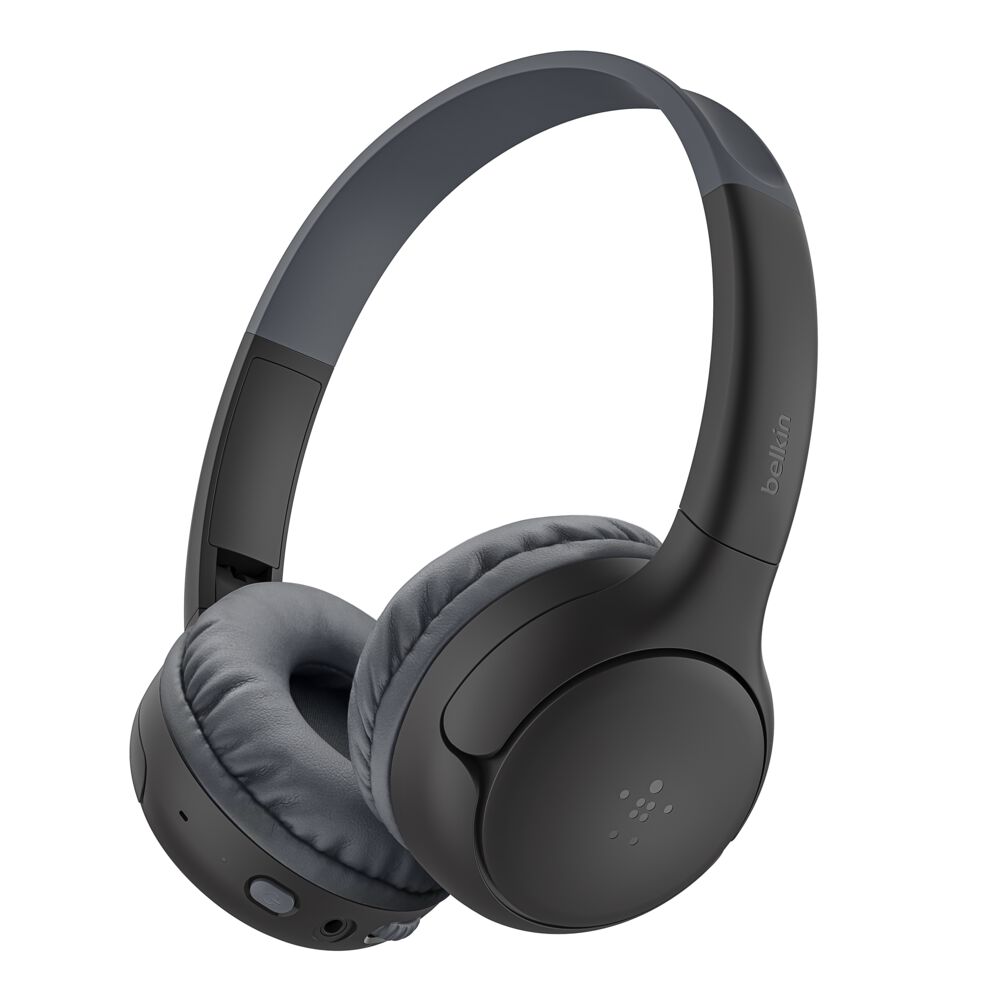
Belkin SoundForm Mini 2
Best OverallBuy if: you want the safe default for a tablet or school laptop — 85 dB cap, 55 hours, $29.99
Don't buy if: your child mostly listens wired — Belkin states the 85 dB cap for Bluetooth mode only
The SoundForm Mini 2 is the pair most families should buy. Belkin caps output at 85 dB, rates the battery at up to 55 hours, and says one charge covers a week at 7 to 8 hours of play a day. The headband folds for a backpack, the earcups are kid-sized, and Belkin tested the build against a spill and a 2-metre drop onto a hard floor.
It is also the cheapest wireless pick here. At $29.99 on Belkin's own store, it costs a third of the Puro at #2 and still carries a 2-year warranty. A built-in mic handles class calls and reading apps, a 3.5mm cable comes in the box, and RockStar Mode lets a second listener share the audio through another pair.
One catch to know before you buy. Belkin states the 85 dB maximum for Bluetooth mode, so a child using the cable may not get the same ceiling. There is no noise cancelling, which matters on planes. Check the cable use in the buying guide below before you hand it over.
Pros
- 55h battery — a week of school use per charge
- $29.99, the cheapest wireless pick here
- 2-year warranty; folds for a backpack
- RockStar Mode shares audio with a sibling
Cons
- 85 dB cap stated for Bluetooth mode only
- No noise cancelling — planes stay loud
- Belkin publishes no age range for this model
- No app or parental lock on the volume
Price $29.99 on Belkin's store, checked 24 Nov 2026. Check the price before buying, as prices change.
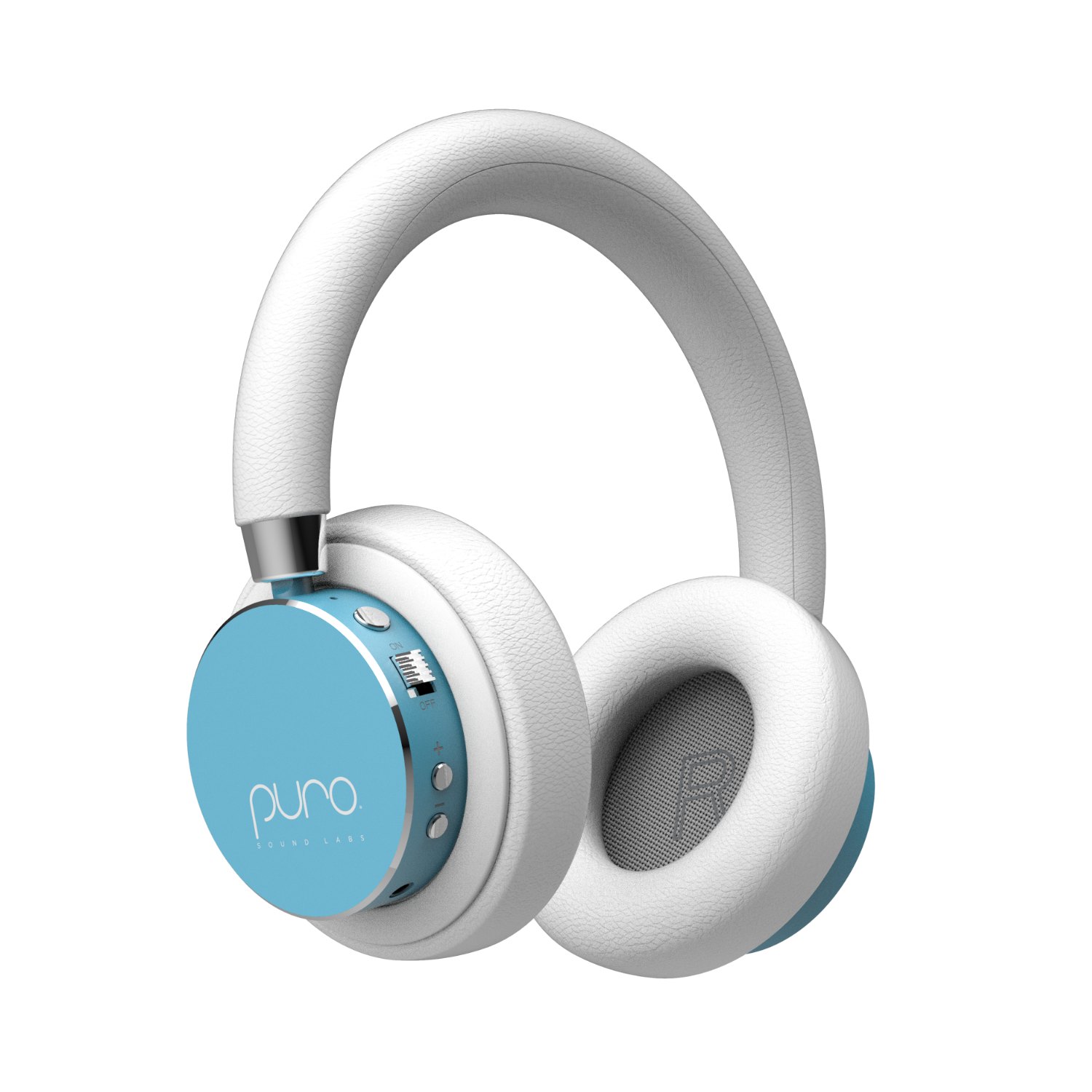
Puro Sound Labs BT2200-Plus
Best Premium SoundBuy if: sound quality matters and you will pay more for it — studio-grade drivers with a real 85 dB cap
Don't buy if: budget is tight — the Belkin at #1 does the safety job for a third of the price
Puro is the specialist brand in this guide. The BT2200-Plus was designed with audiologists, and it sounds like it: studio-grade drivers, a balanced tuning that suits music and audiobooks, and cups Puro says block 82% of background noise. That passive isolation matters, because a child who can hear clearly at 85 dB has no reason to want it louder.
The cap works in both modes. Bluetooth is limited to 85 dB, and the included cable is a volume-limiting cable, so the ceiling holds when the battery dies too. The aluminium headband survives the school bag better than the plastic on the cheaper pairs, and the 20-hour battery covers a school week of listening.
Or maybe I should say it this way: you are paying for sound and build, not for extra safety. The 85 dB cap is the same number the Belkin gives you for $29.99. Buy the Puro if your child actually listens to music for hours. Buy the Belkin if the tablet is mostly for videos and homework.
Pros
- Best sound here — studio-grade, audiologist-informed tuning
- 85 dB cap holds on Bluetooth and on the limiter cable
- Strong passive isolation — Puro claims 82% of background noise blocked
- Durable aluminium headband
Cons
- About $89 — the priciest pick here
- 20h battery is the shortest wireless battery here
- Heavier than the Belkin and the JLab
- No ANC, no app controls
Price about $89 on Puro's store, checked 24 Nov 2026. Check the price before buying, as prices change.
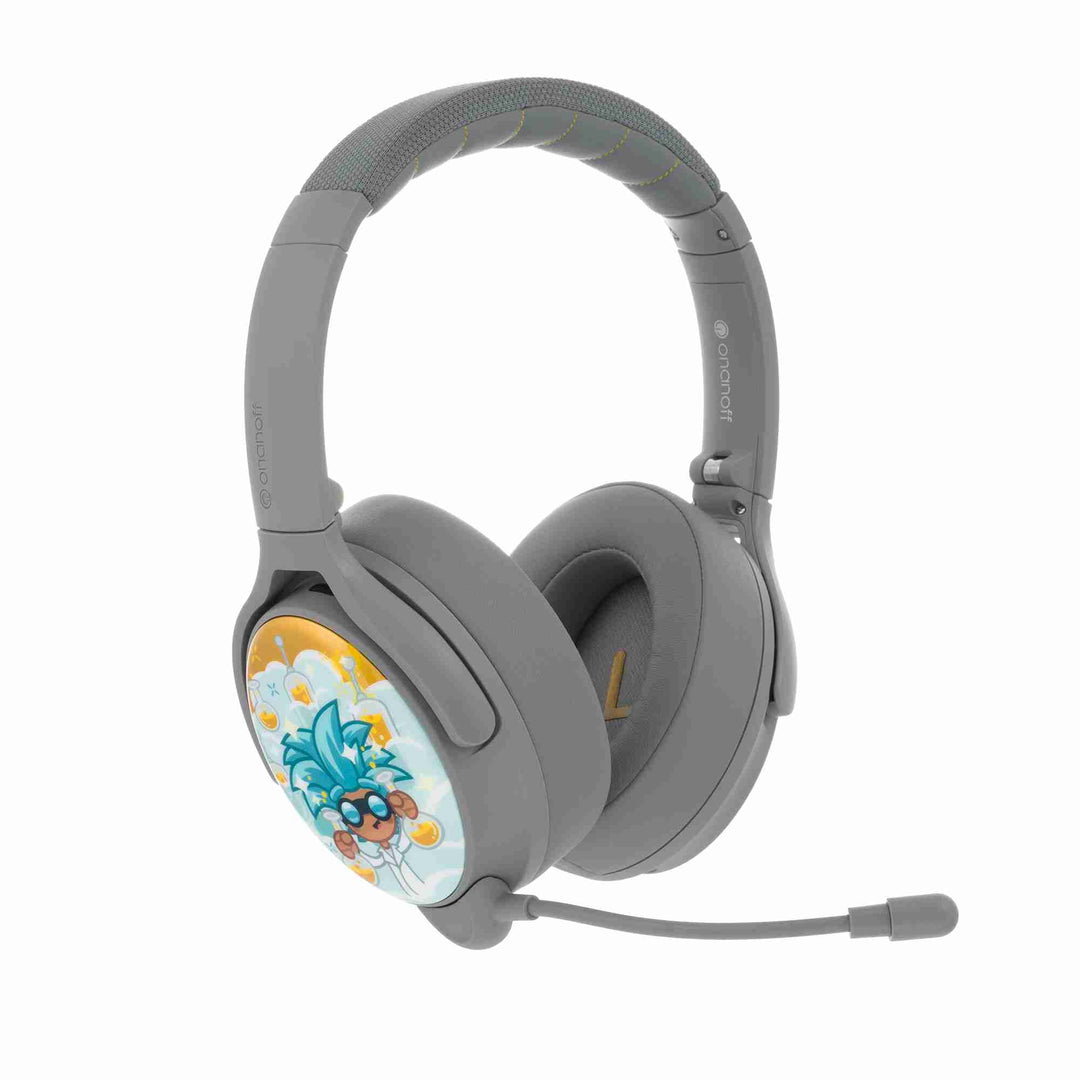
BuddyPhones Cosmos+
Best for ToddlersBuy if: your child is under five — the only pick here with a 75 dB toddler mode
Don't buy if: your child is eight or older — the toddler mode is wasted on them
The Cosmos+ is the only pair in this guide built for the youngest listeners. Its SafeAudio switch offers three ceilings: 75 dB for toddlers, 85 dB for kids, and 94 dB for travel. For a two- or three-year-old, that 75 dB setting is the whole point — their ear canals are shorter and narrower than an adult's, so sound pressure builds up faster at the same output level.
It is also the cheapest way to get noise cancelling on a kids pair. ANC quiets plane engines and car noise, so a capped volume still sounds clear, and the 24-hour battery covers a long trip both ways. StudyMode is a sound profile that pushes voices forward, which helps with phonics apps and audiobooks. Headphones Addict named the Cosmos+ its best toddler headphone after testing.
Two honest limits. First, the 94 dB travel mode is a parent's decision, not a child's — check the switch before every trip. Second, Headphones Addict's own tests found the 75 dB mode still spiking to 79 dB on some songs. Close, not perfect. Keep sessions short for toddlers either way.
Pros
- Only 75 dB toddler mode in this guide
- ANC for planes and car rides; up to 24h battery
- Three modes grow with the child
- Headphones Addict's top toddler pick after testing
Cons
- 94 dB travel mode needs a parent to manage the switch
- 75 dB mode still spiked to 79 dB in independent tests
- Pricier than the Belkin and the JLab
- Overkill for kids aged eight and up
Check the price before buying, as prices change.
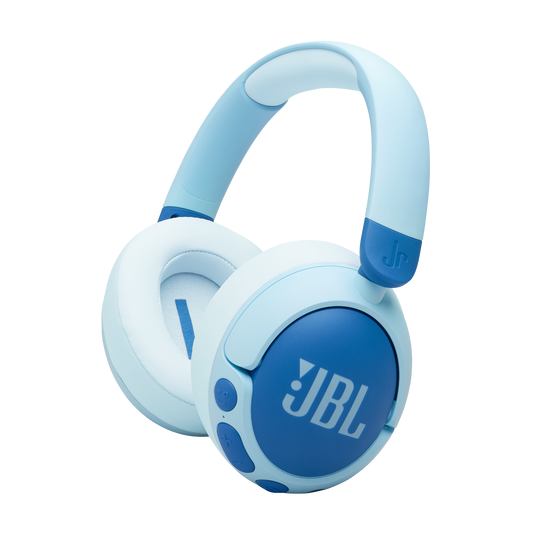
JBL Junior 470NC
Best Noise CancellingBuy if: you fly a lot and want the only pair here with PIN-locked parental controls
Don't buy if: you want controls on the headphones — the best locks here live in the app, not on the pair
The Junior 470NC is the travel pick. Active noise cancelling cuts engine hum, so the 85 dB cap still sounds clear at 35,000 feet. The battery runs up to 50 hours with ANC off and 34 hours with it on — the longest ANC-on figure in this guide — and the over-ear cups fit kids from around age five.
What sets it apart is the JBL Headphones app. You can set a volume ceiling lower than 85 dB and cap the daily listening time, both locked behind a PIN your child cannot change. No other pair here gives a parent that much control after the box is opened.
The trade is that the controls need the app. If you never install it, you get a good ANC kids headphone with a fixed 85 dB cap and nothing more. That is still a solid buy. But the PIN locks are the reason to pick the JBL over the Cosmos+, so set the app up on day one.
Pros
- App parental controls — lower cap and daily time limit, PIN-locked
- ANC for flights; up to 50h battery, 34h with ANC on
- JBL sound in a kid-sized over-ear fit
- Built-in mic for calls and class
Cons
- Best controls need the app installed and set up
- Bulkier than the on-ear pairs here
- Price varies by seller — check before buying
- No 75 dB toddler mode
Check the price before buying, as prices change.
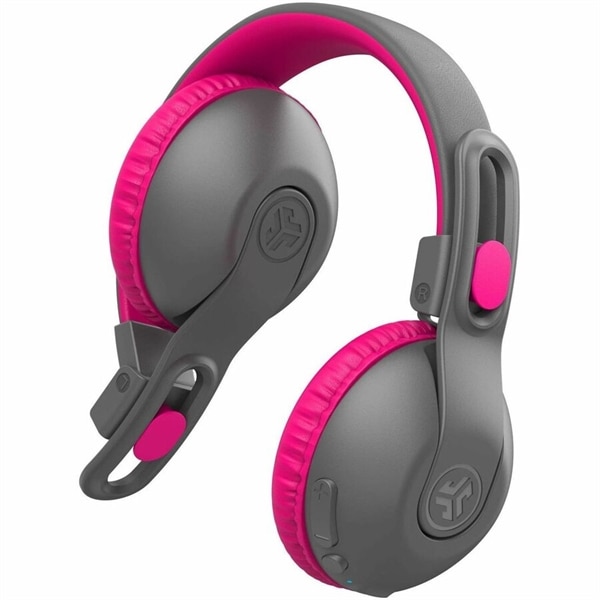
JLab JBuddies Studio 2 Wireless
Best BatteryBuy if: your child wears headphones for hours at school — 65-plus hours per charge, at 150 grams
Don't buy if: your child is under six — JLab aims this pair at ages six and up
The Studio 2 is the battery king of this guide. JLab rates it at 65-plus hours of wireless playtime on a three-hour charge, so it can go weeks between charges on school use. At 150 grams it is also the lightest pair here, with Cloud Foam cushions and pinch-free hinges that suit long wear.
A hearing protection switch chooses between 85 dB and 95 dB. JLab positions the higher setting for louder places, which helps on a train — but it means a parent should check the switch afterwards. Bluetooth 5.3 handles the connection, and Wireless Share mode links two headphones to one source, so two kids can watch the same film on a plane.
Small print: the box has a USB-C charging cable but no wall adapter, and wired listening runs over USB-C, which older school devices may not have. If you don't check the switch, it won't stay on 85 dB — and that's the bit most parents miss.
Pros
- 65+h battery — the longest here by a wide margin
- Light at 150 g with pinch-free hinges
- $29.99 — tied for the cheapest pick here
- Wireless Share links two pairs to one source
Cons
- 95 dB setting is louder than the 85 dB guidance — parents must manage the switch
- No wall charger in the box
- Wired mode uses USB-C, which older devices may not have
- No noise cancelling
Price $29.99 at Dell, checked 24 Nov 2026. Check the price before buying, as prices change.
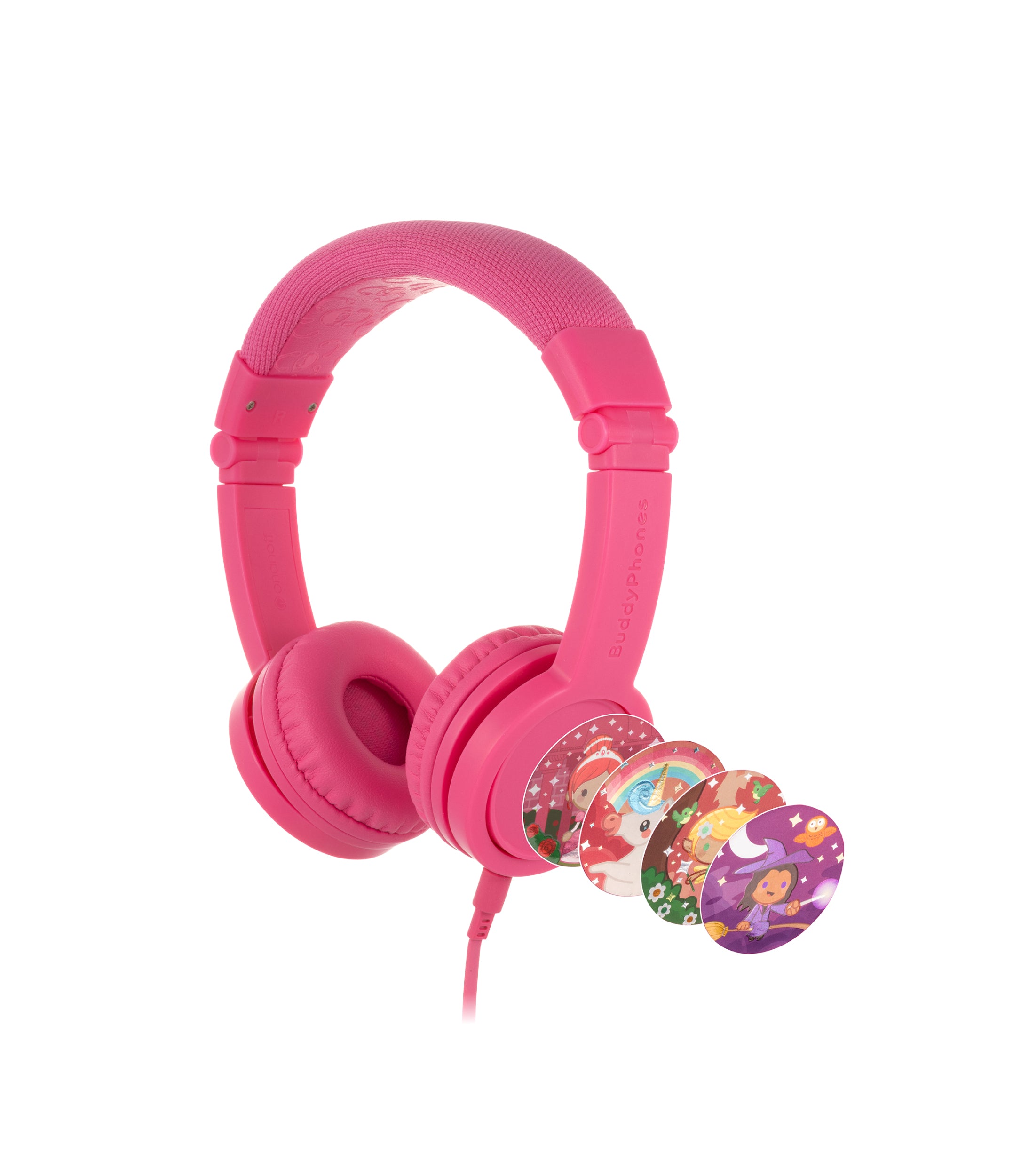
BuddyPhones Explore+
Best Wired BudgetBuy if: you want the simplest safe pair — 85 dB cap, no battery, nothing to charge
Don't buy if: your child's tablet has no headphone jack — you will need an adapter
The Explore+ is the no-fuss pick. It is wired, so there is no battery to charge, no Bluetooth to pair, and nothing that runs flat halfway through a lesson. Plug it in and the 85 dB cap works every time, because the limiter is in the cable's path, not in a setting a child can change.
A built-in sharing cable lets a second pair plug in and listen to the same audio — handy for siblings on a long car ride. The build is tough enough for a school bag, and at $39.99 on ONANOFF's own store it is the cheapest way to get a named-brand volume-limited pair with no charging routine at all.
Quick note: wired means a cable, and cables snag. They catch on chair arms, tangle in bags, and get yanked by small hands. If your child is rough with things, the Belkin at #1 survives drops better. If your child just needs sound for school, the Explore+ is the pair that never needs a charger.
Pros
- No battery, no charging, nothing to run flat
- 85 dB cap works whenever it is plugged in
- Built-in sharing cable for a second listener
- Tough build for a school bag
Cons
- Wired — the cable can snag and tangle
- No Bluetooth for tablets without a headphone jack
- No noise cancelling
- One pair, one cable — no wireless freedom
Price $39.99 on ONANOFF's store, checked 24 Nov 2026. Check the price before buying, as prices change.
What Volume Is Actually Safe for a Child's Ears?
85 decibels, for up to eight hours a day. That is the line the World Health Organization and the US Centers for Disease Control both use — and it is a time limit as much as a volume limit.
85 decibels is the safe volume limit for kids headphones. According to the World Health Organization, 85 dB is the maximum for prolonged listening, and the US National Institute for Occupational Safety and Health pairs that level with eight hours a day. Louder than that, the safe time shrinks fast.
The 85 dB figure is a time limit as much as a volume limit. According to NIOSH, every 3 dB above 85 halves the safe listening time, so 88 dB allows about four hours and 94 dB about one. That is why a 94 dB travel mode is a real trade-off, not a small bump.
Put it in real terms. 85 dB is about as loud as busy city traffic or a noisy restaurant. A normal conversation sits near 60 dB. An adult headphone with no limiter can hit 110 dB or higher — loud enough to damage hearing in minutes, not hours.
The stakes are not small. A 2022 BMJ Global Health meta-analysis put 0.67 to 1.35 billion adolescents and young adults at risk of hearing loss from unsafe listening, and found 23.81% exposed to unsafe levels from personal listening devices such as phones and earbuds. Hearing damage in childhood lasts a lifetime, and it builds up quietly — there is no warning pain.
One number to keep. 85 dB is the ceiling, not the target. Quieter is always safer, and a child who listens at 75 dB can listen far longer than one at 85 dB.
What Age Can Kids Start Using Headphones?
Around age two or three, with a volume-limited pair. Before that, headphones are not recommended — an infant's ear canals are still developing.
Most audiologists say children can start using headphones around age two or three, as long as the pair caps volume at 85 dB or lower. Earbuds should wait until at least age eight, and ideally ten, because small ear canals and loose fit make them harder to control.
Age changes what to buy. Toddlers aged two to four need the strictest cap — 75 dB if you can get it — and over-ear cups that fit a small head. School-age kids from six need battery and durability for the classroom. Tweens from nine can use the same pairs as younger kids, but they will want something that does not look like a toy.
I've seen conflicting data — some sources say 85 dB is safe for eight hours, others point to 75 dB for children under five. My read is the lower number is the right one for toddlers, and 85 dB is the ceiling for older kids, not the target.
Fit matters as much as the number on the box. A headband that is too big slides around, the cups sit off-centre, and the child turns the volume up to make up for the bad seal. If the pair is made for ages six and up, do not put it on a three-year-old.
Do Volume-Limited Headphones Really Work?
Mostly yes — but the box claim is a promise, not a guarantee. Independent tests keep finding pairs that play louder than they say.
Headphones Addict tested ten kids headphones and found 68.5% went over their advertised limit. Wirecutter's tests found up to a third exceeded their stated limit with pink noise, and nearly half with real music. The market has improved since then, but a printed "85 dB" is still worth checking, not trusting blind.
Three traps explain most of the gap. First, the cable: some pairs cap volume in Bluetooth mode only, and the cable bypasses the limiter entirely — the Belkin at #1 states its cap for Bluetooth, so check your pair the same way. Second, the switch: a 75/85/94 dB model only protects at the setting you left it on. Third, the seal: a loose fit makes a child crank the volume, limiter or not.
Here's the thing: the cap is the seatbelt, not the speed limit. It stops the worst case — a child sliding the volume to max — but it does not make eight hours at 85 dB harmless. Breaks still matter, and quieter is still better.
The 94 dB travel mode should not be on a kids headphone at all. A plane is loud, and a parent reaching for more volume is natural — but 94 dB gives a child about one hour of safe listening, and no flight is one hour. Noise cancelling is the honest answer on a plane, not a louder cap. That is an opinion, and plenty of parents will disagree. The JBL at #4 and the Cosmos+ at #3 both cancel noise instead of raising the ceiling, and that is the right trade.
Wired or Wireless: Which Is Better for Kids?
Wireless for school and travel. Wired for younger kids and tight budgets. The right answer depends on your child's age and your patience with chargers.
Wireless wins on freedom. No cable to snag on a chair, no tangled mess in the school bag, and no headphone jack needed — most new tablets have dropped the jack entirely. The trade is a battery to charge, Bluetooth to pair, and a cap that may only hold in wireless mode.
Wired wins on simplicity. Plug it in and it works, the cap holds every time, and there is nothing to charge or pair. The trade is the cable itself: it snags, tangles, and gets yanked. For a child under five, that trade is usually worth it.
Our best true wireless earbuds guide covers the pocketable pairs for adults — but earbuds are the wrong shape for young kids, so keep them on the shelf until age eight at least. For school, wireless wins. For a toddler, wired wins. For a flight, either works if the pair has noise cancelling.
How Long Can Kids Listen Safely Each Day?
Short sessions with breaks — not hours on end. Even at a safe volume, young ears tire.
A sensible rule is the 60/60 rule: no more than 60 minutes of listening at a time, at no more than 60% volume. For younger children, audiologists suggest one to two hours of total headphone time a day, with a break every 30 to 60 minutes.
Watch for the signs. If your child says "what?" more than usual, turns the TV up, or complains of ringing after taking the headphones off, the volume or the time is too much. Turn it down, take a break, and check the cap setting before the next session.
Set the limit before you hand the pair over. The JBL at #4 lets you cap daily listening time in the app and lock it with a PIN. On any other pair, a kitchen timer does the same job — just less quietly.
Buying Guide: What Actually Matters
To pick safe kids headphones, follow these steps: 1. Match the pair to your child's age. 2. Check the cap works on the cable too. 3. Test the fit before you buy. 4. Set the 85 dB mode and lock it. 5. Set a daily listening limit.
- Match the pair to your child's age. Under five, buy a 75 dB mode — the Cosmos+ at #3 is the only pick here with one. Six and up, any 85 dB pair in this guide works. Earbuds wait until eight, ideally ten.
- Check the cap works on the cable too. Ask whether the 85 dB limit holds in wired mode. Some makers state it for Bluetooth only. The Puro at #2 and the Explore+ at #6 cap the cable as well.
- Test the fit before you buy. The cups should cover the whole ear without pressing, and the headband should adjust small enough to stay put. A pair made for ages six and up will slide on a toddler.
- Set the 85 dB mode and lock it. If the pair has a switch — the JLab at #5, the Cosmos+ at #3 — put it on the lowest setting your child needs and check it after every trip.
- Set a daily listening limit. Use the JBL app's PIN-locked timer, or a kitchen timer. Breaks every 30 to 60 minutes matter as much as the volume number.
Buy the battery for year three, not day one. Every wireless pair here loses capacity over two to three years. A pair that starts at 65 hours still gives a school week at year two. A pair that starts at 20 hours may not.
Ignore the cartoon on the box. Bright colours and a character print say nothing about the limiter inside. If the spec sheet does not say "volume limiting" or "85 dB", it is a regular headphone in a bright case.
What to Skip
Any "kids" headphone with no stated volume limit. If the listing says "kid-friendly" but the spec sheet never mentions a decibel number, there is no limiter. Walk away.
Cheap no-name pairs promising 85 dB. Independent tests found more than two-thirds of tested kids headphones played louder than their advertised limit. A $10 pair from a brand with no website and no support line is a guess, not a measurement.
Adult headphones in a smaller size. Shrinking an adult pair does not add a limiter. The ear cups may fit, but the driver can still hit 110 dB.
Earbuds for kids under eight. Small ear canals, loose fit, and no way for a parent to check the seal. Over-ear is the right shape until at least age eight — and the sleep earbuds in our best wireless sleep earbuds guide are built for adults, not children.
A 94 dB mode left on by accident. If you buy a pair with a travel mode, check the switch every time it comes out of the bag. One forgotten switch turns a safe pair into a loud one.
Frequently Asked Questions
What's the best kids volume limited headphone overall?
The Belkin SoundForm Mini 2 at $29.99 — 85 dB cap, 55-hour battery, 2-year warranty, and the cheapest wireless pick here.
What volume is safe for kids headphones?
85 decibels for up to eight hours a day, per the WHO and CDC. Every 3 dB above that halves the safe time.
How old should a child be before using headphones?
Around two or three, with a volume-limited pair capped at 85 dB or lower. Earbuds should wait until at least age eight.
Do volume-limited headphones work on the cable too?
Not always. Some pairs cap volume in Bluetooth mode only, so check your model's spec sheet before relying on the cable.
Can my child wear headphones on a plane?
Yes — and noise cancelling helps more than a louder cap. The JBL Junior 470NC and BuddyPhones Cosmos+ both cancel engine noise.
Are earbuds safe for kids?
Not for young children. Over-ear headphones fit better and seal properly; earbuds should wait until at least age eight.
Should I buy wired or wireless headphones for my child?
Wireless for school and travel, wired for toddlers and tight budgets. Wired never needs charging; wireless has no cable to snag.