How the freshness check works
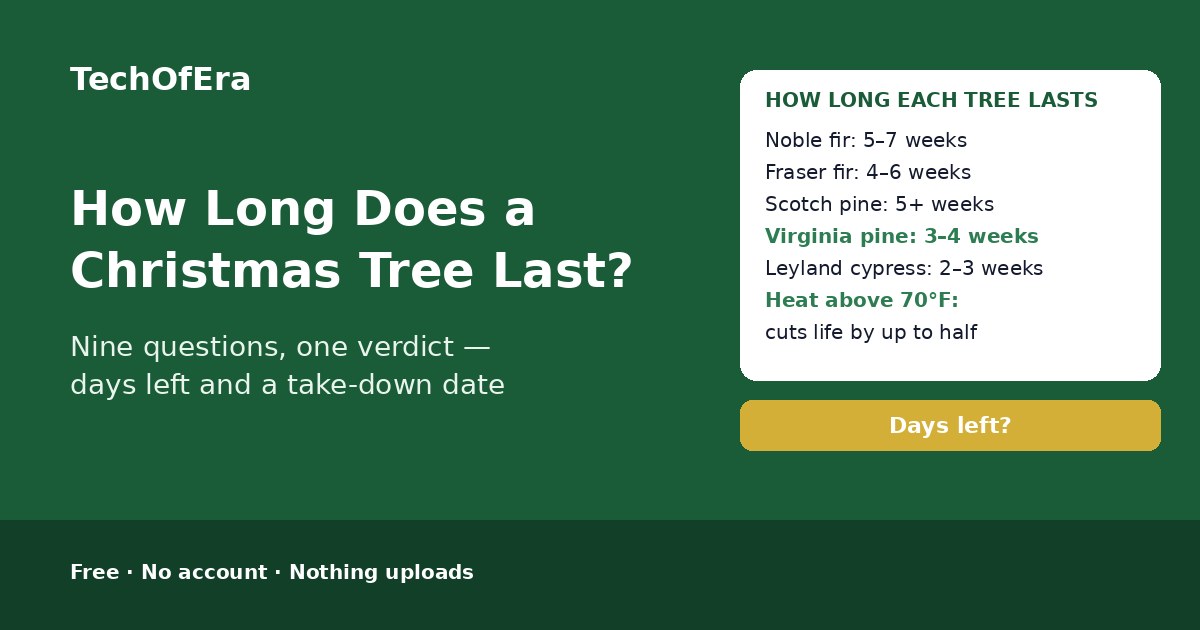
How long a Christmas tree lasts is one of the most-searched Christmas questions, and the guides that rank for it all say the same thing in different words — but none of them runs your tree's numbers. What decides it is nine things: what kind of tree it is, when you put it up, how fresh it was, how often it is watered, how warm the room is, how many needles are dropping, what lights are on it, whether the trunk was trimmed, and how long it still needs to last. The starting point is the species: a Noble fir lasts 5 to 7 weeks, a Fraser fir 4 to 6, a Balsam fir 4 to 5, a Douglas fir up to 6, a Scotch pine 5 or more, a Colorado blue spruce 3 to 5, a Virginia pine 3 to 4, and a Leyland cypress 2 to 3. Care moves the number a lot: a room above 70F (21C) can cut a tree's life by up to half, a tree can start to dry out within 6 to 8 hours without water in a warm room, and daily watering plus a 1-inch trunk trim before setup are what keep it fresh. An artificial tree lasts 6 to 10 years, or 10 to 20 with good storage, and a living potted tree must not stay indoors more than 7 to 10 days.
To use it:
- Say what kind of tree it is. This sets the starting point. A Noble fir lasts longest at 5 to 7 weeks; a Leyland cypress is shortest at 2 to 3. If you are not sure, pick that — the checker uses the average for a cut tree, about 5 weeks, and says so.
- Say when you put it up. The days left are counted from that day. A tree put up in early December usually stays fresh until after Christmas; one put up before Thanksgiving is already well into its life by Christmas Day. If you are not sure of the exact day, guess the nearest one.
- Say how fresh it was when you bought it. Bend a needle: on a fresh tree it bends, on a dry tree it snaps. Shake a branch gently: only a few green needles should fall. A dry start shortens everything that follows.
- Say how often it is watered. About 6 cups a day keeps a tree fresh — up to a gallon on the first day, a quart or more each day after. Check the stand each morning: if it is empty, the tree is already thirsty, and a tree can start to dry out within 6 to 8 hours without water in a warm room.
- Say how warm the room is. Heat is the biggest single threat to your tree's life. A room above 70F (21C) can cut it by up to half, and a tree next to a radiator, fireplace or heater dries out fastest of all. The coolest spot in the room is best.
- Say how many needles are dropping. A few needles is normal. Handfuls every day means the tree is drying out, and lots of needles with thinning branches means it is well into its decline.
- Say what lights are on it. LED lights stay cool to the touch. Old-style incandescent lights give off heat and dry the tree out faster — swap them for LEDs if you can.
- Say whether the trunk was trimmed. Cutting 1 inch off the trunk before setup stops sap blocking water uptake. If it was not trimmed, you can still do it now: take the tree out of the stand, cut an inch off, and put it straight back in fresh water.
- Say how long it still needs to last. Pick the date it has to reach — Christmas Day, New Year's Day or Twelfth Night — and the checker says whether it will make it, or whether it will probably be fading by then.
What makes this checker different
The pages that rank for this search are guides — a home-services guide putting a healthy tree at five to six weeks with daily watering and a 1-inch trunk trim, and several long freshness guides laying out the species table, the 70F heat rule and the 6-to-8-hour dry-out warning. None of them runs your tree's numbers: none takes your species, your setup date, your watering, your room heat, your needle drop, your lights and your trunk trim — and none gives you a verdict with the days left, a take-down date and whether it will still be fresh on the date you picked. This page is that answer: nine questions, one verdict, with the estimate worked out and the reason shown. It is a self-assessment, so it says plainly what it cannot know: it cannot walk into your living room, feel your tree's needles, or check whether the stand still has water.
When is this the right check?
When you are wondering whether the tree will make it to Christmas Day — because it went up early, or the needles are already dropping. When the stand has run dry and you want to know whether the tree can recover (it can, if you fill it now). When the tree sits next to a radiator and you want to know how much that is costing it in days. When you are choosing between species next year and want to know which one lasts longest. When you have a living potted tree and need to know how many indoor days it has left. And when the tree looks tired and you want an honest answer on whether to take it down now or give it a few more days.
Honest limitations
A self-assessment, not a promise
This checker cannot walk into your living room, feel your tree's needles, or check whether the stand still has water. The day counts are planning estimates from the guides — your tree may beat them or fall short of them.
Species ranges are guides, not guarantees
A Noble fir lasts 5 to 7 weeks and a Leyland cypress 2 to 3, but an individual tree can sit anywhere in its range — or outside it, if it was cut weeks before you bought it or left dry on the lot.
The estimate assumes steady care
The days left assume you keep watering it daily and keep it cool. One dry stand or one hot afternoon can pull the take-down date closer — re-run the check if anything changes.
A dry tree near heat is a fire risk
No freshness estimate makes a very dry tree safe next to a radiator or under warm incandescent lights. If the tree is very dry, take it down — do not wait for the estimate to run out.
Potted trees have their own limit
A living potted tree must not stay indoors more than 7 to 10 days, whatever the freshness estimate says. The checker counts its indoor days against that limit, not against a cut tree's weeks.
Facts from the freshness guides, dated November 2026
The facts here are the guides that rank for this question — Angi and the long freshness guides — as they read in November 2026. Guides change and trees do not: recheck the facts if anything about your tree changes.