How the tree-takedown check works
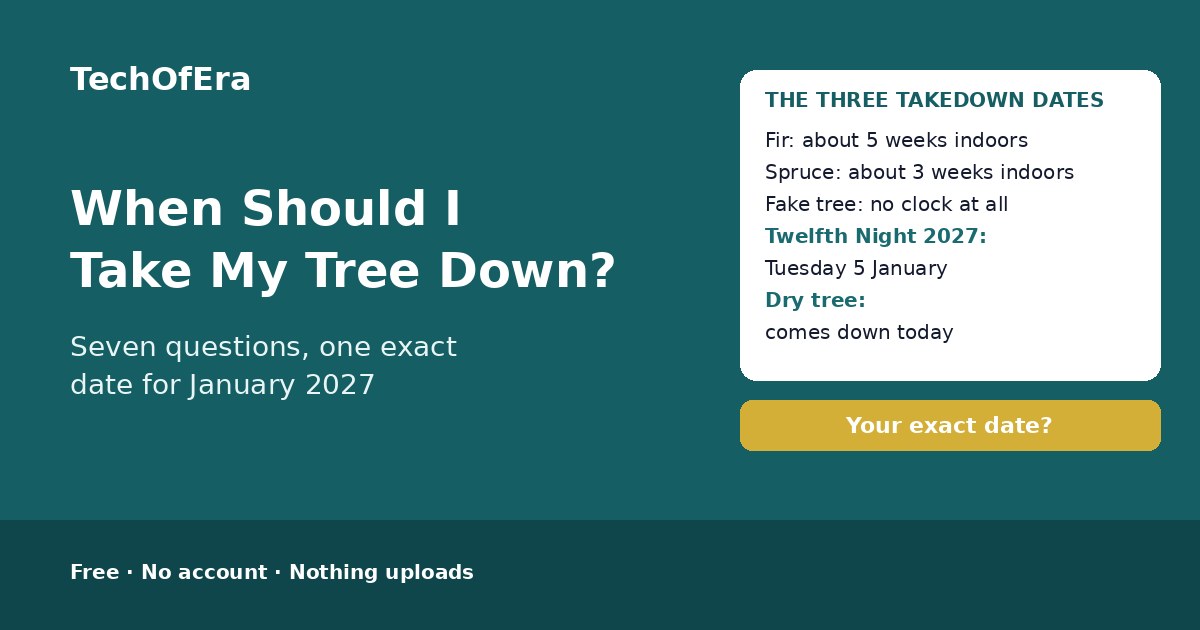
When to take the Christmas tree down is one of the most-searched Christmas questions, and the guides that rank for it all say the same thing in different words — but none of them gives you a date for your household. What decides it is seven things: what kind of tree it is, when it went up, which tradition you follow, how dry it is, what lights it carries, what disposal plan you have, and when you have time to take it down. The freshness rule is the one the guides agree on: a real fir stays fresh for about five to six weeks indoors with care, a spruce or pine for about three to four weeks, and a living tree in a pot must not stay indoors for more than 7 to 10 days. Twelfth Night is Tuesday 5 January 2027, Epiphany is Wednesday 6 January 2027, and most households take a fake tree down on the first weekend of January — 2–3 January. A dry tree overrides the calendar entirely: brittle needles, green needles dropping at a touch, branches that snap and no scent mean it comes down today.
To use it:
- Say what kind of tree it is. This decides whether any date can be too late at all. A fir has about five weeks indoors, a spruce about three, a potted tree must not stay indoors more than 10 days, and a fake tree has no freshness clock — it can stay up until Candlemas if you like.
- Say when it went up. This is the date everything counts forward from. A fir put up on Advent Sunday — 29 November 2026 — runs out on Sunday 3 January 2027; a spruce put up the same day runs out on Sunday 20 December 2026, before Christmas is even over. If you do not know the date, the checker says so instead of guessing.
- Say which tradition you follow. Twelfth Night, Epiphany, New Year's Day, the first weekend of January and Candlemas are all real traditions — and the checker tests yours against the freshness clock instead of just repeating it. Twelfth Night (5 January) fits a fir put up in early December, but not one put up on Advent Sunday; Candlemas (2 February) fits no real tree at all.
- Say how dry it is. This is the one answer that can override everything else. Bend a green needle: a fresh one bends, a dry one snaps. If the tree is dry, the checker says take it down today — 35% of reported Christmas-tree fires occurred in January, and a dry tree can go from spark to fully engulfed in under a minute.
- Say what lights it carries. Old incandescent lights run hot, damaged or frayed lights are the classic ignition, and lights left on overnight are a risk even on a fresh tree. On a dry tree, the lights are the first thing to unplug.
- Say how it will be disposed of. Most towns run curbside tree collection or drop-off mulching in early January, and the tree must be undecorated before it goes out. If there is no plan yet, the checker says so — and the date it gives is the date to have the plan ready by.
- Say when you have time. If taking the tree down is a job for a free weekend, the checker moves the date to the nearest one — but never past the freshness deadline. If there is no time until later in January, a real tree does not wait: if it dries out first, it comes down anyway.
What makes this checker different
The pages that rank for this search are guides — a UK homes magazine naming Twelfth Night as the sweet spot, a home site laying out the dates by tree type, a guide walking through the dryness signs that override any date. None of them scores your situation: none takes your tree type, when it went up, your tradition, how dry it is, your lights, your disposal plan and your schedule — and none gives you a date. The closest interactive rival is a freshness calculator that estimates how long a tree will stay fresh — but it never names a takedown date for your household, and it covers real trees only. This page is that answer: seven questions, one exact date for the 2026-27 season, with the freshness deadline worked out and the reason shown. It is a self-assessment, so it says plainly what it cannot know: it cannot walk into your living room, check whether the corner is clear, or feel how dry your tree is.
When is this the right check?
When the tree has been up for weeks and the guides have left you no closer to a date — because the answer genuinely depends on your tree, not on which tradition is best in general. When you follow Twelfth Night and need to know whether your fir will still be fresh on 5 January (if it went up on Advent Sunday, it will not — the latest safe day is Sunday 3 January). When the tree is dropping needles and you need to know whether to wait for the weekend (you should not). When you have a potted tree and need to know how late you can leave it indoors (no more than 10 days from when it came in). And when you want to keep the tree up until Candlemas and need to know whether that works (only if it is fake).
Honest limitations
A self-assessment, not shopping advice
This checker cannot walk into your living room, check whether the corner is clear, or feel how dry your tree is. It scores the answers you give against what the takedown guides say — it cannot tell you which tree to buy, and it is not shopping advice.
Five weeks is a planning figure, not a promise
About five to six weeks is the figure the guides give for a fir with care, and three to four weeks for a spruce. Your tree's real window depends on its species, how fresh the cut was, and how warm and dry your room runs. The checker plans on the shorter end of each range, and says so.
The dates are for the 2026-27 season
Twelfth Night, Epiphany, New Year's Day and Candlemas all move from year to year — the dates here are for the 2026-27 season (Twelfth Night is Tuesday 5 January 2027). If you are reading this after Christmas, the same five-week and three-week rules apply to next year's dates.
Traditions vary — yours wins
Twelfth Night, Epiphany, New Year's Day, the first weekend of January and Candlemas are all real traditions in different households and countries. If your household has its own date, that is the one to follow — the checker only moves it when the freshness clock makes it unsafe for a real tree.
Fire safety is about dryness, not dates alone
A date inside the freshness window is only safe if the tree is watered every day and kept away from radiators, fireplaces and candles. A tree that stops taking water and drops needles at a touch is done, whatever the calendar says — take it down today.
Facts from the takedown guides, dated November 2026
The facts here are the guides that rank for this question — Homes & Gardens, silkstonehome, leafypixels and Tom's Guide — as they read in November 2026. Guides change and traditions do not: recheck the dates if anything about your household changes.