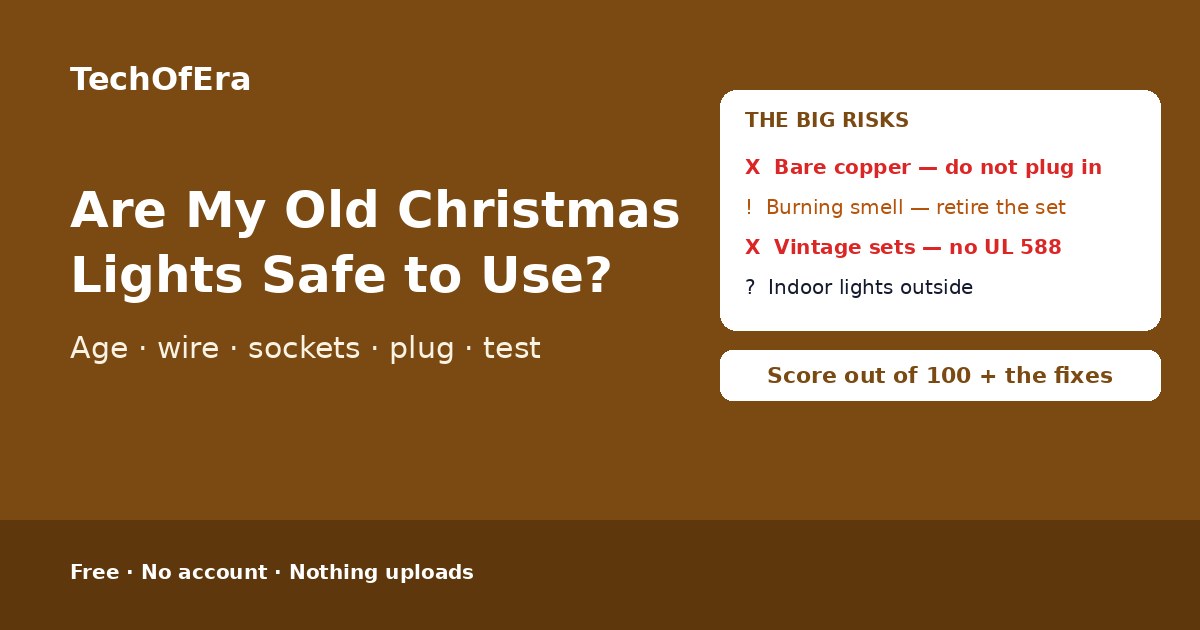
How to tell whether your old Christmas lights are safe to use
The bulbs are rarely the problem. Incandescent mini-lights last about 1,000 to 3,000 hours and LED strings about 25,000 to 50,000 hours, but the wire, the sockets and the plug age faster than the bulbs do — and they fail invisibly. The US Consumer Product Safety Commission puts holiday lighting at about 700 home fires a year, and nearly half of those involve lights older than five years. The UL mark does not save an old set either: UL 588, the standard for seasonal decorative lighting, covers products as manufactured and explicitly does not cover aged or previously used products, so a mark from 2010 says nothing about the same string today. What kills a string is heat cycling and storage: attics routinely pass 130°F (54°C) in summer, above the 104°F (40°C) maximum most sets are rated for, and that makes PVC insulation brittle. Most failures start at the plug or the first three feet of cord, where heat and physical stress concentrate. Then come the sockets: loose bulbs arc inside them, corrosion means moisture has been in there, and a darkened or melted socket has already overheated. And the test result matters more than any of it — a string that buzzes, smells, feels warm or trips the breaker is failing under load, whatever it looked like unplugged. This checker scores all of it at once, so you can see which risk is actually driving the verdict.
To use it:
- Answer the ten questions honestly. The age, the bulb type, the wire, the plug, the sockets, what happens when you plug them in, where they were stored, where they will hang, what protection they have, and whether anything has already happened. If you are not sure about the age, the type or the wire, say so — the checker scores the unknown as a risk and lists it as something to confirm, rather than guessing.
- Read the score and the biggest risk. The verdict is a score out of 100, and the biggest risk is named in plain words. A string can score well on nine questions and still be unsafe because of one bad one — bare copper, or a burning smell, is enough on its own.
- Fix the blockers first. Anything in the blockers list means do not plug the string in: bare copper, a burning smell, sparks, a shock, a vintage set, or indoor-only lights hung outside. If the lights sparked, smoked or shocked you, stop checking and unplug them now — and do not plug them in again to test them.
- Work down the cautions. Every caution is a ten-minute fix or a decision: replace the dead bulbs with the same voltage and wattage, move an indoor set inside, add a GFCI/RCD outlet and a timer, or retire a set that is past its life. Each fix moves the score up — re-run the checker after the fixes to see the new verdict.
- Test before you hang. Plug the string in on a non-flammable surface, on a GFCI outlet, and watch it for five minutes before it goes on the tree. If anything flickers, buzzes, smells or feels warm, unplug it and retire the string — do not hang a string you have not tested.
- Know the warning signs. Buzzing, warm sockets, a burning smell, a tripped breaker, or a tingle when you touch the lights mean unplug them now and do not use them again — not even for one more evening, and not even if they still light up.
Conditions and what to do at a glance
The table below is built from the same rules as the checker, so it can never disagree with your verdict. The biggest risk decides, not the number of small ones.
| Condition | Verdict | What to know |
|---|
What makes this checker different
The pages that rank for this search are guides — thorough explanations of how to test old lights, how long they last, and when to replace them — but they leave you to judge your own string: to weigh a twelve-year-old set against a stiff wire against corroded sockets against attic storage against no GFCI, and to decide which of those matters most. The lifespan articles that do exist give you a number of years and stop there, with no verdict for your actual string. This page is the answer for your lights: ten questions in, a score out of 100, the single biggest risk named, and a verdict that says safe, fix a few things, or do not plug them in — with the fixes in the order that matters, and the emergency case handled as an emergency, not a low score. It is a self-assessment, so it says plainly what it cannot know: a web page cannot see your wire, sockets or plug, so anything you mark “Not sure” stays on the list until you confirm it.
When is this the right check?
Whenever the box of lights comes out of storage: the day you pull them from the attic, the day you buy a second-hand set, the day you inherit your grandparents’ lights, or the day you notice a section go dark or a socket feel warm. Also whenever the setup changes — the lights move from indoors to outdoors, a new timer or GFCI goes in, or the string gets wet. And whenever something has already happened: a tripped breaker, a burning smell, sparks, or a tingle when you touch the lights — the last three mean unplug them now, not a checklist.
Honest limitations
A self-assessment, not an inspection
This checker works only from the answers you enter. It cannot inspect your light string — no web page can see your wire, sockets or plug, or know how the set was stored. If an answer is wrong, the verdict is wrong. When in doubt, retire the set — a new LED string costs less than a fire.
The score is a guide, not a guarantee
A high score means the risks you described are handled — not that nothing can happen. Insulation can fail inside the wire where you cannot see it, and a string that tested fine yesterday can fail today. Re-check every year, and test before you hang.
Age is a guide, not a deadline
There is no universal expiry date for Christmas lights: a well-kept LED set can outlast its ten-year guidance, and a badly stored incandescent set can fail at three years. The checker scores age together with condition, storage and test — never age alone.
“It still lights up” proves nothing
A failing string often still lights up. Flicker, buzzing, warmth, a burning smell and a tripped breaker are the signs that matter — not whether the bulbs glow. Never use “it lights up” as a safety test.
Warning signs override the verdict
A burning smell, buzzing, warm sockets, a tripped breaker or a tingle on touch mean unplug the lights and do not use them again, whatever the checker said. If you got a shock, get an electrician to check the outlet as well as the lights.
Rules from electrical-safety sources
The rules here follow guidance from the US Consumer Product Safety Commission and UL 588, as they read in November 2026. Guidance can be revised, so re-check if a new edition appears — and an electrician who can see your lights always outranks a web page.