How the real-or-fake check works
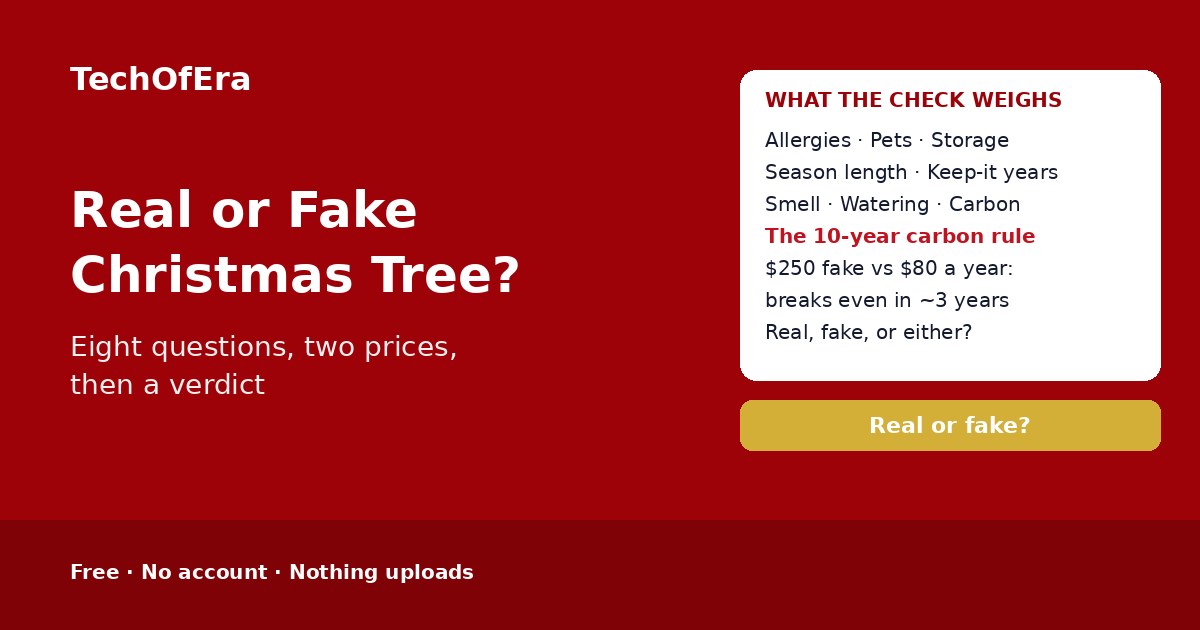
Real or fake is one of the most-searched Christmas questions, and the guides that rank for it all say the same thing in different words — but none of them scores your situation. What decides it is eight things: whether anyone has a pine or mould allergy, whether a pet would climb or chew the tree, whether there is room to store a boxed tree for 11 months, how long the tree will be up, how many years you would honestly keep a fake one, how much the pine smell matters, whether someone will water a real tree every day, and how much the environmental impact matters — plus the two prices, which decide the money maths. The carbon rule is the Carbon Trust's: a 2m artificial tree carries around 40kg CO2e against around 3.5kg for a real tree that is chipped into mulch, so a fake tree needs about 10 years of use to come out ahead. A real tree stays fresh for 4 to 6 weeks with daily watering; a fake tree can be up as long as you like. And the money rule is simple division: a $250 fake tree against $80 a year for a real one breaks even after about 3 years — but only if you actually keep it that long.
To use it:
- Say whether anyone has a pine or mould allergy. This one can decide the whole thing on its own: real trees can carry mould, pollen and insects into the house, and the American College of Allergy, Asthma and Immunology suggests an artificial tree for people allergic to mould. If the answer is yes, the checker tells you to buy fake outright — no amount of pine smell is worth a month of sneezing.
- Say whether a pet would climb or chew the tree. A climbing cat can topple a real tree, and a chewing dog can get at pine needles and tree water — real tree water can contain preservatives. A fake tree is sturdier and has no standing water to drink, though it still needs anchoring against a determined cat.
- Say whether there is room to store a boxed tree. A fake tree needs a big box kept for 11 months a year — a 7ft tree in a box is roughly 4ft long. If there is nowhere to keep it, a real tree, which arrives and leaves, is the practical choice. A slim or half-height tree, or one that splits into a smaller box, may fit where a full one will not.
- Say how long the tree will be up. A real tree stays fresh for 4 to 6 weeks with daily watering. A tree put up after Thanksgiving and taken down in early January is just inside its window; a tree put up in early November will be dry long before Christmas — and a dry tree is a fire risk.
- Say how many years you would honestly keep a fake one. This is the question most people get wrong about themselves. A fake tree needs about 10 years of use to beat a real tree on carbon, and it only saves money if it outlasts its break-even point — yet most fake trees are thrown out after 6 to 9 years, before they ever break even.
- Say how much the pine smell matters. The smell is the one thing a fake tree cannot copy. Fraser fir holds its needles longest, Douglas fir smells strongest, and balsam fir is the classic pick — but if the smell and the trip to pick one out are the point of the tree, the answer is real, whatever the maths says.
- Say whether someone will water a real tree every day. A real tree needs water every day and drops needles. Without watering it dries out in days, and a dry tree can catch fire fast — US fire departments responded to an average of 160 home fires a year started by a Christmas tree between 2016 and 2020. A fake tree needs no care at all.
- Say how much the environment matters, and enter the two prices. A real tree chipped into mulch carries around 3.5kg CO2e; sent to landfill it gives off around 16kg. A fake one carries around 40kg. The two prices decide the money maths: the checker divides the fake tree's price by the real tree's yearly price and weighs the break-even against how long you would keep it.
What makes this checker different
The pages that rank for this search are guides — a tree farm laying out the carbon maths, a home-services site walking through fire risk and allergies, a review site comparing the 10-year cost. None of them scores your situation: none takes your allergies, your pets, your storage, your season length, your keep-it years, your smell, your watering and your environmental view — and none gives you a verdict — buy real, buy fake, or either works — with the break-even worked out from your own prices. There is no free, standalone checker that takes a household's answers and returns a real-or-fake verdict with the cost and carbon maths applied. This page is that answer: eight questions, two prices, and an instant verdict for your exact household. It is a self-assessment, so it says plainly what it cannot know: it cannot smell your living room, meet your cat, or measure your storage cupboard, and where someone has a pine or mould allergy it tells you to buy fake instead of giving you a maybe.
When is this the right check?
When you are about to spend real money on a tree and the guides have left you no closer to a decision — because the answer genuinely depends on your household, not on which tree is better in general. When someone in the house has an allergy and you need to know whether that settles it (it does). When you put the tree up in early November and want to know whether a real one will survive the season (it will not). When you are weighing a $300 fake tree against $80 a year for a real one and want the break-even in years, not in vibes. And when you care about the environment and want to know whether the fake tree you would buy would actually be greener (only if you keep it for about a decade).
Honest limitations
A self-assessment, not shopping advice
This checker cannot smell your living room, meet your cat, or measure your storage cupboard. It scores the answers you give against what the real-vs-fake guides say — it cannot tell you which tree to buy, and it is not shopping advice.
The carbon numbers are averages, not your tree
40kg for a fake tree and 3.5kg for a real one are the Carbon Trust's figures for a typical 2m tree. Your tree's footprint depends on its weight, its materials, how far it travelled, and how far you drive to buy a real one — other studies put the break-even anywhere from 4 to 20 years.
Prices are US averages — change them
$60 to $100 a year for a real tree and $80 to $700 once for a fake one are US figures for 2026. Prices where you live will differ — in the UK a real tree runs roughly £40 to £80. Enter your own prices above and the break-even will use them.
Allergies vary — this is not medical advice
A pine or mould allergy is a medical matter, and this checker is not a doctor. If the allergy is severe, talk to your clinician — and note that a dusty fake tree from the loft can still carry dust, so wipe it down before you put it up.
“Keep it 10 years” is a promise, not a fact
Most fake trees are thrown out after 6 to 9 years — before they break even on carbon or on cost. The verdict assumes you will keep it as long as you say you will. Be honest with yourself about that before you buy.
Facts from the real-vs-fake guides, dated November 2026
The facts here are the guides that rank for this question — Jack Frost, TrimmersHD, Farmers Almanac, Fantastic Services, OnLagend and Christmas Tree Review Hub — as they read in November 2026. Guides change and prices move: recheck the numbers if anything about your household changes.