How the tree-date check works
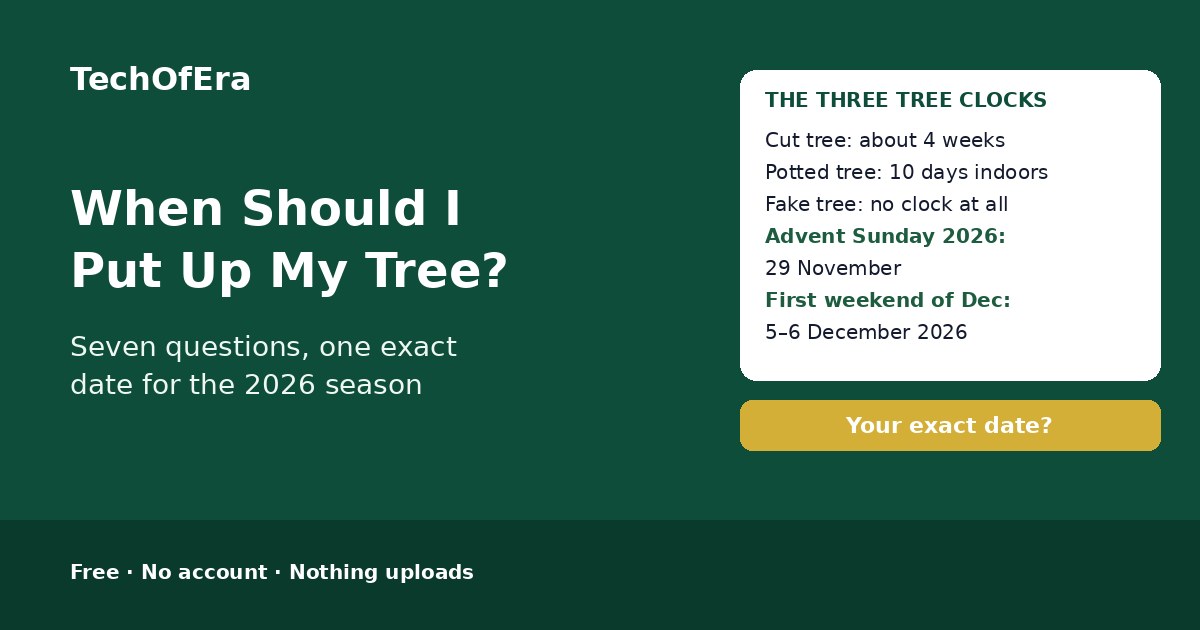
When to put up the Christmas tree is one of the most-searched Christmas questions, and the guides that rank for it all say the same thing in different words — but none of them gives you a date for your household. What decides it is seven things: what kind of tree it is, how long it must still look good, which tradition you follow, how early you would like it up, whether a cat climbs or small children reach it, whether the room is ready, and whether someone will water a real tree every day. The freshness rule is the Royal Horticultural Society's: a cut tree lasts about four weeks with care, so count back four weeks from the day it must still look good. A living tree in a pot must not stay indoors for more than 7 to 10 days, and a fake tree has no freshness clock at all. Advent Sunday 2026 is 29 November, the post-Thanksgiving weekend is 28–29 November, and the first weekend of December — 5–6 December — is when a third of UK homes put theirs up.
To use it:
- Say what kind of tree it will be. This decides whether any date can be too early at all. A cut tree has a four-week freshness clock; a potted tree must not stay indoors more than 10 days; a fake tree can go up whenever you like — even 1 November.
- Say how long it must still look good. This is the date everything counts back from. Christmas Day is Friday 25 December 2026, New Year's Day is Friday 1 January 2027, Twelfth Night is Tuesday 5 January 2027, and Candlemas is Tuesday 2 February 2027. A cut tree that must last to Twelfth Night cannot go up before Tuesday 8 December; one that must last to Candlemas cannot go up before Tuesday 5 January.
- Say which tradition you follow. Advent Sunday, the weekend after Thanksgiving, 1 December, 8 December (Immaculate Conception) and Christmas Eve are all real traditions — and the checker tests yours against the freshness clock instead of just repeating it. Advent Sunday 2026 is 29 November, which fits a real tree nicely; 1 December does not fit one that must last to Twelfth Night.
- Say how early you would like it up. Wanting it up on 1 November is fine for a fake tree, but a real tree put up then will be dry long before Christmas. The checker takes the earlier of your tradition and your wish, then moves it later if the freshness clock demands it — and says so.
- Say whether a cat climbs or small children reach the tree. This does not change the date, but it changes what the date needs: a climbing cat means the tree must be anchored, and small children mean unbreakable ornaments low down. Both are easier to sort out on a weekend with time to spare.
- Say whether the room is ready. If putting the tree up is a big job, it needs a free weekend — and the checker moves the date to the nearest one. If the spot still needs clearing, clear it first: the most popular tree height in the UK is 6–7ft, and you need that much clear ceiling plus the stand.
- Say whether someone will water a real tree every day. A real tree needs water every day and must be kept away from radiators, fireplaces and candles. Without watering it dries out in days, and a dry tree can catch fire fast — US fire departments responded to an average of 160 home fires a year started by a Christmas tree between 2016 and 2020. If nobody will water it, a fake tree is the safer choice.
What makes this checker different
The pages that rank for this search are guides — a UK Christmas site laying out the 2026 dates and traditions, a US planning site walking through the real-tree maths, a retailer naming Advent Sunday as the ideal date. None of them scores your situation: none takes your tree type, how long it must last, your tradition, how early you want it up, your pets, your room and your watering — and none gives you a date. The closest interactive rival, Holiday Home Ideas' Real Christmas Tree Care Calculator, estimates how long a real tree will stay fresh and how much water it needs — but only for real trees, and it never names a date for your household. This page is that answer: seven questions, one exact date for the 2026 season, with the earliest safe day worked out and the reason shown. It is a self-assessment, so it says plainly what it cannot know: it cannot walk into your living room, check whether the corner is clear, or feel how dry your tree is.
When is this the right check?
When you are about to put the tree up and the guides have left you no closer to a date — because the answer genuinely depends on your tree, not on which tradition is best in general. When you want it up on 1 November and need to know whether a real tree will survive the season (it will not). When you follow Advent Sunday and want to know whether that still works for a tree that must last to New Year (it does not — the earliest safe day is Friday 4 December). When you have a potted tree and need to know how late to bring it in (no more than 10 days before the day it must last until). And when putting the tree up is a big job and you need the date to land on a weekend.
Honest limitations
A self-assessment, not shopping advice
This checker cannot walk into your living room, check whether the corner is clear, or feel how dry your tree is. It scores the answers you give against what the timing guides say — it cannot tell you which tree to buy, and it is not shopping advice.
Four weeks is a planning figure, not a promise
About four weeks is the Royal Horticultural Society's figure for a cut tree with care; Iowa State University Extension puts it at three to four weeks, with hardy firs such as Fraser fir sometimes stretching to five. Your tree's real window depends on its species, how fresh the cut was, and how warm and dry your room runs.
The dates are for the 2026 season
Advent Sunday, Thanksgiving, Christmas Day and Twelfth Night all move from year to year — the dates here are for 2026 (Christmas Day is Friday 25 December 2026). If you are reading this after Christmas, the same four-week and 10-day rules apply to next year's dates.
Traditions vary — yours wins
Advent Sunday, 1 December, 8 December and Christmas Eve are all real traditions in different households and countries. If your household has its own date, that is the one to follow — the checker only moves it when the freshness clock makes it unsafe for a real tree.
Fire safety is about watering, not dates alone
A date inside the freshness window is only safe if the tree is watered every day and kept away from radiators, fireplaces and candles. A tree that stops taking water and drops needles at a touch is done, whatever the calendar says — take it down.
Facts from the timing guides, dated November 2026
The facts here are the guides that rank for this question — The Christmas Dream, Christmas Navigator, Quite Recipes, Gato Preto, Holiday Home Ideas, Christmas Tree World, Farming Life and the Scottish Sun — as they read in November 2026. Guides change and traditions do not: recheck the dates if anything about your household changes.