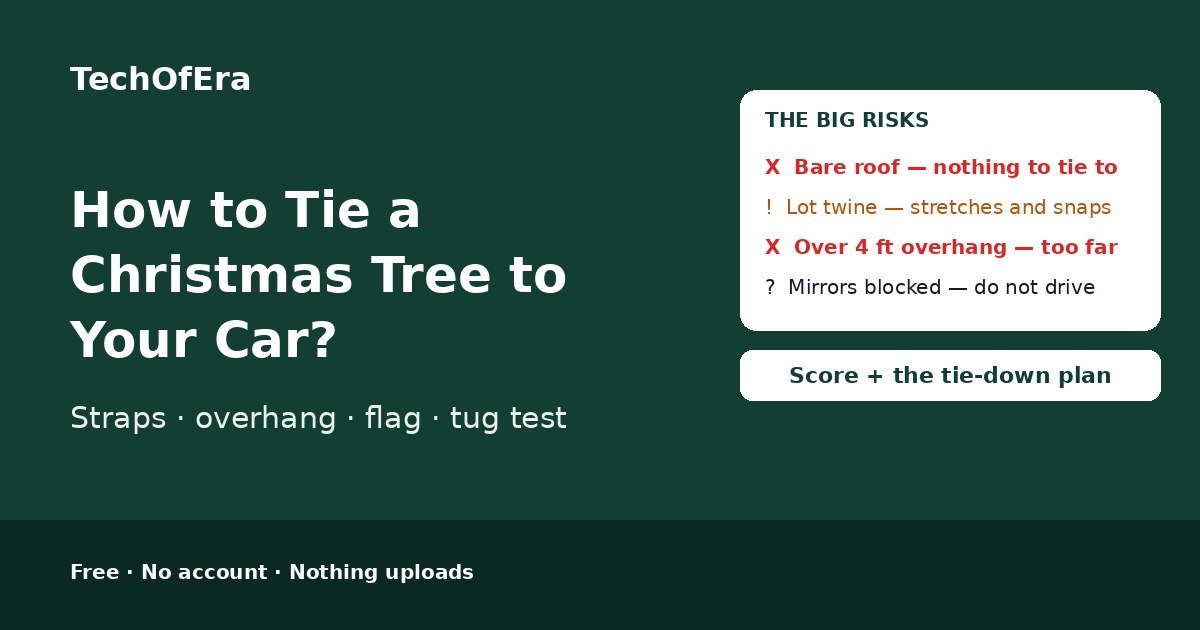
How to tie a Christmas tree to your car
The guides that rank for this search — AAA, The Drive, This Old House and Lugg — all tell the same story, and it starts before you leave for the lot. Bring strong rope or nylon ratchet straps, an old blanket and gloves, and a vehicle suited to the job: a car with a roof rack is ideal, but a pickup truck, SUV, van or minivan can work as well. Measure your car first. A tree rides inside only when the netted tree is shorter than the usable cargo floor and the hatch closes completely — fold the seats, measure from the inside of the closed hatch to the nearest point behind the front seats, and check the narrowest part of the hatch opening too. If it does not fit, it goes on the roof — and only if the car has a roof rack with fixed tie-down points. A bare roof is never an option. Have the tree netted at the lot: it is narrower, catches less wind and is easier to tie down. Lay a blanket on the roof first, put the tree on trunk first toward the front of the car, and tie it at three points — near the trunk, through the middle and near the top — looping each strap around the trunk above a branch so it cannot slide forward when you brake. Then tug it hard from several angles. If it moves, tighten it. Drive slowly, take back roads, and stop after a few minutes to check the straps are still tight.
To use this checker:
- Answer the ten questions honestly. The vehicle, the tree height, the inside length and the roof or bed length, whether the tree is netted, what will hold it down, how many tie points, whether there is a blanket under it, what the journey home looks like, and whether the final checks are done. If you are not sure about the gear or the checks, say so — the checker scores the unknown as a risk and lists it as something to confirm, rather than guessing.
- Read the placement first. Inside the car is safest, a roof rack is fine, a pickup bed is fine — and if the tree does not fit inside and there is no roof rack, there is no safe way to carry it. That verdict is not a low score, it is a stop: borrow a bigger vehicle or ask the lot about delivery.
- Fix the blockers first. Anything in the blockers list needs a change before you drive: no straps at all, thin lot twine as the only tie-down, a tree that is not tied down, too much overhang, or mirrors blocked and a hatch that will not close.
- Work down the cautions. Every caution is a quick fix at the lot: get the tree netted, swap twine for ratchet straps, add a third tie point, put a blanket under the tree, tie a red flag on the end, or take the back-road route home. Each fix moves the score up — re-run the checker after the fixes to see the new verdict.
- Do the tug test at the lot, not on the road. Pull the tree hard from several angles — forward, back and side to side. If it moves at all, tighten the straps or add another tie-down. Then sit in the driver's seat and check every mirror before you pull away.
- Know the cost of getting it wrong. AAA Hudson Valley reports repair bills as high as $1,500 from damage caused during tree transport, and all 50 US states prohibit items falling off vehicles, with fines up to $5,000. A tree that comes off the roof is a danger to everyone behind you, not just an embarrassment.
Rules and what to do at a glance
The table below is built from the same rules as the checker, so it can never disagree with your verdict. The placement decides first, not the number of small fixes.
| Rule | Verdict | What to know |
|---|
What makes this checker different
The pages that rank for this search are guides — thorough, well-sourced explanations from AAA, The Drive, This Old House and Lugg of how to load a tree, which way it should face, and what to tie it with — but they leave you to judge your own load: to weigh your vehicle against your tree height against your straps against your route, and to decide whether the combination is safe to drive. There is no interactive checker anywhere in the results: no page takes your car and your tree and returns a verdict. This page is the answer for your trip: ten questions in, a placement — inside, roof rack, pickup bed, or no safe way — a score out of 100, the single biggest risk named, and a verdict that says ready to drive, fix a few things, or don't drive it like this, with the tie-down plan in the order that matters. Where the sources disagree, it says so instead of picking one quietly: one guide says to point the trunk toward the rear, and this checker follows the majority that says trunk forward. And where the sources give no number — the flag rule, the overhang limit, a safe speed — it uses its own rule and labels it as its own, rather than dressing a guess up as a fact.
When is this the right check?
At the tree lot, before you load anything: the day you buy the tree, the day you borrow a different car, or the day the tree you wanted turns out to be a foot taller than the one you measured for. Also whenever the setup changes — a roof rack comes off, the only straps you have are the lot's twine, or the journey home turns out to involve a motorway. And whenever the load has already moved: if the tree shifted on the way home, stop, re-tie it, and re-check before you carry on.
Honest limitations
A self-assessment, not an inspection
This checker works only from the answers you enter. It cannot see your car or your tree — no web page can measure your roof, check your rack's load rating, or watch you tie a knot. If an answer is wrong, the verdict is wrong. When in doubt, ask the lot staff to check the load with you.
The score is a guide, not a guarantee
A high score means the load you described is tied down well — not that nothing can happen. Wind, sudden braking and a strap that loosens after a few miles can still move a tree. Stop after a few minutes and check the straps are still tight.
The flag and overhang limits are the checker's own
The sources disagree on overhang: one guide says to flag the tree once it sticks out more than a couple of feet, another quotes 4 ft as the usual US limit. This checker flags anything past 2 ft and treats more than 4 ft as too far — its own rules, labelled as such, not a law quoted as fact.
Trunk direction: the majority, not a consensus
AAA, The Drive, This Old House and Lugg all say trunk forward, toward the front of the car. One guide says trunk toward the rear. This checker follows the majority and names the disagreement, so you can judge it yourself.
Check your rack's load limit
A roof rack has a rated load limit, and so does the car — check the vehicle and rack manuals before you load a heavy tree. This checker asks about the rack's length, not its rating, so a tree the rack cannot legally carry is something you must confirm yourself.
Rules from motoring sources
The rules here follow guidance from AAA, The Drive, This Old House and Lugg, as they read in November 2026. Guidance can be revised, so re-check if a new edition appears — and the lot staff who can see your car always outrank a web page.