How to tell whether your Christmas tree is safe for your cat
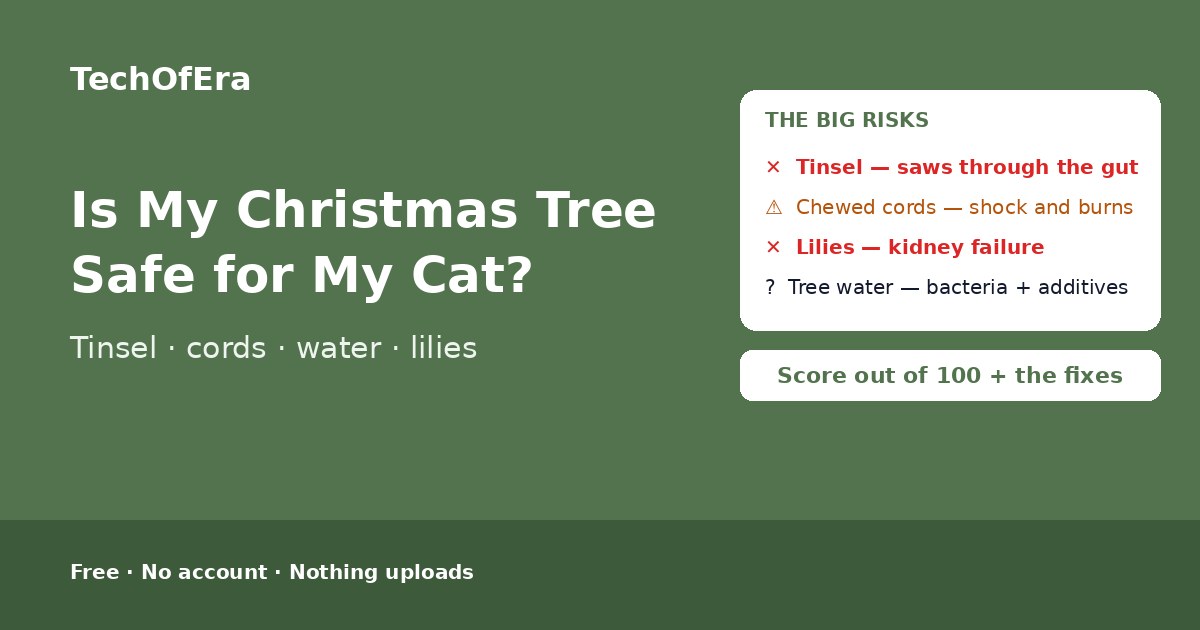
The tree itself is rarely the problem. The Pet Poison Helpline says Christmas trees are not generally a concern — most of their tree-related calls are about the stand water, not the tree. Real fir, spruce and pine needles are only mildly toxic: the sap and oils irritate the mouth and stomach, and a cat would have to eat a lot of needles to be seriously poisoned. The danger is what hangs on and around the tree. Tinsel is the worst of it: swallowed tinsel becomes a linear foreign body, anchoring at one point — often the base of the tongue — while the rest keeps moving, so the gut bunches up like an accordion along the strand and the tinsel saws through the intestinal wall. That needs surgery and can kill, which is why the ASPCA says to skip tinsel entirely in a home with pets. Ribbon, string and garland carry the same risk. Then come the cords: a chewed mains cord can burn the tongue, shock the cat, and damage the lungs or heart. Then the stand water, which breeds bacteria and turns toxic the moment anyone adds a preservative, fertiliser or sweetener — xylitol especially. And the plants: lilies can cause kidney failure from a single nibble. This checker scores all of it at once, so you can see which risk is actually driving the verdict.
To use it:
- Answer the ten questions honestly. The tree type, the tinsel, the ornaments within reach, the lights and cords, the stand water, how steady the tree is, whether the cat is ever alone with it, how your cat behaves, what else is nearby, and whether anything has already happened. If you are not sure about the tree type or your cat’s behaviour, say so — the checker scores the unknown as a risk and lists it as something to confirm, rather than guessing.
- Read the score and the biggest risk. The verdict is a score out of 100, and the biggest risk is named in plain words. A tree can score well on nine questions and still be unsafe because of one bad one — tinsel plus a string-eating cat, or lilies in the room, is enough on its own.
- Fix the blockers first. Anything in the blockers list needs a vet today or a change today: lilies in the house, a chewed cord, or tinsel with a known string-eater. If your cat has swallowed tinsel, ribbon or string, stop checking and call your vet now — and do not pull it out, even if you can see it.
- Work down the cautions. Every caution is a five-minute fix: take the tinsel off, swap the low glass ornaments for shatterproof ones, run cords behind furniture, cover the stand, anchor the tree to the wall. Each fix moves the score up — re-run the checker after the fixes to see the new verdict.
- Keep the cat out until the tree is fixed. A verdict of “not safe yet” or worse means the cat should not be alone with the tree. Shut the tree in a room the cat cannot reach, or put a pet gate around it, until the fixes are done.
- Know the warning signs. Vomiting, diarrhoea, drooling, loss of appetite, lethargy, straining to pass a motion, or a painful belly after the tree goes up mean call your vet the same day. String or tinsel visible from the mouth or rear end means call your vet first and never pull it out yourself.
Hazards and what to do at a glance
The table below is built from the same rules as the checker, so it can never disagree with your verdict. The biggest risk decides, not the number of small ones.
| Hazard | Verdict | What to know |
|---|
What makes this checker different
The pages that rank for this search are guides — thorough explanations from PetMD, Purina, the ASPCA and VCA Hospitals of why tinsel is dangerous, why tree water is bad, and how to cat-proof a tree — but they leave you to judge your own tree: to weigh tinsel against glass ornaments against exposed cords against an unanchored tree against a kitten, and to decide which of those matters most. The general pet-safety pages that do exist list the hazards one by one, with no score and no verdict. This page is the answer for your tree: ten questions in, a score out of 100, the single biggest risk named, and a verdict that says safe, fix a few things, or call your vet now — with the fixes in the order that matters, and the emergency case handled as an emergency, not a low score. It is a self-assessment, so it says plainly what it cannot know: a web page cannot watch your cat or examine your tree, so anything you mark “Not sure” stays on the list until you confirm it.
When is this the right check?
Whenever the tree goes up and a cat lives in the house: the day you put the tree up, the day you add the tinsel, the day a new kitten arrives, or the day you notice the cat chewing a cord or batting ornaments. Also whenever the setup changes — a real tree replaces a fake one, mains lights replace battery ones, someone brings lilies into the house, or the cat starts climbing after ignoring the tree for a week. And whenever something has already happened: a chewed cord, a swallowed ribbon, or string visible from the mouth or rear end — that last one is a vet call, not a checklist.
Honest limitations
A self-assessment, not a diagnosis
This checker works only from the answers you enter. It cannot diagnose your cat — no web page can watch your cat, examine your tree, or know your cat’s medical history. If an answer is wrong, the verdict is wrong. When in doubt, take the tinsel off and shut the cat out of the tree room — or ask your vet.
The score is a guide, not a guarantee
A high score means the risks you described are handled — not that nothing can happen. A cat that has ignored the tree for a week can start climbing it tomorrow, and a single swallowed strand of tinsel is an emergency whatever the score was. Re-check whenever the cat’s behaviour changes.
Tinsel is a mechanical risk, not a poison
Tinsel is not toxic — it does not poison a cat. Its danger is physical: it anchors in the gut and saws through the wall as the gut tries to pass it. That is why even a tiny piece matters, and why the advice is to skip it entirely rather than to use less of it.
Cats hide illness
Cats are good at hiding pain, so by the time the signs are obvious — repeated vomiting, not eating, a painful belly — the damage may already be serious. After the tree goes up, watch for the small signs: drooling, hiding, a cat that will not eat, or straining to pass a motion.
Warning signs override the verdict
Vomiting, lethargy, loss of appetite, a painful belly, or string visible from the mouth or rear end mean call your vet the same day, whatever the checker said. Never pull string or tinsel out yourself — call your vet first.
Rules from veterinary sources
The rules here follow guidance from the ASPCA, the Pet Poison Helpline, PetMD, Purina and VCA Hospitals, as they read in November 2026. Guidance can be revised, so re-check if a new edition appears — and a vet who can see your cat always outranks a web page.