How the buy-vs-rent check works
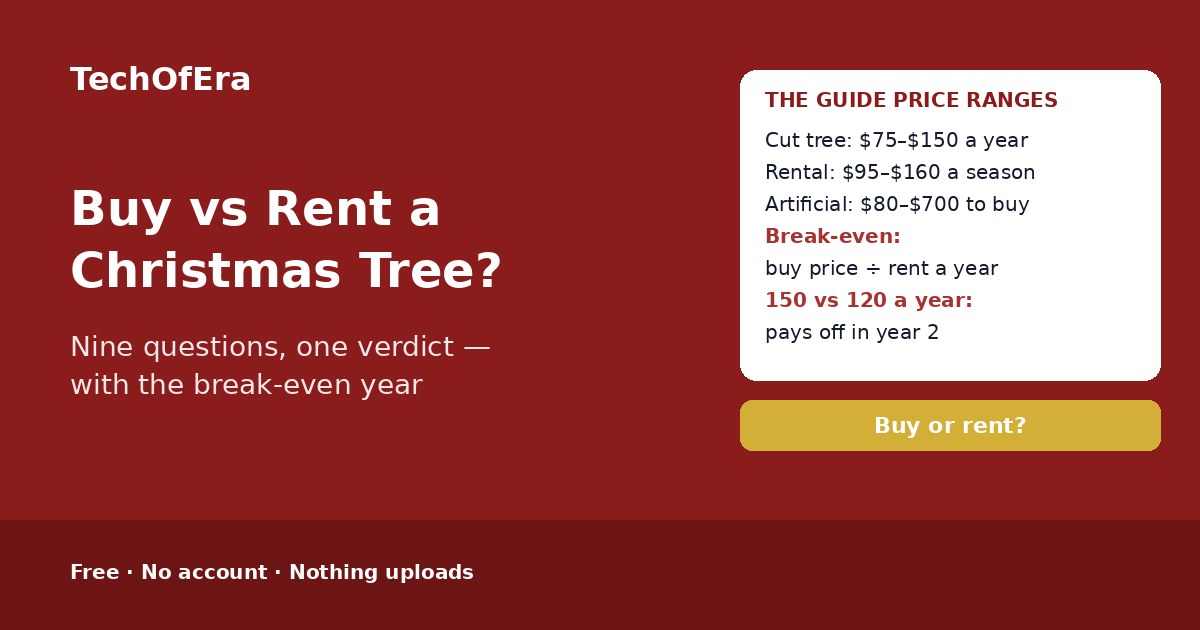
Whether to buy or rent a Christmas tree is one of the most-searched Christmas questions, and the guides that rank for it all say the same thing in different words — but none of them runs your numbers. What decides it is nine things: what kind of tree you would buy, what buying costs, what renting costs per year, how many years you plan to have a tree, storage and disposal costs, how much space you have, allergies, and what matters most to you. The cost rule is simple: a cut tree is bought fresh every year, so buying only wins when one year's tree plus disposal costs less than one year's rent. An artificial or potted tree is bought once, so buying wins once the rent you have avoided passes the purchase price — divide the buy price by the rent minus storage to find the break-even year. The guide prices are planning estimates only: a cut tree roughly $75–$150 in the US or £56–£120 in the UK, a rental roughly $95–$160 a season in the US or £30–£95 in the UK, and an artificial tree roughly $80–$700 to buy. A living potted tree must not stay indoors more than 7 to 10 days, and an artificial tree needs about 10 years of reuse to beat a real tree on carbon.
To use it:
- Say what kind of tree you would buy. This decides the whole maths. A cut tree is bought fresh every year, so the comparison is annual. An artificial or potted tree is bought once, so the comparison is the break-even year — how many years of rent it takes to pass the purchase price.
- Say what buying would cost. This is the number the verdict rests on, so use your local price, not the guide estimate. A cut tree runs roughly $75–$150 in the US or £56–£120 in the UK; an artificial tree roughly $80–$700; a potted tree roughly £50–£110 in the UK.
- Say what renting would cost per year. Rentals run roughly $95–$160 a season in US cities or £30–£95 in the UK, delivery and collection usually included — but deposits are sometimes extra, and a refundable deposit (often £15 in the UK) comes back when the tree returns in good shape.
- Say how many years you plan to have a tree. The break-even year is the whole point: an artificial tree bought for 150 against a 120 rental pays for itself in year 2, but only wins if you keep it that long. Five years is a fair default.
- Say what storage and disposal would cost. Storage eats the saving on a bought artificial tree — at 20 a year, storage alone costs 100 over five years. Disposal does the same to a bought cut tree. Both are 0 if you have a free loft or your town runs free curbside collection in early January.
- Say how much storage space you have. An artificial tree needs somewhere to live for 11 months a year. No storage at all rules buying one out, whatever the maths says — and a bought potted tree needs a garden, a balcony or a sheltered spot to live in after Christmas.
- Say whether anyone reacts to real trees. Real trees can carry mould and pollen that trigger itchy eyes and sneezing. If anyone in the house reacts, an artificial tree avoids it entirely — and a rented living tree is still a real tree, so it does not help.
- Say what matters most to you. Lowest cost, freshest tree, least hassle and greenest can each point a different way when the money is within 10% — say which one wins ties, and the checker breaks the tie for you. Greenest has its own rules: a rented living tree goes back to the farm, and an artificial tree only beats a real tree on carbon after about 10 years of reuse.
What makes this checker different
The pages that rank for this search are guides — a US tree-finding guide laying out the $75–$150 buy price against the $95–$160 rental, a living-tree rental guide listing the $45–$225 range, a long financial comparison of renting against buying over five years, a UK farm guide with RentalClaus trees from £30, and a London guide pricing rentals at £39–£69. None of them runs your numbers: none takes your buy price, your rental price, your years, your storage and disposal costs, your space, your allergies and what matters most to you — and none gives you a verdict with a break-even year and a year-by-year cost table. This page is that answer: nine questions, one verdict, with the totals worked out and the reason shown. It is a self-assessment, so it says plainly what it cannot know: it cannot walk into your living room, measure your cupboard, or phone your local tree farm.
When is this the right check?
When the guides have left you no closer to an answer — because the answer genuinely depends on your prices, not on whether renting is better in general. When you are choosing between a cut tree every year and a rented living tree, and the two prices are close. When you are thinking of buying an artificial tree and need to know how many years it takes to pay for itself. When you have no storage space and need to know whether that rules buying out (it does, for an artificial tree). When someone in the house sneezes around real trees and you need to know whether renting helps (it does not — a rented living tree is still a real tree). And when you want the greenest option and need to know whether that means renting a living tree or buying artificial and keeping it a decade.
Honest limitations
A self-assessment, not shopping advice
This checker cannot walk into your living room, measure your cupboard, or phone your local tree farm. It scores the answers you give against what the buy-vs-rent guides say — it cannot tell you which tree to buy, and it is not shopping advice.
Guide prices are estimates, not quotes
The $75–$150 cut-tree price, the $95–$160 rental range and the £30–£95 UK rental range are what the guides say as they read in November 2026. Your local prices will differ — the verdict only works from the prices you enter, so re-check them at the till.
The break-even year assumes prices stay flat
The year-by-year table holds prices steady. In real life both buy and rent prices rise a little each year, and a rental firm can change its deposit or delivery terms. The verdict is a planning figure, not a promise.
Renting is not available everywhere
Living-tree rental is common in big cities and rare elsewhere, and rental stock is limited — the popular sizes sell out before December. If no firm delivers to your area, renting is not an option whatever the maths says. Check availability before you decide.
Storage is about space, not just money
A bought artificial tree costs nothing to store in a free loft, but it still takes up a cupboard for 11 months a year — and a 6ft tree packs down to roughly a metre-long box. Measure the box before you buy, and the cupboard before that.
Facts from the buy-vs-rent guides, dated November 2026
The facts here are the guides that rank for this question — oreateai, LoveToKnow, Alibaba insights, TreePeople, AAA, RentalClaus, Christmas on the Hill and Good Elf — as they read in November 2026. Guides change and prices do not: recheck the prices if anything about your household changes.