What temperature should your house be in winter?

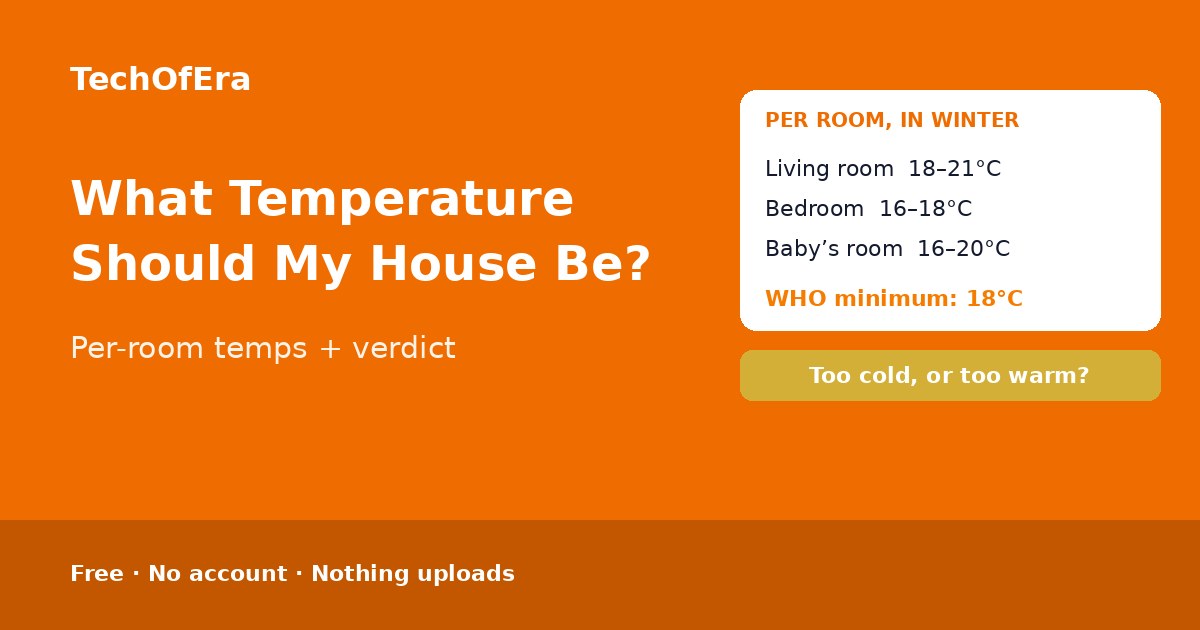
Everyone quotes a different number — 18°C, 20°C, 68°F — and the honest answer is that it depends on who lives there. The World Health Organization names 18°C as the safe indoor minimum, the UK NHS says 18–21°C for the living room, and the US Department of Energy says 68°F while you are awake — but a baby, someone 65 or over, or someone with a health condition needs it warmer, and a bedroom needs it cooler than a bathroom. Answer six questions about your household, your heating and what matters more — saving money or comfort — and this checker gives you a temperature for every room, a verdict on the temperature you keep now, and a money-vs-comfort reading — free, in your browser, nothing uploads.

  • WHO 18°C minimum
  • Per-room temperatures
  • Money vs comfort verdict
  • Free, no account, nothing uploads
What temperature should your house be in winter? Check it in seconds.

Check the right winter temperature for your house

Try a preset:
0 of 5 answered

Your result

Answer the questions Your verdict appears here as you answer.
Your living room

Answer the questions above and your living-room temperature will appear here.

Your per-room winter temperatures

Blockers

Things that do not fit

Things to check

Still to confirm

What to do next

    Your result summary


    Answer the questions above — the verdict updates live.

    Privacy you can verify, not just trust

    Checking what temperature your house should be by uploading your home's details to a website would be backwards — the check should never be the leak. This one can't: your answers are checked in your browser, and they never leave the device — the only third-party requests are the site's own analytics, which count page views. Don't take our word for it:

    New cross-origin requests during use: 0
    1. Press F12 to open developer tools, then the Network tab.
    2. Answer a question above. Watch: apart from the site's analytics, nothing new is requested — no uploads, and no data ever leaves your device.
    3. Extra credit: disconnect your internet after this page loads — the checker still works.

    How the winter-temperature check works

    The World Health Organization names 18°C (about 64°F) as a safe indoor temperature in cold seasons, and says older people, children, and people with chronic illnesses may need it warmer. The UK NHS says heat the living room to 18–21°C, and the US Department of Energy recommends 68°F (20°C) while you are awake and at home. But one number does not fit every room: the bedroom should be cooler than the living room, the bathroom warmer, and the rooms you do not use should never fall below 13°C (55°F), the American Red Cross floor for keeping pipes from freezing. This checker combines six clues — who lives there, what heats your home, what matters more (saving money or comfort), what temperature the house is at now, whether you get morning condensation or damp, and how well the home holds heat — and gives you a temperature for every room, a verdict on the temperature you keep now, and a money-versus-comfort reading.

    To use it:

    1. Tick who lives here. A baby, someone 65 or over, or someone with a cold-sensitive health condition lifts the living room to 20–21°C and the bedroom to 18°C. A baby's room gets its own temperature, 16–20°C, per the Lullaby Trust.
    2. Say what heats your home, and what matters more. The system decides how the house should be heated — a heat pump holds steady, a boiler handles a setback — and your priority moves the living room a degree or two: 18–19°C for saving money, 20–21°C for comfort, 19–20°C for a balance.
    3. Say what temperature the house is at now. Check the thermostat or a room thermometer. This is the number the verdict judges: too cold, cooler than the guidance suggests, just right, or warmer than you need.
    4. Say whether you get morning condensation or damp. Letting the house go cold overnight makes condensation worse, and condensation feeds mould — so a home with damp spots needs the heating on and the moisture source fixed, not a lower temperature.
    5. Say how well your home holds heat. A home that holds heat well stays warm for hours after the heating goes off; a draughty one cools down fast, so holding the same temperature costs more.

    What makes this checker different

    The pages that rank for this search are guides — a long article that tells you the Department of Energy's 68°F figure and lists the setbacks by system, and a UK guide that tells you it depends on your home. Neither one asks who lives there, what heats your home, or what matters more to you, and neither one tells you the temperature for every room. There is no free, standalone checker that takes your household, your heating system, your priority, your current temperature, your morning damp, and your insulation — and gives you a per-room temperature for the living room, bedroom, baby's room, bathroom and rooms you do not use, plus a verdict on the temperature you keep now and a money-versus-comfort reading. This page is that answer: six questions, an instant verdict, the blockers named, and the next steps. It is a self-assessment, so it says plainly what it cannot know: it cannot measure your rooms, and where vulnerable people or damp are involved it says warm the house up instead of saving money.

    When is this the right check?

    When the heating bill arrives and you are wondering whether the house is warmer than it needs to be — because turning the living room down 2°C could save roughly 14% on heating, as an estimate, and this checker works out the saving for your exact house. When a baby is born, or an older parent moves in — because the temperature the house needs changes with who lives there, and this checker lifts the living room to 20–21°C and gives the baby's room its own temperature. When the windows steam up in the morning and you are not sure whether the house is too cold — because cold surfaces breed condensation, and this checker says so. And when you move into a new home and have no idea what to set the thermostat to — because the guidance is different for every room, and this checker gives you all five numbers at once.

    Honest limitations

    A self-assessment, not a survey

    This checker cannot measure your rooms, test your insulation, or know how cold your pipes get. It cannot check whether your pipes have frozen before, how draughty your home really is, or what your heating system can do. If your home drops below 15°C, or pipes have frozen before, get a heating engineer in.

    The score is a guide, not a diagnosis

    A score of 92 does not mean your house is warm enough, and a score of 58 does not mean your home is broken. The score weighs the current temperature, the damp and who lives there together — but only a proper inspection can say what is actually wrong with a house.

    The saving is an estimate, not a promise

    Each 1°C lower saves around 7% on heating, as a rough rule for a typical home. Your saving depends on your insulation, your system, your tariff and how cold the winter is — this checker quotes the rough rule and says which band you are in, not a number for your bill.

    One answer is not every winter's

    The verdict changes with the weather and the household: a mild winter can take a cooler house than a cold snap, and a baby or an older parent moves the numbers up. Re-run the checker when the household or the weather changes, and do not treat one winter's verdict as a rule for every year.

    Heat pumps have their own rules

    A heat pump warms a house slowly — it holds a steady temperature rather than blasting heat. Turning it up and down by large amounts can trigger backup electric heat, which is expensive. Set it to hold the living-room temperature steadily — this checker says so, but it cannot check your thermostat for you.

    Rules from official sources, dated November 2026

    The rules here are the World Health Organization Housing and Health Guidelines (18°C safe indoor minimum), the UK NHS living-room guidance (18–21°C), the US Department of Energy thermostat guidance (68°F while awake at home), the Lullaby Trust baby's-room guidance (16–20°C), and the American Red Cross pipe guidance (never below 55°F / 13°C), as they read in November 2026. Guidance changes: recheck with a professional if anything about your home changes.

    Frequently asked questions

    What temperature should my house be in winter?

    It depends on who lives there and what matters more to you. For healthy adults, the living room should be 18–21°C: the World Health Organization names 18°C (about 64°F) as the safe indoor minimum in cold seasons, the UK NHS says heat the living room to 18–21°C, and the US Department of Energy recommends 68°F (20°C) while you are awake and at home. The bedroom should be 16–18°C, the bathroom 20–22°C, and rooms you do not use 14–15°C — never below 13°C (55°F), the American Red Cross floor for keeping pipes from freezing. Where a baby, someone 65 or over, or someone with a cold-sensitive health condition lives, the living room should be 20–21°C. This checker takes your household, your heating system and your priority and gives you the temperature for every room.

    What temperature should I keep my house at in winter with a baby?

    The living room should be 20–21°C, and the baby's room 16–20°C, per the Lullaby Trust. A baby should never sleep in a room that is too hot or too cold — check the baby's room with a thermometer, not by touch, because a baby loses body heat more easily than an adult. The World Health Organization names 18°C as the safe indoor minimum in cold seasons and says children may need it warmer, so do not let the house fall below 18°C where a baby sleeps. This checker gives you the baby's room temperature alongside the rest of the house, and holds the 18°C floor wherever a baby lives.

    What temperature should my bedroom be in winter?

    16–18°C for healthy adults: cool helps sleep, per the Sleep Foundation, which puts the ideal sleep temperature between 65 and 68°F (18–20°C). But below 16°C the morning is cold and condensation gets worse. Where someone 65 or over or with a health condition sleeps, the bedroom should be 18°C — the UK Met Office says keep bedrooms at least 18°C overnight for those groups, and the UK NHS says the same. A baby's room should be 16–20°C, per the Lullaby Trust. This checker gives you the bedroom temperature for your household, not one number for everyone.

    What is the lowest temperature I should keep my house at in winter?

    18°C (about 64°F) is the safe indoor minimum in cold seasons, per the World Health Organization, and older people, children, and people with chronic illnesses, especially heart and lung disease, may need it warmer. The UK Met Office guidance is the same: heat your home to at least 18°C, particularly if you are 65 or over or have a health condition. For the building itself, the American Red Cross says never go below 55°F (13°C) in cold weather, to keep pipes from freezing — so rooms you do not use should stay at 14–15°C. A healthy adult in a well-insulated home can let the living room fall to about 16°C, but below that the morning is cold and condensation gets worse.

    How much money do you save by turning the heating down?

    As a rough rule, each 1°C you turn the thermostat down saves around 7% on heating — an estimate for a typical home, not a promise for your bill, because it depends on your insulation, your system and your tariff. The US Department of Energy puts it another way: you can save as much as 10% a year on heating and cooling by turning your thermostat back 7–10°F for 8 hours a day, roughly 1% for each 1°F you set back over eight hours. Turning the living room down 2°C could save roughly 14% on heating — but only down to the recommended range for your household, never below the 18°C safe minimum where someone vulnerable lives. This checker works out the saving for your exact house and labels it as an estimate.

    What temperature should unused rooms be in winter?

    14–15°C, and never below 13°C (55°F). The American Red Cross says never let a home fall below 55°F in cold weather, to keep pipes from freezing — and the pipes in a room you do not heat are the first to freeze. Keep the door open a crack so warm air from the rest of the house reaches the room, and lag any exposed pipes. If the room has a radiator, leave it on low rather than switching it off completely. This checker gives you the unused-room temperature alongside the rooms you live in, so nothing in the house falls below the pipe floor.

    Does this checker give professional advice?

    No. This checker is a self-assessment: it runs your answers against the World Health Organization, UK NHS and American Red Cross guidance as it reads in November 2026, entirely in your browser, and nothing you enter leaves your device. A web page cannot measure your rooms, test your insulation, or know how cold your pipes get — it cannot check whether your pipes have frozen before, how draughty your home really is, or what your heating system can do — so it says plainly what still needs checking, and where vulnerable people or damp are involved it says warm the house up instead of saving money. The only third-party requests are the site’s own analytics, which count page views. If your home drops below 15°C, or pipes have frozen before, get a heating engineer in.