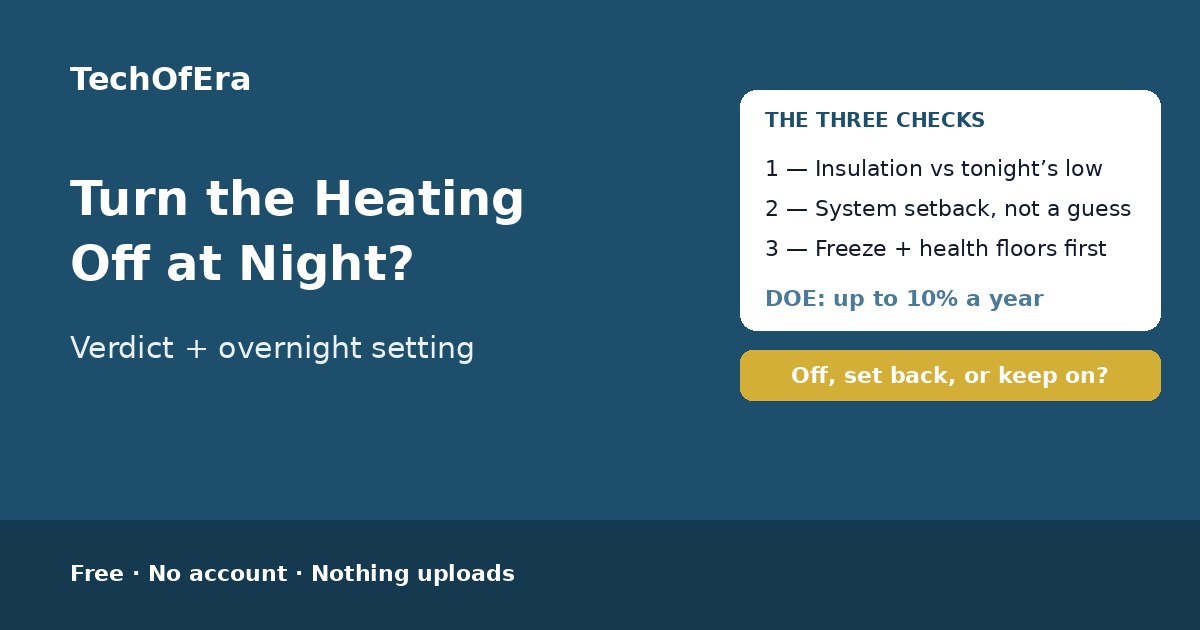
Should you turn the heating off at night?

Everyone says something different — switch it off and save, leave it on low, never go below 18°C — and the honest answer is that it depends on your home. The US Department of Energy says a 7–10°F setback for 8 hours a day can save as much as 10% a year — but a heat pump with a big drop can trigger costly backup heat, and a freezing night with pipes in the loft can end in burst pipes. Enter your insulation, tonight's low, your system and who lives there, and this checker scores your home, names the overnight setting, and tells you whether to switch off, set back, or keep it on low — free, in your browser, nothing uploads.

  • DOE 10% setback saving
  • Heat-pump trap caught
  • Freeze and health floors
  • Free, no account, nothing uploads
Should you turn the heating off at night? Check it in seconds.

Check whether to switch the heating off tonight

Try a preset:
0 of 6 answered

Your result

Answer the questions Your verdict appears here as you answer.
Recommended action

Answer the questions above and the recommended action will appear here.

Blockers

Things that do not fit

Things to check

Still to confirm

What to do next

    Your result summary


    Answer the questions above — the verdict updates live.

    Privacy you can verify, not just trust

    Checking whether to switch your heating off by uploading your home's details to a website would be backwards — the check should never be the leak. This one can't: your answers are checked with plain JavaScript on your device, and they never leave the device — the only third-party requests are the site's own analytics, which count page views. Don't take our word for it:

    New cross-origin requests during use: 0
    1. Press F12 to open developer tools, then the Network tab.
    2. Answer a question above. Watch: apart from the site's analytics, nothing new is requested — no uploads, and no data ever leaves your device.
    3. Extra credit: disconnect your internet after this page loads — the checker still works.

    How the heating-at-night check works

    The US Department of Energy says you can save as much as 10% a year on heating and cooling by turning your thermostat back 7–10°F for 8 hours a day — roughly 1% for each 1°F you set back over an eight-hour stretch. A cooler house also loses heat to the cold outside more slowly, so the longer it stays cooler, the more you save. But the right move depends on your home: a furnace handles a deep setback, a heat pump only a small one, and a freezing night with pipes in the loft is a different decision from a mild night in a well-insulated home. This checker combines six clues — how well your home holds heat, how cold it is outside tonight, what heats your home, your daytime temperature, what you plan to do, and whether you get morning condensation or damp — plus who lives there, and gives you a score out of 100, a verdict, and the overnight setting for your system.

    To use it:

    1. Say how well your home holds heat. If the house stays warm for hours after the heating goes off, it holds heat well. If it feels cold first thing in the morning and takes ages to warm up, it does not — and switching off means a cold morning and a long catch-up heat-up.
    2. Say how cold it is outside tonight. Check tonight's forecast low: above 5°C (41°F) is mild, 0–5°C (32–41°F) is cold, and below 0°C (32°F) is freezing — when pipes are at risk.
    3. Say what heats your home, and your daytime temperature. The system decides how far you can set back — a furnace 7–10°F, a boiler 3–5°F, a heat pump 2–4°F, underfloor heating almost nothing — and the daytime setting decides the overnight number.
    4. Say what you plan to do, and whether you get morning condensation or damp. Letting the house go cold overnight makes condensation worse, and condensation feeds mould — so a home with damp spots needs the heating on low, not off.
    5. Tick who lives here. A baby, someone 65 or over, or someone with a cold-sensitive health condition needs 18°C overnight, per the World Health Organization. Pipes in unheated spaces need at least 13°C (55°F), per the American Red Cross.

    What makes this checker different

    The pages that rank for this search are guides — a long article that tells you the Department of Energy's 10% figure and lists the setbacks by system, and a UK guide that tells you it depends on your home. Neither one asks how well your home holds heat, how cold it is tonight, what heats it, or who lives there, and neither one tells you the overnight setting to put on your thermostat. There is no free, standalone checker that takes your insulation, tonight's low, your system, your daytime temperature, your plan, your morning damp, and your household — and gives you a score, a verdict (switch off, set back, keep on low, or do not switch off), and the overnight setting for your exact home. This page is that answer: six questions, an instant verdict for tonight, the blockers named, and the next steps. It is a self-assessment, so it says plainly what it cannot know: it cannot measure your rooms, and where freezing pipes or vulnerable people are involved it says keep the heating on instead of switching off.

    When is this the right check?

    When the heating bill arrives and you are wondering whether switching off overnight would actually save anything — because the saving is real, about 10% a year for a deep setback, but only if your system can recover from it. When you have a heat pump and the advice online contradicts itself — because a big drop can trigger the backup heat and cancel the saving, and this checker catches that trap. When it is freezing outside and you are not sure whether switching off risks the pipes — because it does, if the pipes run through unheated spaces, and this checker says so. And when someone vulnerable sleeps in the house — because 18°C is a health floor, not a preference, and this checker holds it.

    Honest limitations

    A self-assessment, not a survey

    This checker cannot measure your rooms, test your insulation, or know how cold your pipes get. It cannot check whether your pipes have frozen before, how draughty your home really is, or what your heating system can do. If your home drops below 15°C overnight, or pipes have frozen before, get a heating engineer in.

    The score is a guide, not a diagnosis

    A score of 92 does not mean switching off is free, and a score of 58 does not mean your home is broken. The score weighs the insulation, the night temperature, the system, the damp and who lives there together — but only a proper inspection can say what is actually wrong with a house.

    The saving is an estimate, not a promise

    The Department of Energy's 10% figure is for a typical home with a 7–10°F setback for 8 hours a day. Your saving depends on your insulation, your system, your tariff and how cold the night is — this checker quotes the official estimate and says which band you are in, not a number for your bill.

    Tonight's answer is not every night's

    The verdict changes with the forecast: a mild night can take a switch-off that a freezing night cannot. Re-run the checker when the weather changes, and do not treat one night's verdict as a rule for the whole winter.

    Heat pumps have their own rules

    A heat pump with a big overnight drop can trigger backup electric heat, which is expensive and can cancel the saving entirely. Keep the drop to 1–2°C unless your thermostat is a heat-pump model designed to handle setbacks — this checker says so, but it cannot check your thermostat for you.

    Rules from official sources, dated November 2026

    The rules here are the US Department of Energy thermostat guidance (as much as 10% a year for a 7–10°F setback for 8 hours a day), the World Health Organization Housing and Health Guidelines (18°C safe indoor minimum), and the American Red Cross pipe guidance (never below 55°F / 13°C), as they read in November 2026. Guidance changes: recheck with a professional if anything about your home changes.

    Frequently asked questions

    Should I turn my heating off at night or leave it on low?

    It depends on your home, the weather and your heating system. In a well-insulated home on a mild night, switching off is the cheapest option — a cooler house loses heat to the cold outside more slowly, so the longer it stays cooler, the more you save. In a draughty home, on a freezing night, or with a heat pump, a setback is better: a few degrees below your daytime setting, sized to your system. And if pipes run through unheated spaces on a freezing night, or a baby, someone 65 or over, or someone with a cold-sensitive health condition sleeps there, keep it on low — 18°C for vulnerable people, and never below 13°C (55°F) for the pipes. This checker takes your insulation, tonight's low, your system and who lives there and gives you the verdict for your exact home.

    How much money do you save by turning the heating down at night?

    The US Department of Energy says you can save as much as 10% a year on heating and cooling by turning your thermostat back 7–10°F for 8 hours a day, and roughly 1% for each 1°F you set back over an eight-hour stretch. Overnight is the easiest 8 hours to capture, because nobody notices the house is cooler while they are asleep under a blanket. A smaller setback saves a few percent. The saving is real, but it is an estimate for a typical home — your saving depends on your insulation, your system and how cold the night is, which is why this checker scores your home instead of quoting one number.

    What temperature should I set my heating to at night?

    It depends on your system. A gas or oil furnace handles a deep setback — 7–10°F (4–6°C) below your daytime setting, so about 14°C (57°F) if you keep the house at 19°C during the day. A boiler recovers slowly through radiators, so about 3–5°F (2–3°C) below. A heat pump only 2–4°F (1–2°C), unless the thermostat is designed for heat pumps. Underfloor heating holds nearly steady, at most 1–2°C below. And two floors apply whatever the system: 18°C (64°F) where a baby, someone 65 or over, or someone with a cold-sensitive health condition sleeps, per the World Health Organization, and never below 13°C (55°F) in freezing weather, per the American Red Cross, to keep pipes from freezing.

    Should I turn my heat pump down at night?

    Only a little. The US Department of Energy says setting back a heat pump in heating mode can make it run inefficiently, which can cancel out the savings — a big drop at night can trigger the backup electric heat when the house warms back up, and that backup heat is expensive. Keep the drop small, about 2–4°F (1–2°C), or hold the heat pump steady, unless your thermostat is a heat-pump smart thermostat designed to handle setbacks. This checker treats a heat pump with a full switch-off as the trap it is, and recommends a small setback instead.

    What is the lowest temperature I should keep my house at in winter?

    The World Health Organization names 18°C (about 64°F) as the safe indoor temperature for general populations in cold seasons, and says older people, children, and people with chronic illnesses, especially heart and lung disease, may need it warmer. The UK Met Office guidance is the same: heat your home to at least 18°C, particularly if you are 65 or over or have a health condition, and keep bedrooms at least 18°C overnight for those groups. For the building itself, the American Red Cross says never go below 55°F (13°C) in cold weather, to keep pipes from freezing. A healthy adult in a well-insulated home can let it fall to about 15°C (59°F) overnight, but below that the morning is cold and condensation gets worse.

    Is it bad to turn the heating off at night if someone elderly lives here?

    Yes — do not switch it off. The World Health Organization names 18°C (about 64°F) as the safe indoor minimum in cold seasons, and says older people may need it warmer; the UK Met Office says the same, and adds that bedrooms should stay at least 18°C overnight for people 65 and over or with pre-existing health conditions. The same applies to a baby or small child, and to anyone with a health condition affected by cold, such as heart or lung disease. Hold 18°C in their rooms and use the timer so the house is back to your daytime setting before anyone wakes — the saving from switching off is not worth the health risk.

    Does this checker give professional advice?

    No. This checker is a self-assessment: it runs your answers against the US Department of Energy, World Health Organization and American Red Cross guidance as it reads in November 2026, entirely in your browser with plain JavaScript, and nothing you enter leaves your device. A web page cannot measure your rooms, test your insulation, or know how cold your pipes get — it cannot check whether your pipes have frozen before, how draughty your home really is, or what your heating system can do — so it says plainly what still needs checking, and where freezing pipes or vulnerable people are involved it says keep the heating on instead of switching off. The only third-party requests are the site’s own analytics, which count page views. If your home drops below 15°C overnight, or pipes have frozen before, get a heating engineer in.