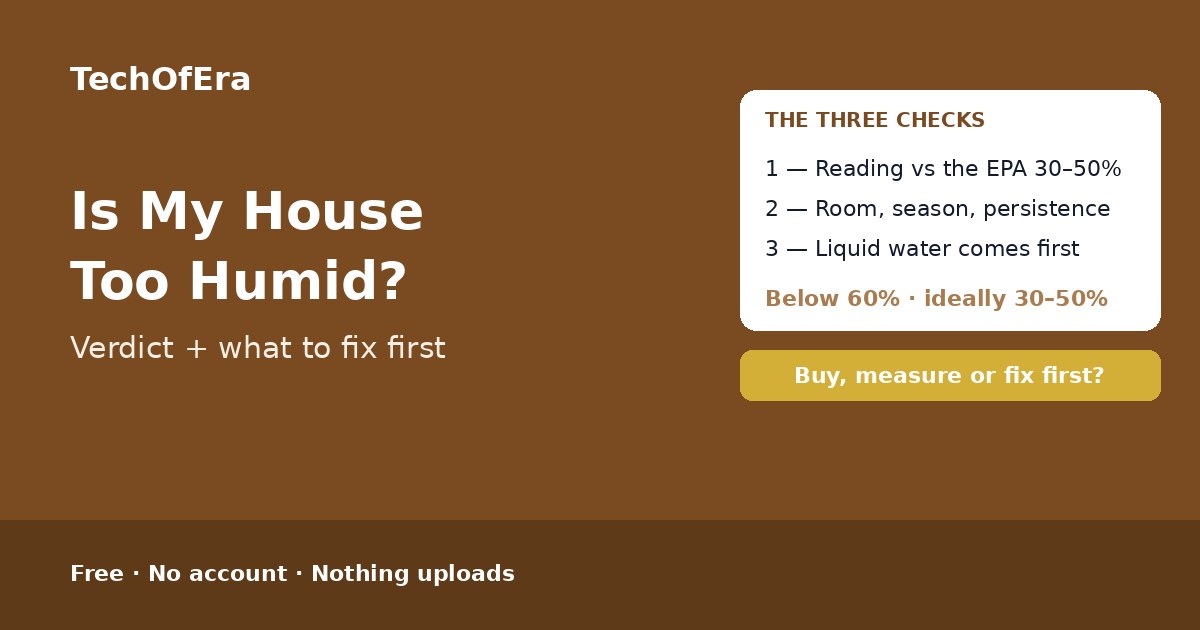
Is your house too humid?

The windows steam up, the basement smells musty, and a dehumidifier costs real money — but a stuffy afternoon is not proof you need one. The EPA says keep indoor humidity below 60%, ideally 30–50% — but no number on a guide tells you whether your home is damp, or what to fix first. Enter your hygrometer reading, the room and the signs, and this checker scores your home, names the cause, and tells you whether to buy, measure, or fix the water first — free, in your browser, nothing uploads.

  • EPA 30–50% range
  • Leak check comes first
  • Basement and bathroom rules
  • Free, no account, nothing uploads
Is your house too humid? Check it in seconds.

Check whether your home is too humid

Try a preset:
0 of 6 answered

Your result

Answer the questions Your verdict appears here as you answer.
Recommended action

Enter your humidity reading above and the recommended action will appear here.

Blockers

Things that do not fit

Things to check

Still to confirm

What to do next

    Your result summary


    Answer the questions above — the verdict updates live.

    Privacy you can verify, not just trust

    Checking whether your house is too humid by uploading your home's readings to a website would be backwards — the check should never be the leak. This one can't: your answers are checked with plain JavaScript on your device, and they never leave the device — the only third-party requests are the site's own analytics, which count page views. Don't take our word for it:

    New cross-origin requests during use: 0
    1. Press F12 to open developer tools, then the Network tab.
    2. Answer a question above. Watch: apart from the site's analytics, nothing new is requested — no uploads, and no data ever leaves your device.
    3. Extra credit: disconnect your internet after this page loads — the checker still works.

    How the humidity check works

    The US Environmental Protection Agency recommends keeping indoor relative humidity below 60%, and ideally between 30% and 50%. Below 30% the air is too dry — static, dry skin, sore throats — and above 60% it is damp enough for mould to grow and for dust mites to thrive. But a number is not a verdict: a reading of 62% after a shower is normal, a reading of 58% that never falls is not, and a dehumidifier in a leaking room is a bucket under a tap that is still running. This checker combines six clues — your hygrometer reading, the room, the season, how long the dampness lasts, whether liquid water is getting in, and the ventilation — plus the damp signs you can see and smell, and gives you a score out of 100, a verdict, and the recommended action.

    To use it:

    1. Enter your humidity reading. Read a digital hygrometer in the room that worries you — place it away from windows, vents and showers, and read it morning and evening for several days. If you have no hygrometer, tick the signs below instead and the checker scores those.
    2. Pick the room. Basements and bathrooms run damper than living rooms, so the room changes the answer: a basement that reads higher than the rooms above it is a common pattern, not a surprise.
    3. Say what season it is, and how long the dampness lasts. Winter condensation and summer humidity have different causes, and a one-off spike after a shower is normal — dampness that never clears is not.
    4. Say whether liquid water is getting in. A leak, standing water or seepage decides the whole verdict: a dehumidifier cannot fix liquid water, so the checker says fix the source first instead of recommending a dehumidifier.
    5. Say how the ventilation is, and tick any damp signs. Exhaust fans during cooking and showers are the free fix. And what you can see and smell — condensation, a musty smell, mould, damp spots — is the check the number cannot give you.

    What makes this checker different

    The pages that rank for this search are guides — a long article that tells you the EPA range and lists the signs, and a brand page that tells you when to run its own dehumidifier. Neither one asks what your reading is, which room it is, how long it lasts, or whether liquid water is getting in, and neither one tells you whether to buy, measure, or fix the water first. There is no free, standalone checker that takes your hygrometer reading, room, season, persistence, water entry, ventilation and damp signs — and gives you a score, a verdict (fine, monitor, dehumidifier, too dry, or fix the source first), and a recommended action built on your own reading. This page is that answer: six questions, an instant verdict for your exact home, the blockers named, and the next steps. It is a self-assessment, so it says plainly what it cannot know: it cannot measure your rooms, and where liquid water is getting in it says so instead of recommending a dehumidifier.

    When is this the right check?

    When the windows steam up every morning and you are not sure whether that is normal winter condensation or a damp house — because the season and the persistence are what tell them apart. When the basement smells musty and a dehumidifier costs real money — because a reading that stays above 60% for a week is the buy signal, and a reading that settles in the 30–50% range means you do not need one. When you can see mould and are wondering whether a dehumidifier will fix it — because it will not, until the moisture source is fixed, and this checker says so. And when the reading is under 30% and the air feels dry — because a dehumidifier would make that worse, and this checker says so instead of recommending one.

    Honest limitations

    A self-assessment, not a survey

    This checker cannot measure your rooms, see your walls, or test for mould. It cannot check whether a leak is hidden, how bad the mould is, or what your walls are made of. If mould covers a large area, or the damp never clears, get a professional in.

    The score is a guide, not a diagnosis

    A score of 92 does not mean your home is perfect, and a score of 58 does not mean it is ruined. The score weighs the reading, the signs, the room, the season and the persistence together — but only a proper inspection can say what is actually wrong with a house.

    One reading is not a verdict

    A brief spike after cooking or a shower is normal, and a single high reading on a rainy day proves nothing. How long the humidity stays high matters more than any one number — which is why the checker asks how long the dampness lasts, and tells you to measure for a week when the answer is borderline.

    Basements have their own rules

    A basement sits against damp ground, so it runs damper than the rooms above it — and a dehumidifier down there needs a drain hose or a condensate pump, or you will be emptying the tank every day. The checker scores basements with that in mind, but it cannot tell you whether your basement needs tanking.

    Winter condensation is often ventilation

    In the heating season, warm moist indoor air hitting cold window glass condenses — and that is often a ventilation problem, not a dehumidifier problem. Open a window briefly each day, run the exhaust fans, and keep furniture a few centimetres off cold outside walls before buying anything.

    Rules from official sources, dated November 2026

    The rules here are the US Environmental Protection Agency indoor humidity and mould guidance — keep indoor relative humidity below 60%, ideally 30–50%, and dry wet materials within 24–48 hours — as they read in November 2026. Guidance changes: recheck with a professional if anything about your home changes.

    Frequently asked questions

    What humidity level is too high indoors?

    The US Environmental Protection Agency recommends keeping indoor relative humidity below 60%, and ideally between 30% and 50%. Above 60% the air is damp enough for mould to grow and for dust mites to thrive, and below 30% it is too dry — static, dry skin and sore throats. A single reading over 60% is not the whole story, though: what matters is whether the reading stays high for days. This checker scores your reading against the EPA range, then weighs the signs, the room, the season and whether liquid water is getting in.

    Do I need a dehumidifier if my humidity is 60%?

    Not necessarily — 60% is the EPA ceiling, not an automatic buy signal. If the reading is 50–60%, log it morning and evening for a week, including a rainy day, and fix the free things first: run the exhaust fans during cooking and showers and for 15–20 minutes after. If the reading stays above 60% for the week, or the damp signs pile up, a dehumidifier set to hold 45% is the right next step. If it settles in the 30–50% range, it was a passing spell and you do not need one.

    How do I measure humidity in my house?

    With a digital hygrometer — a small device that costs about the price of a takeaway coffee and is sold in most hardware stores. Place it in the room that worries you, away from windows, supply vents, exterior doors and showers, and read it morning and evening for several days, including a rainy day or another period when the room normally feels damp. Measure basements and living areas separately, because humidity varies a lot between floors. A brief spike after cooking or a shower is normal — how long the reading stays high matters more than any single number.

    Can a dehumidifier fix a leak?

    No. A dehumidifier controls water vapour in the air — it cannot repair a leak, remove standing water, correct poor drainage, or clean up existing mould. Running one in a leaking room is a bucket under a tap that is still running. Find where the water is coming from and fix it first, dry the wet materials within 24–48 hours, and only then re-check the humidity before deciding about a dehumidifier. This checker treats liquid water as a blocker and says so instead of recommending a dehumidifier.

    Why is my basement more humid than the rest of the house?

    Basements and crawl spaces sit against damp ground, so they run damper than the rooms above them — a basement that reads higher than the living areas above it is a common pattern, not a surprise. Ground moisture, poor drainage and short air-conditioning cycles all add to it. In a basement, a dehumidifier with a drain hose or a condensate pump saves emptying the tank every day, and it should be set to hold 45% relative humidity until the reading holds in the 30–50% range for a week.

    Is 30% humidity too low indoors?

    Yes — below 30% relative humidity the air is too dry, and a dehumidifier would make it worse. Dry indoor air brings static shocks, dry skin, sore throats and nosebleeds, and it is most common in the heating season, when winter heating dries the air out. If dry air is the problem, that is humidifier territory: a bowl of water near a radiator is the free first try, or a humidifier set to hold 40%. This checker says so instead of recommending a dehumidifier when the reading is under 30%.

    Does this checker give professional advice?

    No. This checker is a self-assessment: it runs your answers against the US Environmental Protection Agency indoor humidity and mould guidance as it reads in November 2026, entirely in your browser with plain JavaScript, and nothing you enter leaves your device. A web page cannot measure your rooms, see your walls, or test for mould — it cannot check whether a leak is hidden, how bad the mould is, or what your walls are made of — so it says plainly what still needs checking, and where liquid water is getting in it says so instead of recommending a dehumidifier. The only third-party requests are the site’s own analytics, which count page views. If you can see mould over a large area, smell damp that never clears, or suspect a hidden leak, get a professional in.