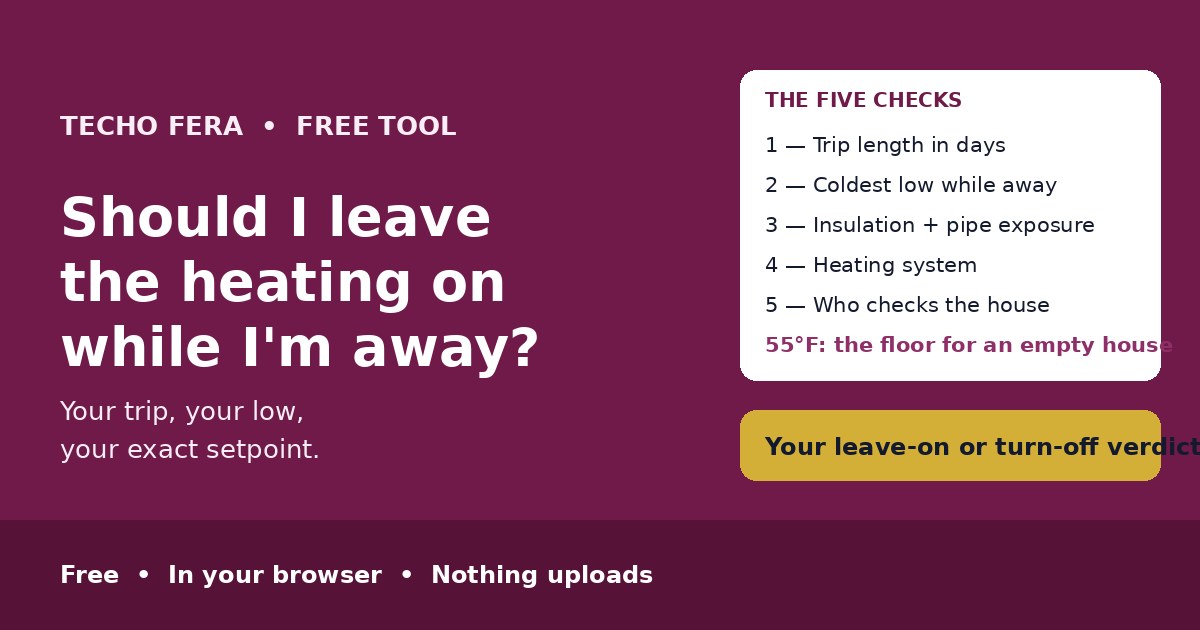
How the heating-away check works
Water freezes at 32°F, but a pipe does not freeze the moment the air hits 32°F. What matters is how cold it gets, how long it stays there, and whether cold air can reach the pipe — and a house sitting empty for days is different from a house with people in it, because nobody is there to notice the heat failing. This checker starts from the freeze-protection floor for your region — 55°F (13°C) in the United States, about 12°C in the United Kingdom and Europe — and adds the margins your house needs: poor insulation, pipes in unheated spaces, a long absence, and nobody checking the house. It caps the setpoint at your normal setting of 68°F, and it floors a heat pump at 63°F, because a heat pump set back further than 4 to 5°F calls for backup strip heat that can cancel the whole saving. If the coldest low stays warm enough — above 54°F, or above 50°F for a short trip — it says you can switch the heating off, and it still tells you to leave the boiler powered so its frost protection works. It also estimates what leaving the heating on low saves you, from the US Department of Energy rule of thumb and your own bill and average outdoor temperature, and it says plainly when it cannot estimate that because you left a number out.
To use it:
- Say how long you are away. A weekend trip and a month away are different decisions: the longer the house sits empty, the more a small margin matters, and the more a burst pipe would cost before anyone notices.
- Enter the coldest low expected while you are away. The coldest overnight low in the days you will be gone, from your weather app — not tonight's low if you leave later, and not the daytime high. This is the number the whole verdict turns on.
- Say how the house is insulated and where the pipes run. Draughty houses cool faster, and pipes in a crawl space, garage or attic sit several degrees colder than the thermostat reads. Tick every place that applies — or "only inside heated walls" if none of them do.
- Say what heats the house and where it is. A heat pump, a gas boiler and a furnace each have their own rule, and the floor is 55°F in the United States and about 12°C in the United Kingdom and Europe.
- Say whether you will shut off the water and whether anyone will check the house. Shutting off the main does not stop pipes freezing, but it stops a burst pipe flooding the house for weeks — and a neighbour checking once changes the risk more than any thermostat setting.
- Read the verdict — and the setpoint breakdown. The verdict tells you whether to leave the heating on or turn it off; the breakdown shows every margin that went into the setpoint, so you can see which part of your house is driving the number. The saving estimate appears when you enter your average outdoor temperature and your monthly bill.
What makes this checker different
The pages that rank for this search are guides — a boiler company's holiday advice, a plumber's frost checklist, an energy guide, a regional HVAC company's vacant-home page. Every one of them gives you the same rule of thumb, 55°F or 12°C, and leaves you to judge your own house. The one calculator that exists answers a different question: it works out what a daily setback saves while you sleep or are out for the day, not what to do with a house empty for a week in a cold snap. None of them asks how long you are away, how cold it gets while you are gone, how your house is insulated, where each pipe runs, what heats the house, or whether anyone will check on it — and none of them gives you the exact thermostat setting, the margins behind it, or what the saving is worth in money. This page is that answer: ten questions, a verdict, a setpoint with its breakdown, and a saving estimate — and it says plainly what it cannot know, instead of guessing.
When is this the right check?
When you are going away in cold weather and the usual advice — "leave it on low" — does not tell you how low. When the trip is long, a week or more — because a burst pipe that nobody notices for a week is a different disaster from one found the next morning. When your house has pipes in unheated spaces, or poor insulation — because those are the houses the generic 55°F rule gets wrong. When you heat with a heat pump — because the setback rules are different, and a deep setback can cost more than it saves. And when you are torn between switching the heating off to save money and leaving it on to protect the house — because the checker prices both sides of that trade instead of picking one for you.
Honest limitations
A planning aid, not heating advice
This checker cannot see your pipes, your insulation, your forecast or your boiler. It cannot tell you whether a specific pipe is already frozen, or whether your house has a draft you have not found. If a faucet runs weakly when you get home, or you can see frost on a pipe, call a plumber.
The 55°F floor is a minimum, not a guarantee
The American Red Cross floor of 55°F is for the air near the thermostat. Pipes in a loft, a crawl space or an outside wall sit several degrees colder than the rooms — which is why the checker adds margins for exposed pipes, poor insulation and long absences, and why it caps the setpoint at your normal setting rather than below it.
Forecasts change
The verdict is only as good as the coldest low you enter. Forecasts move, and a low that drops by five degrees before you leave changes the answer. Recheck the forecast on the day you travel, and if it drops, raise the setpoint before you go.
Frost protection protects the boiler, not the pipes
A boiler's built-in frost protection keeps the boiler itself from freezing — it does not keep the pipes around your home warm, and it only works if the boiler stays switched on. Never switch a boiler off at the mains in freezing weather, and do not rely on frost protection as a substitute for background heat.
Shutting off the water does not stop freezing
Closing the main water supply limits the damage if a pipe bursts, because the house stops feeding water into the break. It does not keep pipes from freezing — water still sits in the lines, and that water can still freeze and split a pipe if the house gets cold enough. The heat is what prevents freezing.
Rules from the Red Cross, DOE and others, dated November 2026
The rules here are the published heating and freeze-prevention rules as they read in November 2026: the American Red Cross on the 55°F floor for an empty house, the US Department of Energy on setback savings and the heat-pump rule, Worcester Bosch boiler manuals and the Association of British Insurers on the 12°C setting, Energuide on the 12°C damp line, and the 1996 University of Illinois study on the 20°F alert threshold. Guidance changes: recheck with those sources if anything about your plans changes.