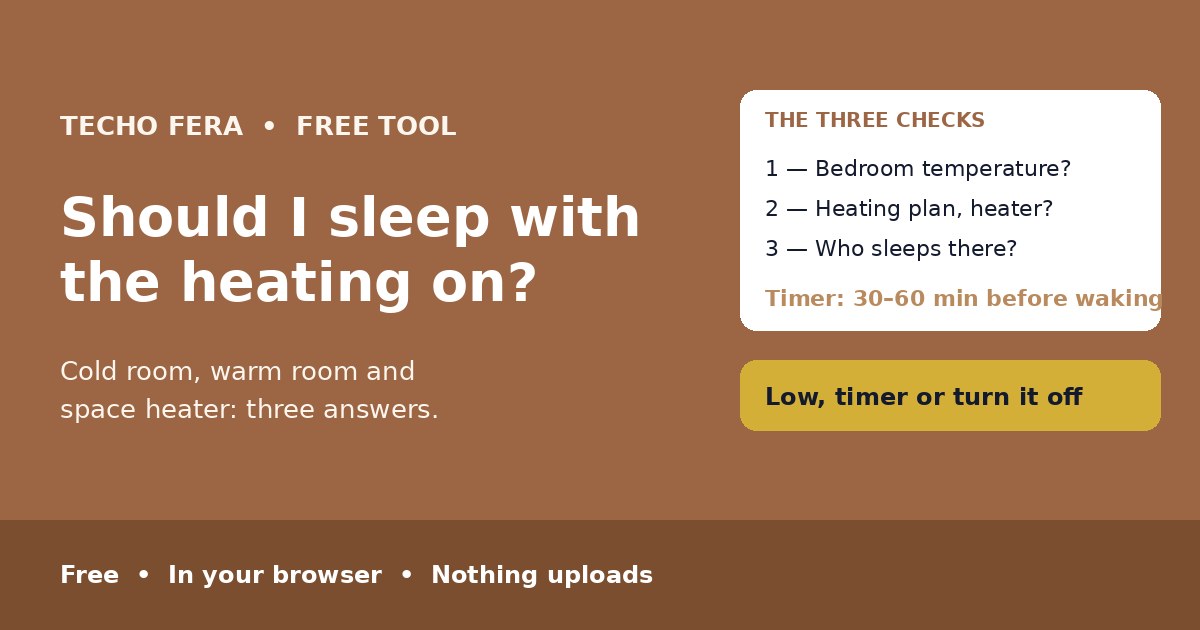
How the heating-on check works
The rule is the temperature, not the habit. The ideal bedroom for sleep is 60–67°F (15.6–19.4°C), and 18°C is the WHO minimum for healthy adults. Below 15°C is too cold for most people; above 22°C is too warm. Older adults need it warmer — about 20°C (68°F) — and a baby's room should stay at 16–20°C. For most bedrooms the expert answer is a timer: heat off overnight, on again 30–60 minutes before you wake at about 18°C (64°F). This checker asks seven questions — the bedroom temperature at bedtime, what the heating does overnight, the heater type, who sleeps there, dry-air signs, damp signs, and what matters most — and gives one verdict: keep it on low, use a timer, turn it down or off, fix the air first, or do not sleep with that heater on.
To use it:
- Pick the bedroom temperature at bedtime. Under 15°C, 15–17°C, 18–19°C, 20–22°C or over 22°C. The temperature decides the answer — a cheap room thermometer on the bedside table gives you the number in one night. If you have not measured it, the checker says so instead of guessing.
- Say what the heating does overnight. Off, on low, on at daytime temperature, or on a timer. Your plan is compared with the recommendation — on at daytime temperature all night is always the wasteful part of the plan.
- Say what heats the bedroom. Central heating, heat pump, electric panel or storage heater, a space heater, underfloor heating, or no heater. The heater type changes the safety rules — a space heater must be switched off before you sleep, and a heat pump should stay steady.
- Say who sleeps there. A healthy adult, an older adult of 65 or over, a baby under 1, a child, or someone with asthma, allergies or sleep apnoea. Babies and older adults need it warmer, and dry air hits breathing conditions hardest.
- Say whether the air is dry in the morning. None, a dry throat or nose, or dry skin, static shocks or nosebleeds. Strong dry-air signs with the heat on all night mean the heat is running too hard or too long.
- Say whether there is condensation or damp. None, condensation on the windows, or damp patches or mould spots. Warm air holds moisture that condenses on cold windows — and that moisture is what mould grows on.
- Say what matters most. Sleeping well, saving money, or both. The saving estimate only shows when money is part of the answer — and a timer is usually the cheapest way to get it.
The temperatures at a glance
| Bedroom at bedtime | Verdict | Why |
|---|---|---|
| Under 15°C (under 59°F) | Keep it on low | Below the 18°C WHO minimum — switching the heat off leaves you shivering |
| 15–17°C (59–63°F) | Use a timer | Inside the sleep band — cool enough to fall asleep, warm before waking |
| 18–19°C (64–66°F) | Use a timer | The optimum band — the heat only needs to run for the morning |
| 20–22°C (68–72°F) | Turn it down or off | Already above the sleep band — more heat dries the air and wastes money |
| Over 22°C (over 72°F) | Turn it down or off | Too warm to sleep well — and too hot for a baby under 1 |
| Older adult (65+), any cool room | Keep it on low | Older adults need about 20°C (68°F), warmer than the sleep band |
| Baby under 1, 16–20°C | Keep it on low | The nursery range — warm enough, never hot |
| Space heater, any plan but off | Do not sleep with it on | CPSC: switch space heaters off before bed, never leave one running while you sleep |
What makes this checker different
The pages that rank for this search are guides — Tom's Guide twice, and space-heater safety guides that answer a different question. Every one of them gives you the same static answer — "turn it down, use a timer" — and leaves you to work out what it means for your room, your heater and the people sleeping in it. None of them asks what temperature your bedroom actually is, what heater you have, whether a baby or an older adult sleeps there, or whether the air is dry or the windows are wet in the morning — and none of them tells you what to do next when the answer is bad. There is no free, standalone checker that takes a bedroom temperature, a heating plan, a heater type, a sleeper, dry-air and damp signs and a priority and gives you one verdict with the reason, the timer setting and the saving estimate. This page is that answer: seven questions, an instant verdict for your exact bedroom, the blockers named, and the next steps. It is general home-comfort guidance, so it says plainly what it cannot know: it cannot measure your room or know your health, and where the guidance is thinner — the actual temperature, the actual humidity — it tells you to measure it instead of guessing.
When is this the right check?
When you are lying in bed wondering whether to leave the heating on — because a cold room, a warm room and a space heater need three different answers, and guessing wrong means either a bad night or a wasted bill. When you wake up with a dry throat or nosebleeds — because the checker tells you whether the heat is the cause and what to change. When the windows are wet in the morning — because heating alone will not dry a damp room, and the checker says so. When a baby or an older adult sleeps in the room — because their temperature needs are different from yours, and the checker adjusts for them. And when the heating bill arrives — because the checker puts a number on the overnight saving, labelled as its own estimate, so you can decide whether the timer is worth setting.
Honest limitations
General guidance, not medical advice
This checker cannot measure your room or know your health. It cannot tell you how cold your bedroom actually is, how humid the air is, or whether your breathing condition changes the answer — only a thermometer, a hygrometer and your doctor can. If you have a breathing condition, are pregnant, or care for a baby or an older adult, ask your doctor or health visitor when in doubt.
Not sure means the cautious answer
If you have not measured the bedroom temperature, the checker refuses to guess — it tells you to measure it. A cheap room thermometer on the bedside table gives you the answer in one night, and the verdict is only as good as the number you enter.
The saving is an estimate, not a bill
The saving figure is the checker's own estimate, built from the US Department of Energy's 1%-per-degree rule and the $180-a-year US example the guides cite. Your bill depends on your tariff, your insulation and your heating system — a heat pump, for example, saves less from big overnight setbacks than a gas boiler does.
Your house is not the average house
Insulation, draughts, window size and which way the room faces all change how fast a bedroom cools overnight. A well-insulated room holds its temperature; a draughty one does not. If the room cools fast, the timer needs a longer run before you wake.
Heating alone will not fix damp
If the windows are wet or there are mould spots, turning the heat up makes it worse, not better — warm air holds the moisture that condenses on cold surfaces. Ventilate the room, fix the damp source, and wipe the mould off. If the damp keeps coming back, get a professional in.
Rules from Sleep Foundation, Tom's Guide and the CPSC, dated November 2026
The rules here are the Sleep Foundation, Tom's Guide, US Department of Energy, WHO, Lullaby Trust and CPSC guidance as it reads in November 2026: the 60–67°F sleep band, the 18°C minimum, the 16–20°C nursery range, the 30–60 minute timer setting, and the CPSC space-heater rule. Guidance changes: recheck if anything about your home or health changes.