How the floss check works
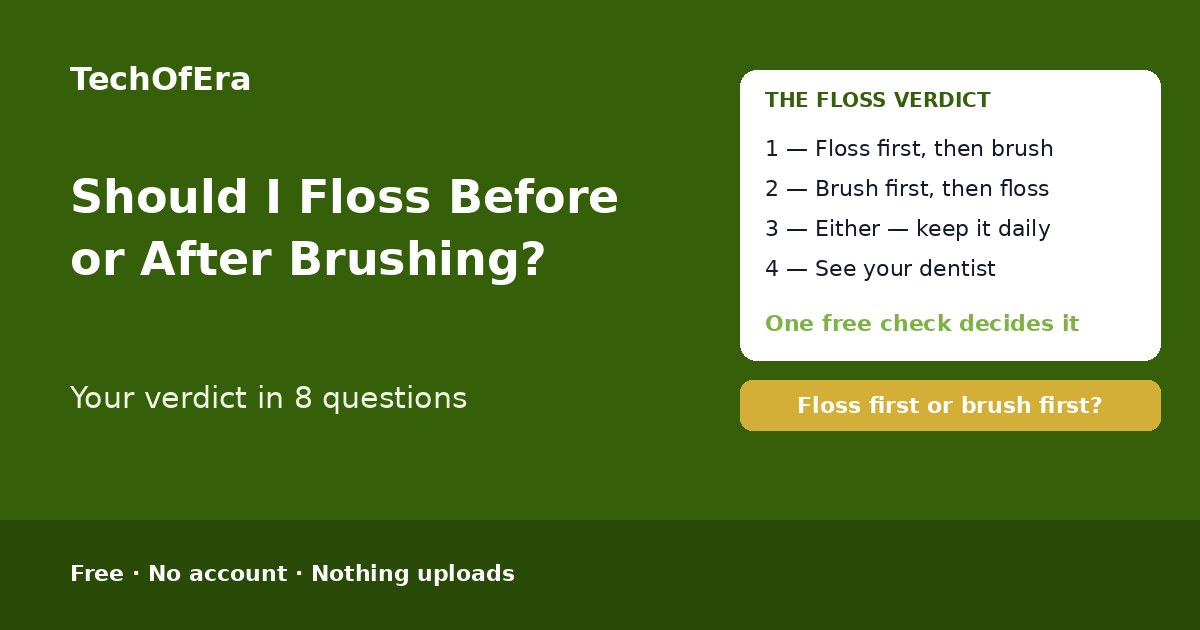
Flossing before or after brushing is a genuine argument, not a settled rule — and the experts disagree. A small 2018 study in the Journal of Periodontology found flossing first removed more plaque between the teeth and left more fluoride on them; the Cleveland Clinic, Northwell Health and the Oral Health Foundation all point the same way. But an American Dental Association spokesperson argues the other way: brush first, so the floss can target the microscopic pieces the brush leaves behind. The ADA itself takes no official position — it only says to floss once a day. So the right order depends on your mouth: braces, aligners, implants, a bridge, bleeding gums, mouthwash, how much time you have, and what you clean between your teeth with. This checker weighs all eight and gives you a verdict: floss first, brush first, either order, or see your dentist.
To use it:
- Say whether you have braces or aligners. No braces or aligners, fixed braces, or clear aligners. Braces and aligners trap food, so the brush usually goes first — then floss threaders or interdental brushes do the fine cleaning.
- Say whether you have implants, a bridge or crowns. No implants, bridge or crowns, dental implants, a bridge, or crowns. Implants and bridges need interdental cleaning after brushing: a toothbrush cannot reach under a bridge or around an implant.
- Say whether your gums bleed when you floss. Never, sometimes, often, or that you do not floss so you would not know. Gums that bleed often need a dentist, whatever the order — and that outranks everything else in the verdict.
- Say whether you use mouthwash. No mouthwash, fluoride mouthwash after brushing, mouthwash before brushing, or antiseptic mouthwash. Fluoride mouthwash works best after brushing, with a 30-minute gap so the toothpaste fluoride gets its time first.
- Say how much time you have. Plenty, two to three minutes, or under a minute. Two to three minutes covers floss plus a two-minute brush; under a minute is not enough for both done properly, which is why the order matters less than doing it at all.
- Say whether string floss is easy for you to hold. Fine, fiddly, or that you already use picks or holders. If floss feels fiddly, picks or interdental brushes clean just as well — the tool that gets used beats the tool that stays in the drawer.
- Say what you clean between your teeth with. String floss, floss picks, interdental brushes, a water flosser, or nothing. Brushing alone does not reach between the teeth, so nothing is the one answer that changes the verdict on its own.
- Say whether you rinse with water after brushing. Spit and do not rinse, rinse with water, or that you have never thought about it. Rinsing washes the fluoride in your toothpaste away — spit instead, and wait 30 minutes before any mouthwash.
The four verdicts, and what each one means
Floss first, then brush
The best-supported order for a straightforward mouth: floss first to loosen the plaque and food between your teeth, then brush for two minutes so the fluoride in your toothpaste can reach the cleaned surfaces. That is what the 2018 Journal of Periodontology study found, and the order the Cleveland Clinic, Northwell Health and the Oral Health Foundation point to.
Brush first, then floss
For braces, aligners, implants or a bridge: brush first to clear the bulk food and plaque, then clean between your teeth with floss threaders or interdental brushes, so the fine cleaning targets what is actually left. That is the American Dental Association spokesperson's reasoning — brush first, then floss the microscopic pieces.
Either order — keep it daily
When the habit itself is the problem — you do not clean between your teeth at all yet, or you have under a minute to spare — the order is not what matters. Only about 41% of Americans floss at least once a day, and 20% never floss. Pick the order you will actually stick to, and do it every day.
See your dentist — then floss first
Your gums bleed most times you floss, which can be an early sign of gum disease — and that needs a professional look, whatever order you floss in. Book a dentist appointment, and meanwhile keep flossing gently every day: bleeding often eases once daily cleaning becomes a habit, but if it does not settle within a couple of weeks, the dentist needs to see it sooner.
Which order for which mouth
The reference table the checker works from — your situation on the left, the order it points to on the right:
| Your situation | Recommended order | Why |
|---|---|---|
| Straightforward mouth, healthy gums | Floss first, then brush | The 2018 study: more plaque removed, more fluoride left on the teeth |
| Fixed braces | Brush first, then floss threaders | Brackets trap bulk food; the brush clears it before the fine cleaning |
| Clear aligners | Brush first, then floss | Plaque sits against the teeth under the aligners; brush first, floss before putting them back in |
| Dental implants | Brush first, then interdental brushes | The implant–gum join needs careful cleaning after the bulk is cleared |
| A bridge | Brush first, then threaders | A toothbrush cannot reach under the bridge; threaders clean the gap after brushing |
| Crowns (caps) | Floss first, then brush | Crowns follow the same routine as natural teeth |
| Gums bleed often | See your dentist first | Bleeding most times can be an early sign of gum disease |
| Gums bleed a little, sometimes | Floss first, then brush | Keep flossing gently daily; bleeding from new flossing usually settles in a week or two |
| Under a minute to spare | Either — keep it daily | The habit matters far more than the order |
| Do not clean between your teeth yet | Either — start today | Doing both daily beats the perfect order done never |
| Fluoride mouthwash user | Floss, brush, wait 30 minutes, then mouthwash | Mouthwash straight after brushing washes the toothpaste fluoride away |
| Water flosser user | Brush first, then water floss | Flush out what the brush loosened, following the manufacturer's guidance |
Your step-by-step routine
Whatever the verdict, this is the routine the checker is aiming for — the plan it builds from your answers:
- Clean between your teeth first — unless you have braces, aligners, implants or a bridge. Floss, picks or interdental brushes, one gap at a time. With string floss, use about 45 cm (18 inches), curve it into a C-shape around each tooth, and slide it up and down. With braces, implants or a bridge, brush first and do this step second.
- Brush for two minutes with fluoride toothpaste. Soft bristles, gentle short strokes near the gumline. Two minutes is the minimum the dental guidance points to — and most people brush for far less than they think.
- Spit out the excess toothpaste — and do not rinse. Rinsing with water washes the fluoride away before it has done its work. Spit, and let the fluoride stay on your teeth.
- Wait 30 minutes before mouthwash. If you use a fluoride or antiseptic mouthwash, use it after the wait, not straight after brushing. The same 30-minute rule applies to rinsing with water.
- Do it every day — once is enough. The American Dental Association says to floss once a day. If you only have time for one full routine a day, do it in the evening, before bed, so the plaque does not sit on your teeth overnight.
- Watch for bleeding, and act on it. A little bleeding when you start flossing is normal and usually settles within a week or two. Bleeding most times, or bleeding that does not settle, means book a dentist appointment.
What makes this checker different
The pages that rank for this search are articles — a Healthline explainer, a GoodRx guide, a Health.com piece quoting an American Dental Association spokesperson, a Northwell Health dentist's routine, a Cleveland Clinic periodontist's walkthrough, and an Ask the Dentist article. They all answer the same question in words: floss first, or brush first. None of them asks whether you have braces, implants, bleeding gums, or a water flosser — and none of them gives you a verdict for your mouth. This page is the answer the articles do not give: eight questions, an instant verdict, the blockers named, and a routine built from your answers. It is a self-assessment, so it says plainly what it cannot know: it cannot see your teeth or your gums.
This checker also answers a different question from the How Often Should I Change My Toothbrush? Checker — that one is about when to replace the brush, this one is about the order of flossing and brushing. The two go together: a worn brush and the wrong order both leave plaque between your teeth.
When is this the right check?
When you have heard both answers — floss first from one dentist, brush first from another — and you want to know which one applies to you, because the answer genuinely changes with braces, implants and bleeding gums. When you have just had braces fitted, or an implant or a bridge, and your old routine no longer fits. When your gums bleed and you are not sure whether to keep flossing or stop. And when you have never flossed and you want the simplest possible start — because the checker will tell you the order matters less than the daily habit, and give you a routine you can actually stick to.
Honest limitations
A self-assessment, not dental advice
This checker cannot see your teeth or your gums. It cannot tell whether your gums need a dentist. If your gums bleed a lot, hurt, or look swollen, talk to a dentist.
The experts genuinely disagree
The 2018 study says floss first; an American Dental Association spokesperson says brush first; the Cleveland Clinic says "we don't yet know for sure". The checker follows the study for a straightforward mouth and the brush-first reasoning for braces, implants and bridges — but the difference between the two orders is small, and doing both daily matters far more.
The 2018 study was small
The Journal of Periodontology study compared the two orders in a small group of participants. It is the only study that directly compared them, and the checker says so rather than pretending the evidence is stronger than it is.
“Bleeding” is a judgement, not a measurement
Most people judge bleeding by eye, and "sometimes" and "often" can look alike. If you are not sure which one yours is, the checker treats sometimes as keep-flossing and often as see-your-dentist — and says so in the answer, rather than pretending it measured your gums.
One mouth at a time
This checker looks at one person's mouth at a time. It does not check the other people in the household, and it does not ask whether anyone in the house has gum disease — so run it once per person, and book a dentist for anyone whose gums bleed often.
Rules from official sources, dated November 2026
The rules here are the dental guidance from the American Dental Association, the NHS, the Oral Health Foundation, the Cleveland Clinic, Health.com, GoodRx and Northwell Health, and the 2018 Journal of Periodontology study, as they read in November 2026. Guidance changes: recheck with a dentist if anything about your mouth, your gums, or your health changes.