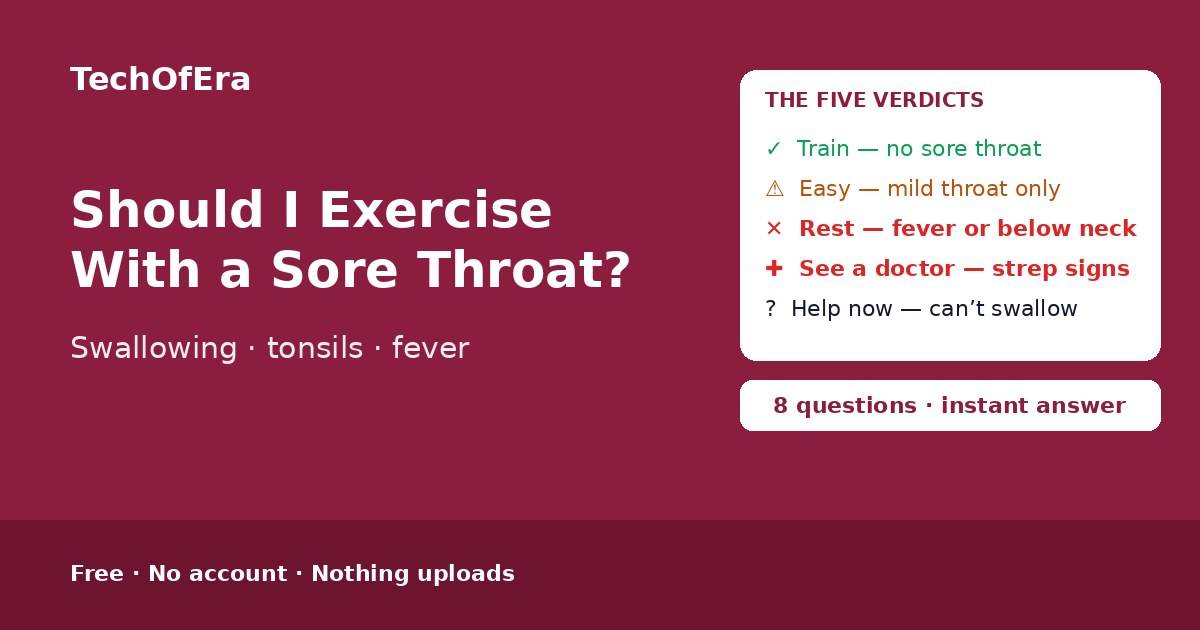
How to decide whether to exercise with a sore throat
A sore throat is a symptom, not a training category — and it is not the same question as a cold. A cold checker sorts symptoms by the neck: above the neck may allow light exercise, below the neck or whole-body means rest. That rule still applies, but a sore throat needs one extra step the generic version skips: check the throat itself. A mild scratchy throat with no fever is an above-the-neck symptom and light exercise is usually fine. A severe throat, white spots or pus on the tonsils, swollen glands at the front of the neck, pain when swallowing, a rash, or a throat that has not improved after 48 hours can mean strep throat or tonsillitis — which need a clinician and a test, not a workout. And two signs override everything: trouble breathing, or being unable to swallow your own saliva. Those are airway problems and need urgent medical help. This checker asks exactly what decides it.
To use it:
- Rate the throat. A tickle, a mild ache when swallowing, a sore throat with a hoarse voice, or a severe throat that really hurts to swallow are four different answers — and the severe one means see a doctor before you train.
- Check swallowing. Can you swallow food and drink normally? Does it hurt? Or can you barely swallow at all? Pain when swallowing is one of the signs CDC lists for strep throat. If you cannot swallow your own saliva and are drooling, get medical help now.
- Look in the mirror. With a light, look at your tonsils: are they red and swollen, and are there any white spots or pus? Feel the front of your neck for swollen, tender glands. White spots or swollen glands with fever point at strep — only a test can confirm it, but do not train on it.
- Take your temperature. Fever is the hard line: 38°C (100.4°F) or above means rest, whatever else is true. Feeling feverish is not a measurement — take your temperature before deciding, and do not use paracetamol or ibuprofen to make a fever “pass” the check.
- Count the days. A sore throat that has not improved after 48 hours needs a clinician, and one that has lasted more than a week needs a GP — even if it never had a fever.
- Downgrade the session, not just the decision. With a mild throat, swap intervals, a long run, heavy lifting or a race for an easy session — about half your usual effort, shorter than usual, conversational pace. Use the ten-minute rule: if you feel worse after ten minutes, stop. Soothe the throat first: warm drinks, honey in tea, throat lozenges — and cover your mouth and nose if you train outdoors in cold air.
- Train solo. A sore throat is still contagious. Skip the gym and group classes while you have symptoms — a walk, a light jog outdoors, or gentle movement at home instead.
- Come back gradually. After a fever, wait at least 24 hours after it has fully gone, without fever-reducing medicine, and only when symptoms are improving. If antibiotics were prescribed, wait at least 24 hours after starting them, and until you feel clearly better. Start easy and build back over several days.
Throat situations and what to do at a glance
The table below is built from the same rules as the checker, so it can never disagree with your verdict. Where the throat sits — and what it looks like — decides together with fever.
| Throat situation | Verdict | What to know |
|---|
What makes this checker different
The pages that rank for this search are guides — thorough explanations of the neck check, the 38°C fever line, and the 24-hour rule for coming back — but they leave you to work out what that means for the throat you have right now: whether pain when swallowing counts, what white spots on the tonsils mean, whether swollen glands change the answer, how long is too long, and whether a gym session is different from a solo walk. They also rarely name the airway red flags — trouble breathing, or being unable to swallow your own saliva — that override the rule entirely. This page is that answer: eight questions, an instant verdict, the reason named, and the strep signs and red flags stated plainly instead of buried in the text — with nothing to install, no account, and nothing uploaded. It is a self-assessment, so it says plainly what it cannot know: a web page cannot take your temperature, look at your tonsils, or know your medical history, so anything you mark “Not sure” stays on the list until you confirm it.
When is this the right check?
Whenever you wake up with a sore throat and a training session on the plan: the scratchy throat on a run day, the hoarse voice the morning of a gym class, the throat that came on fast overnight with a fever before a race. Also whenever the throat has been there a few days and you are not sure whether it has gone on too long — the checker applies the 48-hour rule for you. And whenever you are not sure what counts: a tickle versus a throat that really hurts to swallow, red tonsils versus white spots, swollen glands versus a normal neck. If the answer is “see a doctor”, the checker names the return rule too — 24 hours after starting antibiotics, fever-free without medicine, feeling clearly better, then easy sessions first.
Honest limitations
A self-assessment, not a diagnosis
This checker works only from the answers you enter. It cannot diagnose you — no web page can take your temperature, look at your tonsils, or know your medical history. Only a test can confirm strep throat. If an answer is wrong, the verdict is wrong. When in doubt, rest — or ask a clinician.
The neck check is a rule of thumb
Sports doctors have used the neck check for decades, but it is a clinical convention, not a tested guideline. The 2022 IOC consensus notes how little data there are on returning to sport after respiratory illness. Treat it as sensible guidance, not a medical clearance.
Airway red flags override everything
Trouble breathing, or being unable to swallow your own saliva and drooling, are airway warning signs. Those are not rest-day questions — stop exercising and seek urgent medical help.
Strep needs a test
White spots, swollen glands and a severe throat point at strep, but they do not prove it — viruses cause most sore throats. Only a clinician’s test can confirm strep throat, and only antibiotics treat it. Do not take someone else’s antibiotics.
Easy means easy
Moderate exercise during a mild upper-respiratory illness did not make colds worse in the best-known experiment — but that was moderate exercise. A threshold session, a long run or a race with a sore throat is not moderate, and the checker never clears one.
Rules from public-health sources
The rules here follow NHS sore-throat guidance, Mayo Clinic exercise-and-illness guidance, CDC strep-throat guidance, Cleveland Clinic sore-throat guidance and the 2022 IOC consensus statement, as they read in November 2026. Guidance can be revised, so re-check if a new edition appears.