How the toothbrush check works
Changing your toothbrush is a date problem and a bristle problem at the same time. The date is simple — the American Dental Association says every three to four months, minimum — but the bristles are the real test: a brush that is only two months old with splayed bristles is done, and a brush that is four months old with straight bristles is still past its best. This checker weighs both — how old the brush is, what the bristles look like, whether you have been ill since you started it, manual or electric, how hard you brush, how it is stored, whose brush it is, and whether it has been dropped, shared or chewed — and gives you a verdict: keep it, replace it soon, replace it now, or replace it after illness, plus a replacement date.
To use it:
- Say how old your current toothbrush is. Less than a month, 1–2 months, about 3 months, 4–6 months, more than 6 months, or that you cannot remember when you started it. The three-to-four-month rule is the clock the verdict runs on — and if you cannot remember, the guidance says that usually means it is time.
- Say what the bristles look like. Straight like new, slightly bent at the tips, splayed or frayed, flattened or matted, or discoloured, or smelling. Splayed, flattened or discoloured bristles mean replace it now, whatever the age — they no longer clean properly and can irritate your gums.
- Say whether you have been ill since you started using it. No, a cold or flu, a sore throat or strep throat, a stomach bug, or a cold sore. Strep throat, a stomach bug or a cold sore means a fresh brush, even if the brush is only a couple of months old.
- Say whether it is a manual brush or an electric head. The rule is the same for both — three months for an electric head, three to four for a manual brush — and you only replace the head on an electric brush, not the whole thing.
- Say how hard you brush. Gently, with normal pressure, or hard. Hard brushing splays the bristles fast and can damage your gums — a hard brusher may need a new brush before three months.
- Say how it is stored. Upright in open air, in a closed case or cover, in a shared holder touching other brushes, or mostly in a travel case. Upright in open air is the storage the guidance recommends: a damp, enclosed case is where germs thrive.
- Say whose brush it is. An adult's, a child's under 8, or a teenager's. Children chew the bristles, so their brushes wear out faster — check a child's brush monthly.
- Say whether it has been dropped, shared, or chewed on. Dropped in the sink or toilet, used by someone else, or chewed on by a child or pet. A dropped or shared brush should be replaced straight away — a rinse will not reliably remove what it picked up.
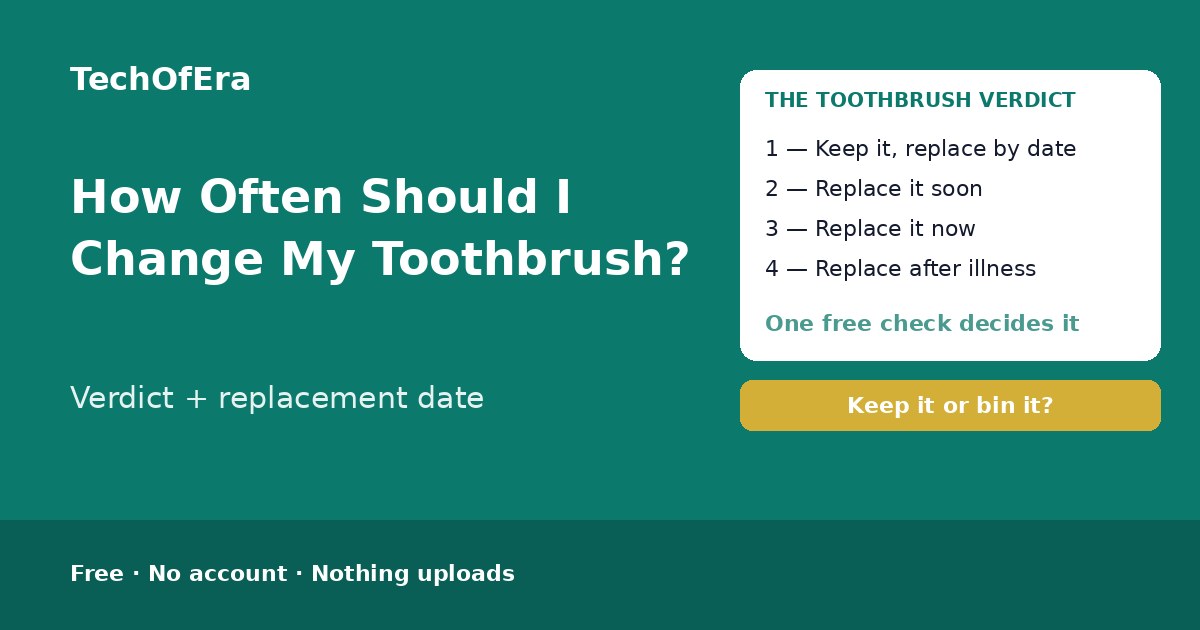
The four verdicts, and what each one means
Keep it — replace it by the date below
The brush is young, the bristles are straight, and nothing has happened to it: it is still cleaning properly. The checker gives you the replacement date — the three-to-four-month mark from when you started it — so you can plan the next one instead of guessing.
Replace it soon — within the next two weeks
The brush is about three months old, or the bristles are starting to bend — it is at the end of the three-to-four-month window. It will still clean for a little while, but it is already less effective. Buy the replacement now so it is ready.
Replace it now
The bristles are splayed, flattened or discoloured, the brush is four months or older, or it was dropped or shared. Worn bristles do not clean properly and can irritate your gums. Throw it away today and start a new one.
Replace it now — after the illness
You have had strep throat, a stomach bug, or a cold sore since you started this brush. Dentists recommend a fresh brush after those illnesses, even if the brush is only a couple of months old. Throw it away today and start a new one.
Your replacement plan
Whatever the verdict, this is the routine the checker is aiming for — the plan it builds from your brush's age:
- Replace every three to four months. That is the American Dental Association's rule, and it applies to manual brushes and electric heads alike. The checker's replacement date is its own planning estimate drawn from that rule — a brush under a month old has about two and a half months left, and one at three months has a two-week grace period.
- Check the bristles monthly. Pay more attention to the bristles than to the date: splayed beyond the width of the brush head, permanently curved, flattened, or very soft to the touch means replace it now, even before three months.
- Replace it after strep throat, a stomach bug, or a cold sore. Even if the brush is only a couple of months old. After a common cold, the guidance says you probably will not reinfect yourself — but replace it if the brush is near three months old, or if you are immunocompromised.
- Store it upright in open air. Let it dry between uses, and do not let the bristles touch another brush. Use a case only while travelling, and only with the brush dry.
- Write the start date on the next brush. Or set a reminder for three months from today. Most people replace their brush when it looks very worn — which is usually well past its time — because nobody remembers when they started it.
- Brush gently, with soft strokes. Hard brushing splays the bristles fast and can damage your gums. If your bristles splay before three months, you are pressing harder than you think.
- Check a child's brush monthly. Children chew the bristles, which wears them out faster than an adult's brush — theirs often needs replacing before three months.
What makes this checker different
The pages that rank for this search are articles — a Cleveland Clinic explainer from a dentist, a Health.com guide, a Hartford Hospital piece, a Texas A&M dental hygiene article, a Verywell Health guide, a GoodRx page, a Reader's Digest piece, and an Oral-B brand page. None of them asks how old your brush is, what the bristles look like, whether you have been ill, or how it is stored — and none of them gives you a verdict for your brush, or a replacement date. The one interactive page that ranks, a small dental site's household reminder, only takes a start date and hands back a calendar file: it does not look at the bristles, the illness, or the storage at all. This page is the answer the articles do not give: eight questions, an instant verdict, the blockers named, and a replacement date. It is a self-assessment, so it says plainly what it cannot know: it cannot see your brush, your bristles, or your gums.
When is this the right check?
When you cannot remember when you started your current brush — because that usually means it is time, and the checker will say so instead of guessing. When the bristles look bent and you are not sure whether bent is bad enough — because slightly bent means replace it soon, and splayed means replace it now, and the line between them matters. When you have just been ill and you are not sure whether the brush needs to go — because strep throat, a stomach bug and a cold sore all mean a fresh brush, and a cold usually does not. And when the brush belongs to a child — because children chew the bristles, and theirs wear out faster than yours.
Honest limitations
A self-assessment, not dental advice
This checker cannot see your brush, your bristles, or your gums. It cannot tell whether your gums need a dentist. If your gums bleed, hurt, or look swollen, or you are immunocompromised, talk to a dentist.
Without the start date, the replacement date is a rule, not a date
The replacement date depends on when you started the brush, and guessing it wrong by a month moves the whole plan. The checker still works without it, but it gives the three-to-four-month rule instead of a date — and the verdict drops to low confidence until the age is known.
“Bristle condition” is a judgement, not a measurement
Most people judge the bristles by eye, and slightly bent and splayed can look alike. If you are not sure which one yours is, the checker treats bent as replace-it-soon and splayed as replace-it-now — and says so in the answer, rather than pretending it measured them.
The replacement date is a planning estimate
The replacement dates on this page are the checker's own planning estimates drawn from the three-to-four-month rule, not a prescription for any one person. Your brushing pressure, your storage, and whether the brush is a child's all change them: if the bristles bend before the date, the bristles win.
Other brushes in the house count too
This checker looks at one brush at a time. It does not check the other brushes in the household, and it does not ask whether anyone in the house is ill — so run it once per brush, and replace any brush that has been in a shared holder with a sick person's brush.
Rules from official sources, dated November 2026
The rules here are the dental guidance from the American Dental Association, the Cleveland Clinic, Health.com, GoodRx, Verywell Health, Texas A&M and Oral-B, as they read in November 2026. Guidance changes: recheck with a dentist if anything about your mouth, your gums, or your health changes.