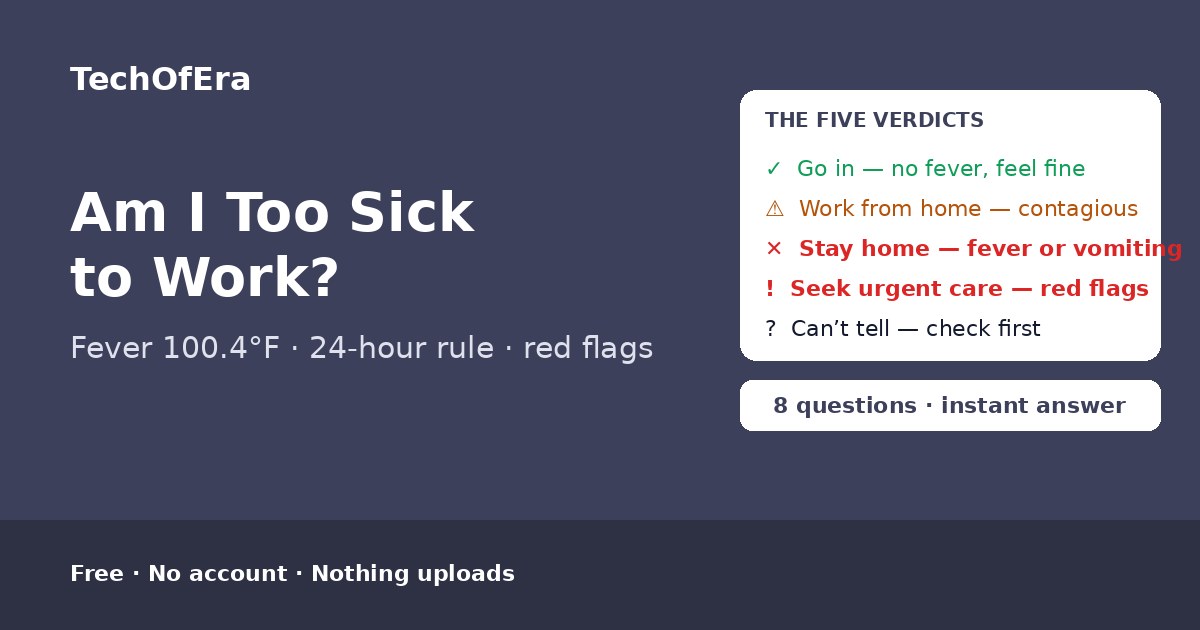
How to decide whether you are too sick to work
The CDC's respiratory-virus guidance gives the headline rule: stay home until you have been fever-free for 24 hours without fever-reducing medicine and your symptoms are improving overall, then take extra precautions for five days. A fever is a temperature of 100.4°F (38°C) or higher. On top of the fever rule, some symptoms mean stay home whatever the thermometer says: vomiting or diarrhoea, flu or COVID in the first few days, strep throat until you have taken antibiotics for at least 24 hours, and being so exhausted that basic tasks are an effort. And some signs are not a work question at all: trouble breathing, chest pain, confusion or fainting mean seek urgent care now. This checker asks exactly what decides it.
To use it:
- Take your temperature. Over 100.4°F (38°C) is a fever and means stay home. A low-grade temperature of 99 to 100.3°F is not officially a fever, but it is often the start of one — recheck in an hour. A fever of 103°F (39.4°C) or higher needs a doctor today.
- Check your stomach. Any vomiting or diarrhoea in the last 24 hours means stay home until at least 24 hours after the last episode — 48 hours for a norovirus-type stomach bug, per the NHS. Do not handle food for others.
- Check your cough and breathing. A wet cough with sneezing and a runny nose is the contagious pattern of a cold or flu. A mild dry cough with no fever is probably allergies or irritation. Shortness of breath, chest pain, or a cough so bad you cannot finish a sentence means seek urgent care.
- Be honest about how you feel. Tired and achy with a foggy head means your body is spending its energy fighting the infection — working through it cuts your output by a third or more and slows recovery. Exhaustion means rest. Confusion or fainting means urgent care.
- Think about your job. A desk job you can do from home is a different question from food handling, healthcare, or driving and machinery. Food handlers and healthcare workers follow stricter rules, and drowsy medicine plus a safety-critical job is a safety rule, not a judgement call.
- Know your return date. Fever-free for 24 hours without medicine, 24 hours after the last vomiting or diarrhoea (48 for norovirus), 24 hours of antibiotics for strep. Write it down — and do not go back early to prove a point.
Sick-day situations and what to do at a glance
The table below is built from the same rules as the checker, so it can never disagree with your verdict. Your temperature, your stomach, your cough, and what your job involves decide together.
| Sick-day situation | Verdict | What to know |
|---|
What makes this checker different
The pages that rank for this search are guides — thorough lists of the symptoms that mean stay home, from WebMD, GoodRx, Houston Methodist and OhioHealth — but they leave you to work out what that means for the morning you are having right now: whether a temperature of 101°F changes the answer, whether a wet cough without a fever is enough, whether your job matters, and when exactly you can go back. This page is that answer: eight questions, an instant verdict, the reason named, and the return-to-work timing stated plainly instead of buried in the text — with nothing to install, no account, and nothing uploaded. It is a self-assessment, so it says plainly what it cannot know: a web page cannot examine you, take your temperature, or know your medical history, so anything you mark “Not sure” stays on the list until you confirm it.
When is this the right check?
Whenever you wake up ill and work is on the plan: the fever that appeared overnight, the stomach bug that struck at 3 a.m., the cough that turned wet, or the morning you feel fine except for a sniffle and are not sure whether that counts. Also whenever you are deciding whether to work from home instead of going in — the checker tells you which one fits, and what precautions to take if you do go in. And whenever your job makes the question harder: food handling, healthcare, driving or machinery, or a public-facing role where a cough reaches dozens of people. If the answer is “stay home”, the checker names the return date too — fever-free for 24 hours, 24 hours after the last vomiting or diarrhoea, or 24 hours of antibiotics for strep.
Honest limitations
A self-assessment, not a diagnosis
This checker works only from the answers you enter. It cannot diagnose you — no web page can examine you, take your temperature, or know your medical history. If an answer is wrong, the verdict is wrong. When in doubt, stay home — or ask a clinician.
The fever rule is the headline, not the whole story
Staying home until fever-free for 24 hours is the CDC's headline rule, but vomiting, diarrhoea, exhaustion and a contagious illness can mean stay home even without a fever. A low number on the thermometer does not clear a stomach bug.
Urgent signs override everything
Trouble breathing, chest pain, confusion, fainting, a fever of 105°F (40.5°C) or higher, or being unable to keep fluids down mean seek urgent care now — whatever the rest of your answers say. Do not drive yourself.
Your employer may have its own rules
Food handling, healthcare, schools and some employers have their own return-to-work rules, and they can be stricter than the general guidance here. Check your contract or your occupational health team — their rule wins.
A long illness needs a doctor, not a checker
A cold that lasts more than 10 days, a cough that lasts more than 3 weeks, or a fever that lasts more than 2 to 3 days should be checked by a doctor. This checker can tell you whether to work today; it cannot tell you what is wrong.
Rules from CDC, NHS and MedlinePlus sources
The rules here follow CDC respiratory-virus guidance, NHS stay-home guidance, and MedlinePlus fever guidance, as they read in November 2026. Guidance can be revised, so re-check if a new edition appears.