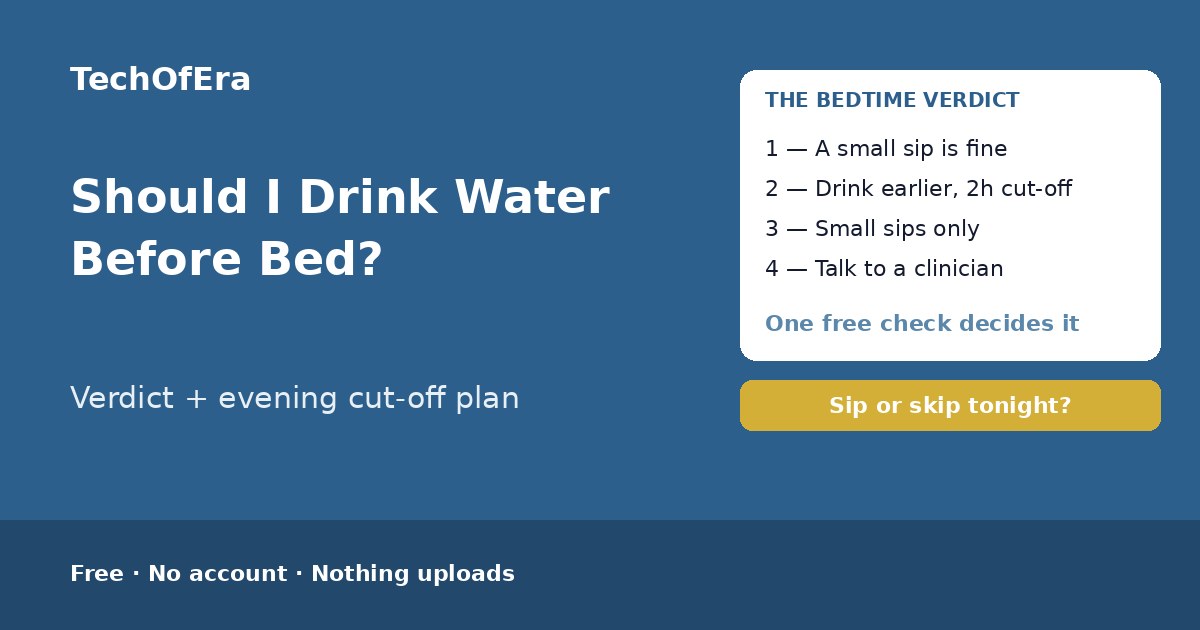
How the drink-before-bed check works
Drinking water before bed is a trade-off, not a yes-or-no question. A few sips settle thirst, help your core temperature drop, and can prevent an overnight headache — but a full glass close to bedtime fills the bladder while you sleep, and the trip to the toilet can break your sleep badly enough to affect the next day. This checker weighs all of it — what time you go to bed, when you last drank a large amount, how much you drank in the last two hours, how often you wake at night, your age, health conditions, medicines and drinks that make you urinate more, and how thirsty you feel — and gives you a verdict: a small sip is fine, drink earlier and stop large drinks two hours before bed, small sips only in the last two hours, or talk to a clinician about your night-time waking, plus a personal evening cut-off plan.
To use it:
- Say what time you go to bed. Before 9 pm, 9–10 pm, 10–11 pm, 11 pm–midnight, after midnight, or a time that varies with shift work. Your bedtime sets the two-hour cut-off: the checker works out the clock time to stop large drinks.
- Say when you last drank a large amount of water. In the last hour, 1–2 hours before bed, 2–3 hours before bed, or more than 3 hours before bed. A full glass in the last hour is the habit that fills the bladder overnight.
- Say how much you drank in the last two hours before bed. Nothing but a few sips, less than half a glass, about a full glass, or more than a glass. A few sips and a full glass are very different at bedtime.
- Say how often you usually wake up at night to use the toilet. Never, once a night, twice a night, or three times or more. Waking three times or more is nocturia, and it is the sign to talk to a clinician.
- Say how old you are. Under 18, 18–39, 40–64, or 65 or older. Night waking is more common after 65, and getting up in the dark raises the risk of a fall.
- Say whether you have a condition that affects night-time urination. None of these, nocturia already, a kidney or heart condition, sleep apnoea, acid reflux, or diabetes. A kidney or heart condition or diabetes changes the answer, because they affect how the body handles fluids during sleep.
- Say whether you take a medicine, or drink something, that makes you urinate more. None of these, water tablets (diuretics), caffeine late in the day, alcohol in the evening, or more than one of these. Water tablets taken late in the day push their effect into the night.
- Say how thirsty you feel at bedtime. Not thirsty at all, a little thirsty, very thirsty or a dry mouth, or needing water to take nightly medicine. Being very thirsty at night usually means too little water during the day — not too little at night.
The four verdicts, and what each one means
A small sip before bed is fine
Little drunk late in the evening and no waking at night: a few mouthfuls before bed are fine, and they can help if you are thirsty or need to take nightly medicine. Keep drinking most of your water earlier in the day, so you are not thirsty at bedtime.
Drink earlier — stop large drinks 2 hours before bed
You are drinking a lot close to bedtime and it is waking you up. Move your water earlier: drink most of it before the evening, and in the last two hours keep it to small sips. The checker works out your cut-off clock time from your bedtime — for a 10–11 pm bedtime, that is about 8:30 pm.
Small sips only in the last two hours
A full glass, or a drink one to two hours before bed, or a reason to be careful — reflux, a single waking, or a bedtime you are not sure about. Keep the last two hours to less than half a glass in total, sipped slowly, and drink more during the day instead.
Talk to a clinician about your night-time waking
Waking three times or more a night, or waking with a kidney or heart condition, diabetes, or water tablets behind it, is not something a drinking schedule fixes on its own. A clinician can check for the cause — an overactive bladder, sleep apnoea, a medicine timing, or a condition affecting how your body handles fluids. In the meantime, keep the last two hours to small sips.
Your evening drinking plan
Whatever the verdict, this is the evening the checker is aiming for — the plan it builds from your bedtime:
- Drink most of your water before the evening. Spread it through the morning and afternoon, so you are not thirsty at bedtime. Being very thirsty at night usually means too little water during the day.
- Stop large drinks two hours before bed. That is the cut-off the guidance points to. The checker works out the clock time from your bedtime — a 10–11 pm bedtime means stopping large drinks at about 8:30 pm.
- Keep the last two hours to small sips. Less than half a glass in total, sipped slowly — not one quick glass. A little water is still fine if you are thirsty or need to take nightly medicine.
- Skip alcohol, juice and tea in the last two hours. Alcohol suppresses the hormone that concentrates urine, so you make more of it overnight — and it fragments sleep. Caffeine late in the day does the same.
- Empty your bladder right before bed. It is the simplest way to buy an extra hour of unbroken sleep.
- If you already wake up a lot, stop three hours before bed. For nocturia, the guidance moves the cut-off an hour earlier — and water tablets should not be taken six hours before bed.
- Try the new timing for a week. One night proves nothing: a week of earlier drinking shows whether the waking stops. If it does not, talk to a clinician.
What makes this checker different
The pages that rank for this search are articles — a Cleveland Clinic explainer from a sleep specialist, a MedicineNet benefits-and-drawbacks page, a Sleep Foundation guide, a Peloton piece with a dietitian and a pulmonologist. None of them asks what time you go to bed, when you last drank a lot, how much you drank in the last two hours, how often you wake up, or whether you take a water tablet — and none of them gives you a verdict for your night. There is no free, standalone checker that takes your bedtime, your last drink, your waking and your health and turns them into a verdict with a personal cut-off time. This page is that answer: eight questions, an instant verdict, the blockers named, and the next steps. It is a self-assessment, so it says plainly what it cannot know: it cannot measure how much water you drank, how full your bladder is, or how well you sleep.
When is this the right check?
When you keep waking up to use the toilet and you are not sure whether the evening glass is the cause — because the fix is timing, and it takes a week to prove. When you take a water tablet and the waking started with it — because the medicine's timing may be the whole story, and it is a question for your clinician. When you are very thirsty at bedtime every night — because that usually means too little water during the day, and the fix is to drink more in the afternoon, not at bedtime. And when you have a kidney or heart condition, diabetes, or sleep apnoea and you are not sure what the evening rules are for you — because the answer for you is not the same as the answer for a healthy adult, and the checker says so instead of guessing.
Honest limitations
A self-assessment, not medical advice
This checker cannot measure how much water you drank, how full your bladder is, or how well you sleep. It cannot tell whether night waking needs a clinician. If you wake three times or more a night to urinate, or you have a kidney or heart condition, diabetes, or take water tablets, talk to a clinician.
Without your bedtime, the cut-off is a rule, not a time
The cut-off clock time depends on your bedtime, and guessing it wrong by an hour moves the whole plan. The checker still works without it, but it gives the two-hour rule instead of a clock time — and the verdict drops to low confidence until the bedtime is known.
“A large amount” is a judgement, not a measurement
Most people judge the evening drink by the glass, and a glass can be 200 ml or 500 ml. If you are not sure how much you drank, the checker treats a full glass as the line — and says so in the answer, rather than pretending it measured it.
The two-hour cut-off is a planning estimate
The two-hour cut-off and the evening drinking schedule on this page are the checker's own planning estimates drawn from the bedtime hydration guidance, not a prescription for any one person. Your body, your medicines and your bedtime all change them: if you still wake up after a week of earlier drinking, the answer is a clinician, not an earlier cut-off.
Other drinks and foods count too
This checker asks about water, caffeine and alcohol. It does not ask about soup, fruit, or other fluids in the evening, and it does not ask about salt — all of which change how much urine you make overnight. The verdict is about the water, not the whole evening.
Rules from official sources, dated November 2026
The rules here are the bedtime hydration guidance from the Cleveland Clinic, MedicineNet, the Sleep Foundation and Peloton's clinical contributors, as they read in November 2026. Guidance changes: recheck with a clinician if anything about your health, your medicines, or your sleep changes.