How the hot water bottle check works
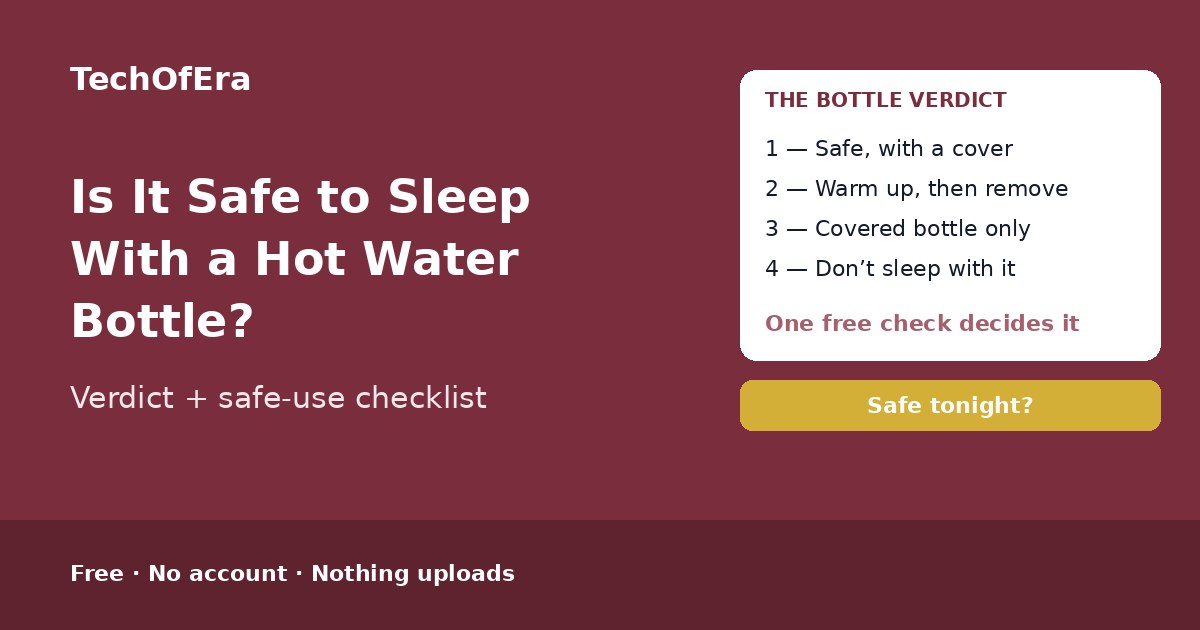
A hot water bottle is one of the cheapest ways to warm a cold bed — and one of the most common causes of winter burns. The danger is not the idea, it is the details: boiling water damages the seams, an old bottle can burst, bare rubber against bare skin burns slowly all night, and someone who cannot feel heat properly may not notice until the damage is done. This checker weighs all of it — who uses the bottle, how old and worn it is, how hot the water is, whether it has a cover, where it sits, how long it stays in bed, how sensitive the skin is, and what other heat is around — and gives you a verdict: safe with a covered bottle and precautions, warm the bed then take it out, use a covered bottle only, or don't sleep with it at all, plus a safe-use checklist.
To use it:
- Say who uses the bottle. A healthy adult, a child aged 5–12, a baby or toddler under 5, an older adult, someone with diabetes, nerve damage or poor circulation, or someone who is pregnant — each one changes the answer. Babies and people who cannot feel heat properly face the highest danger.
- Say how old and worn the bottle is. New this winter, 1–2 years old and still supple, 2–3 years old or showing wear, or cracked, perished, sticky, leaking or bulging. Check the daisy-wheel symbol embossed on the bottle: the number in the middle is the year it was made, the twelve petals are the months, and the dots are the weeks.
- Say how hot the water is. Warm, not boiling — cooled for a few minutes, about 40°C — is the right temperature. Hot from the kettle, cooled only a minute or two, is hotter than it needs to be. Boiling, straight from the kettle, damages the seams and can scald.
- Say whether the bottle has a cover. A proper thick cover is the barrier between hot rubber and skin. A thin cover or a towel is better than bare rubber, but still lets a lot of heat through over hours. No cover at all is the most common way people get burned.
- Say where the bottle sits in the bed. At the feet, not touching bare skin, is the safest spot. Against the back or stomach, over nightclothes, is fine for aches while awake. Directly against bare skin, or under the body where weight can split the bottle, is not.
- Say how long the bottle stays in bed. Warm-up only — out before falling asleep — is the safe habit: 5–15 minutes warms the sheets. The first hour or so, then taken out, is short enough. All night, every night, is the habit to break.
- Say how sensitive the skin is where the bottle sits. Normal skin that feels heat well, sensitive or thin skin that burns easily, reduced feeling that cannot always tell how hot something is, or broken skin, a rash or a wound where the bottle sits.
- Say what other heat is in the bed. Nothing else, an electric blanket as well, a heating pad as well, or a very warm room with heavy bedding. Two heat sources together can overheat the bed — use one or the other.
The four verdicts, and what each one means
Safe with a covered bottle and precautions
Warm water, a thick cover, a bottle in good condition and a healthy adult, used to warm the bed or for a short while: the bottle is safe to use as it stands. Keep it at the feet, fill it two-thirds full, and take it out before you fall asleep — or at most after the first hour.
Warm the bed, then take it out
The bottle itself is fine, but staying in bed with it all night is the risk: heat held against the same patch of skin for hours can cause a low-temperature burn, and a bottle can leak or burst while you sleep. Put it in 5–15 minutes before bed to warm the sheets, then take it out before you nod off.
Covered bottle only — never bare skin
A fixable problem: no cover, or water too hot, or the bottle against bare skin. Put it in a proper thick cover, let the water cool for a few minutes to around 40°C, and keep it over nightclothes. With those three fixes the bottle is safe to use for warming the bed.
Don’t sleep with this bottle
Something about this setup is not fixable by a cover or cooler water: a damaged bottle can burst, a baby can overheat, and someone who cannot feel heat properly can be burned without warning. Replace a damaged bottle, warm a baby’s bed with the room heating instead, and talk to a clinician about safe ways to stay warm.
The safe-use checklist
Whatever the verdict, these are the rules that keep a hot water bottle safe — the checklist the checker runs through, and the one to pin by the kettle:
- Check the bottle before every use. Look for splits in the rubber or along the seams, sticky or perished patches, and a stopper that fits straight and tight. Fill it with cold water, put the stopper in, turn it upside down and squeeze gently: any leak means it is done.
- Check the daisy wheel every winter. The number in the middle is the year the bottle was made. Replace it every 2–3 years, whatever it looks like — the Children’s Burns Trust advises that a bottle more than two years old is too old.
- Never use boiling water. Boil the water, then let it cool for a few minutes before filling, to around 40°C. For children, use cooled boiled water at about bath temperature.
- Fill only two-thirds full. Squeeze the air out before tightening the stopper, hand-tight, and check for leaks over a sink. Never fill it from a domestic hot water system, and never heat a bottle in the microwave or oven unless the maker says it is safe.
- Always use a cover. A proper thick cover, every time — and never put bare rubber against bare skin.
- Put it at the feet. Never sit or lie on a hot water bottle, and never put one in a baby’s sleep space.
- Warm the bed, then take it out. Five to fifteen minutes before bed, then out before you fall asleep. If the bed cools too fast, add a blanket — not a longer stay for the bottle.
- One heat source at a time. Never use a hot water bottle with an electric blanket or a heating pad as well.
- Store it empty, in a cool, dry, dark place. Never store it full of water, near a radiator, or in sunlight — all of them age the rubber.
- Know the burn first aid. Cool a burn under cool running water for 20 minutes, cover it loosely, and get medical help if it blisters, is large, or is on a baby or young child.
What makes this checker different
The pages that rank for this search are articles — a sleep-mattress guide to the risks, a how-to on using a bottle in bed, a safety guide from a training provider, a council's winter tips page. None of them asks who uses your bottle, how old it is, how hot your water is, whether it has a cover, where it sits, or how long it stays in bed, and none of them gives you a verdict for your bottle. There is no free, standalone checker that takes your person, bottle, water, cover, placement and night and turns them into a verdict with a safe-use checklist. This page is that answer: eight questions, an instant verdict, the blockers named, and the next steps. It is a self-assessment, so it says plainly what it cannot know: it cannot feel how hot your bottle is, check its rubber, or know how well you feel heat.
When is this the right check?
When the nights turn cold and the bottle comes out of the cupboard for the first time this winter — because a bottle that sat all summer may have perished, and the daisy wheel may say it is past 2–3 years. When someone in the house has diabetes or nerve damage and reaches for the bottle for cold feet — because they may not feel the heat building up. When a child wants the bottle in bed — because children need cooler water, a cover, and the bottle out before sleep. And when you have been sleeping with the bottle all night for years — because the low-temperature burn builds up slowly, and the safe habit is to warm the bed for 5–15 minutes and take it out.
Honest limitations
A self-assessment, not medical advice
This checker cannot feel your bottle, check its rubber, or know how well you feel heat. It cannot tell whether a burn needs a clinician. If anyone using the bottle has diabetes, nerve damage or poor circulation, or a burn that blisters, talk to a clinician before using a bottle to stay warm.
Without the bottle's age, the verdict is weaker
The bottle's age decides whether it is safe at all, and guessing it wrong by a year changes the answer from safe to replace. The checker still works without it, but it says so — the verdict drops to low confidence and the first step is to read the daisy wheel.
Water temperature is a guess without a thermometer
Most people judge the water by feel, and a hand dipped in a kettle is a poor thermometer. If the water is too hot to hold your hand in comfortably for a few seconds, it is too hot for the bottle: let it cool for a few minutes more.
The warm-up time is a planning estimate
The 5–15 minute warm-up and the 40°C water figure on this page are the checker's own planning estimates drawn from the safety guidance, not a prescription for any one person. Your bottle, your cover and your bed all change them: if the sheets are still cold after 15 minutes, the water was too cool — not a reason to leave the bottle in longer.
Electric and rechargeable bottles are different
This checker is built for the traditional rubber bottle filled with water. Rechargeable electric bottles have their own risks — never use one while it is still plugged into its charger, and never use one that shows wear on the charging port or cord. The cover, the age and the take-it-out rule still apply.
Rules from official sources, dated November 2026
The rules here are the hot water bottle safety guidance from the Children’s Burns Trust and CAPT, the Lullaby Trust advice on babies’ sleep spaces, the BS 1970:2012 safety standard, and the NHS burn first-aid guidance of cool running water for 20 minutes, as they read in November 2026. Guidance changes: recheck with a clinician if anything about the person using the bottle changes.