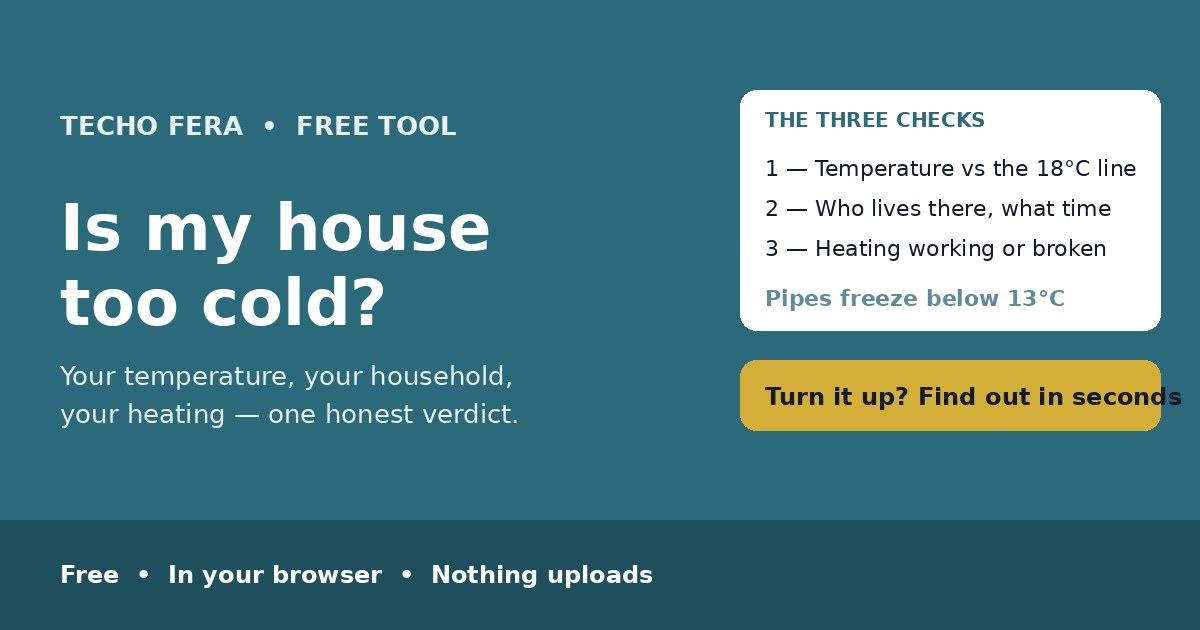
How the cold-house check works
The World Health Organization proposes 18°C (64°F) as a safe and well-balanced indoor temperature for general populations in the cold season, and says a higher minimum may be necessary for older people, children, and people with chronic illnesses. The US National Institute on Aging tells older adults to keep the heat at at least 68°F (20°C), and the American Red Cross says never set the heat below 55°F (13°C) when away from home, so the pipes do not freeze. But a number is not a verdict: 16°C in a bedroom overnight is fine, 16°C in a living room with an older adult is not, and a house that will not warm up has a heating problem, not a thermostat problem. This checker combines six clues — your room temperature, the room, who lives there, the time of day, how long it has been this cold, and whether the heating is working — plus the cold signs you can feel and see, and gives you a score out of 100, a verdict, and the recommended action.
To use it:
- Enter your room temperature. Read a room thermometer in the room that worries you — place it at about chest height, away from radiators and outside walls, and read it at the time of day that worries you. If you have no thermometer, tick the signs below instead and the checker scores those.
- Pick the room. A bedroom overnight and a living room in the daytime have different floors: a bedroom can run cooler under a proper duvet, a nursery should stay in the 16–20°C range, and a living room needs the full daytime floor.
- Say who lives there, and what time of day it is. Healthy adults need 18°C in the daytime and 16°C overnight; older adults, babies and people with a heart or lung condition need 20°C in the daytime and 18°C overnight. An empty house only needs the 13°C pipe floor.
- Say how long it has been this cold, and whether the heating is working. A one-off cold day is the weather; a house that never warms up has a heating or insulation problem. And a broken heating system decides the whole verdict: no setting fixes it, so the checker says call for help instead of recommending a higher thermostat setting.
- Tick any cold signs. Draughts, condensation, feeling cold indoors, shivering, cold radiators or pipes, mould, and rooms that are much colder than others — what you can feel and see is the check the number cannot give you.
What makes this checker different
The pages that rank for this search are guides — a long article that tells you the WHO 18°C line and lists the temperatures for different rooms, and a question-and-answer page that repeats the same bands for every question. Neither one asks what your temperature is, who lives there, what time it is, or whether the heating works, and neither one tells you whether to turn the heating up, fix the draughts, or call for help. There is no free, standalone checker that takes your room temperature, room, household, time of day, persistence, heating and cold signs — and gives you a score, a verdict (fine, chilly but safe, too cold, or dangerously cold), and a recommended action built on your own reading. This page is that answer: six questions, an instant verdict for your exact home, the blockers named, and the next steps. It is a self-assessment, so it says plainly what it cannot know: it cannot measure your rooms, and where the heating is broken it says so instead of recommending a higher thermostat setting.
When is this the right check?
When the house feels cold even with the heating on and you are not sure whether that is normal winter or a heating problem — because the heating question and the persistence are what tell them apart. When an older relative lives alone and you want to know whether their house is warm enough — because the floor for an older adult is 20°C, not 18°C, and older people feel the cold less, so they may not notice the room is too cold. When you are going away and want to know how low you can set the heating — because the answer is the 13°C pipe floor, not the health floor. And when you rent and the house will not warm up — because in England, excess cold is a hazard under Awaab’s Law from 30 November 2026, and dated thermometer readings are the evidence.
Honest limitations
A self-assessment, not a survey
This checker cannot measure your rooms, see your heating, or test your boiler. It cannot check whether the boiler is safe, how bad the mould is, or what your walls are made of. If someone in the house is shivering, confused or unusually sleepy in a cold room, get help now — a web page cannot tell hypothermia from feeling chilly.
The score is a guide, not a diagnosis
A score of 92 does not mean your home is perfect, and a score of 58 does not mean it is ruined. The score weighs the temperature, the signs, the household, the room, the time of day and the heating together — but only a proper inspection can say what is actually wrong with a house.
One reading is not a verdict
A room is coldest in the early morning and warmest in the evening, and a reading taken next to a cold outside wall is not the temperature where you sit. How long the cold lasts matters more than any one number — which is why the checker asks how long it has been this cold, and tells you to measure at the time of day that worries you.
Bedrooms have their own rules
A bedroom can run cooler than a living room overnight: 16–18°C with a proper duvet is comfortable for a healthy adult, and a nursery should stay in the 16–20°C range. The checker scores bedrooms with that in mind, but it cannot tell you whether your duvet is warm enough.
Feeling cold is not the same as being cold
How cold a room feels depends on draughts, humidity, what you are wearing and whether you have been sitting still — a draughty 19°C room can feel colder than a still 17°C one. The checker scores both the number and the signs, but it cannot feel the draught for you.
Rules from official sources, dated November 2026
The rules here are the World Health Organization Housing and Health Guidelines (18°C for general populations in the cold season), the US National Institute on Aging guidance for older adults (at least 68°F), and the American Red Cross pipe floor (never below 55°F when away) — as they read in November 2026. Guidance changes: recheck with a professional if anything about your home changes.