How the winter window check works
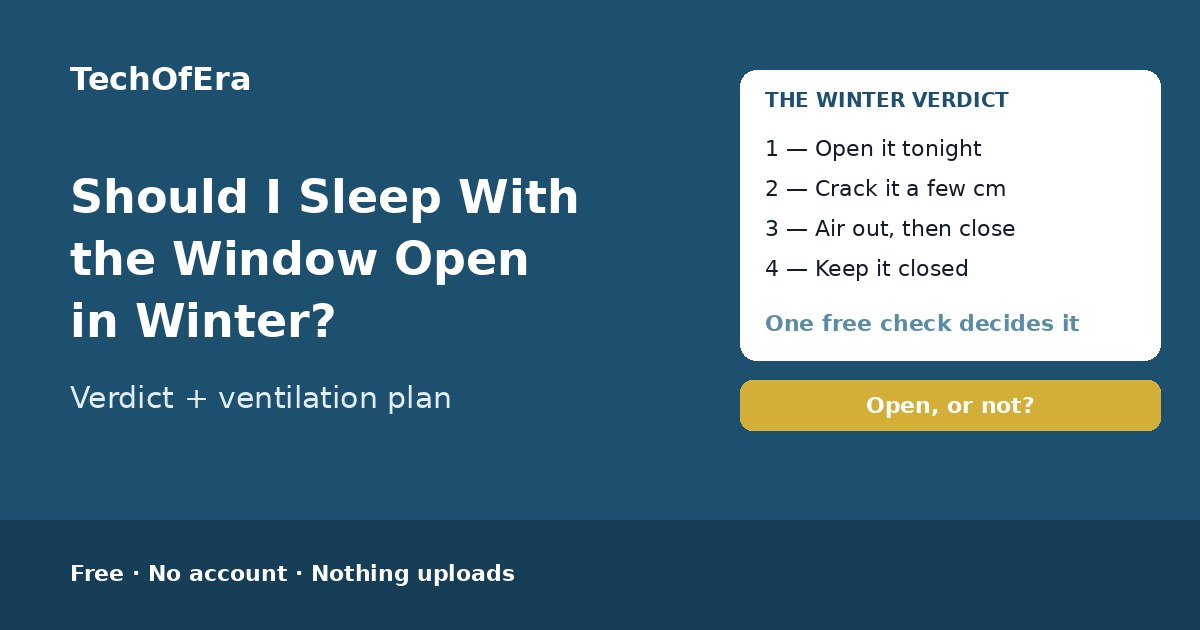
Sleeping with the window open in winter is a balance, not a habit. Fresh air flushes out the carbon dioxide that builds up in a closed bedroom overnight and keeps the room near 18°C, the temperature sleep researchers point to — but the same opening on a freezing night cools the room below 16°C, on a busy road it lets the traffic in, and on a ground floor without a lock it is a security risk. This checker weighs all of it — the outside temperature overnight, the bedroom temperature, the room humidity, who sleeps there, the heating, the street noise, the window security, and the outdoor air — and gives you a verdict: sleep with it open, crack it a few centimetres, air the room out before bed and then close it, or keep it closed tonight, plus a ventilation plan.
To use it:
- Say how cold it is outside overnight. Check tonight’s forecast: above 10°C is a mild winter night, 0–5°C is just above freezing, and below −5°C is a hard frost. The colder the night, the smaller the opening the room can take.
- Say how warm the bedroom is. About 18°C is the usual sleep range, and 16–20°C is the range the NHS points to for a baby’s room. Under 16°C the room is already cold, and opening the window would make it colder.
- Say what the room humidity is, if you know it. A cheap hygrometer by the bed tells you in a day. Under 30% is very dry, 30–50% is the healthy range the US EPA recommends, and over 50% is damp — cold outdoor air is dry, so a cracked window in winter dries a damp room.
- Say who sleeps there. A baby under 12 months, a young child, someone with asthma or a breathing condition, or an older adult — each one changes the answer. A baby’s room should stay at 16–20°C, and cold air can trigger an asthma flare.
- Say how the heating runs overnight. Heating off means the room can only cool down while you sleep; heating on low or timed can hold the room near 18°C against a small crack, but not against a wide opening.
- Say how noisy the street is at night. A quiet street costs nothing to open onto; a busy road lets steady traffic straight in, and traffic noise is genuinely bad for sleep — it can undo the fresh-air gain entirely.
- Say whether the window locks. An upper-floor window, or one that locks securely, has no security reason to stay shut. A ground-floor window that does not lock, or has no restrictor, should stay shut overnight — safety overrides temperature.
- Say what the outdoor air is like tonight. Clean air is the night to use the window. High pollen brings hay fever in with the fresh air, and polluted air or wildfire smoke means the outdoor air is worse than the indoor air.
The four verdicts, and what each one means
Sleep with the window open
A mild winter night above 10°C, a warm room, a quiet street and a window that locks: the fresh air and the cooler room both help you sleep, and nothing on the other side of the glass argues against it. Open it wide enough to feel the air move, and keep the bed out of the direct draft.
Crack it open a few centimetres
The usual winter answer: about 10 cm on a mild night (5–10°C), about 5 cm just above freezing (0–5°C). A small opening changes the air and keeps the room near 18°C without chilling it. Keep the bed out of the draft line, and leave the bedroom door ajar so the air circulates.
Air the room out before bed, then close it
Open the window wide for 5–10 minutes before bed — the lüften habit — then close it for the night. That flushes the stale air and the carbon dioxide out without cooling the walls, so the room stays warm while you sleep. The answer for a freezing night, a busy road, a baby’s room, or heating that cannot keep up.
Keep it closed tonight
Tonight the window stays shut: a hard frost with a baby or an already-cold room, polluted or smoky air, or a ground-floor window that does not lock. Air the room out for 5–10 minutes in the morning instead, when you can warm it back up, and leave the bedroom door ajar overnight so the air still moves.
What makes this checker different
The pages that rank for this search are articles — a guide to the lüften sleep method, a piece on house burping, an explainer on what the research shows about sleeping with the window open. None of them asks how cold it is outside tonight, how warm your room already is, who is sleeping there, how noisy your street is, or whether your window locks, and none of them gives you a verdict for your night. There is no free, standalone checker that takes your temperature, room, sleeper, heating, noise, security and air and turns them into a verdict with an opening width and a ventilation plan. This page is that answer: eight questions, an instant verdict, the blockers named, and the next steps. It is a self-assessment, so it says plainly what it cannot know: it cannot measure your room, hear your street, or check your window lock.
When is this the right check?
When you wake up groggy every winter morning and wonder whether the window should have been open — because a closed bedroom builds up carbon dioxide overnight, and a crack is the cheapest fix. When the forecast says −6°C and you are not sure whether the lüften habit still applies — because below −5°C it does not, and the room should be aired before bed instead. When a baby is sleeping in the room — because the room has to stay at 16–20°C, and an open window on a freezing night cannot hold that. And when you live on a busy road — because the noise coming through the window can undo the fresh-air gain, and the right answer is to air the room out before bed and then close it for quiet.
Honest limitations
A self-assessment, not medical advice
This checker cannot measure your room, hear your street, or check your window lock. It cannot tell whether a cough is the cold air or something else. If a baby’s breathing gets worse, or anyone in the room has asthma that flares in cold air, talk to a clinician before changing the sleep setup.
Without a forecast, the verdict is weaker
The outside temperature decides the opening width, and guessing it wrong by 5°C changes the answer from a crack to airing out first. The checker still works without a reading, but it says so — the verdict drops to low confidence and the first step is to check tonight’s forecast.
Room temperature is not one number
A thermometer by the radiator can read 19°C while the wall by the window reads much colder — condensation happens at the coldest surface, not at the room average. Measure beside the bed, not in the middle of the room, and watch the windows in the morning.
The opening width is a planning estimate
The crack widths on this page — about 10 cm on a mild night, about 5 cm just above freezing, about 2 cm just below freezing — are the checker’s own planning estimates, not published rules. Your window, your wind and your heating all change them: if the room drops under 16°C by morning, the opening was too wide.
Noise and air change night to night
A street that is quiet on a Sunday can be busy on a Friday, and a clear evening can turn smoky if a neighbour lights a bonfire. The checker judges tonight only: re-run it when the street or the air changes, and listen at bedtime before trusting yesterday’s answer.
Rules from official sources, dated November 2026
The rules here are the sleep-research and NHS bedroom temperature guidance (about 18°C, 16–20°C for a baby’s room), the WHO housing guidance (18°C as the safe indoor temperature in cold seasons), the US EPA indoor humidity range of 30–50%, and the Building and Environment field study on bedroom ventilation, carbon dioxide and sleep, as they read in November 2026. Guidance changes: recheck with a clinician if anything about the sleeper changes.