How the electric blanket check works
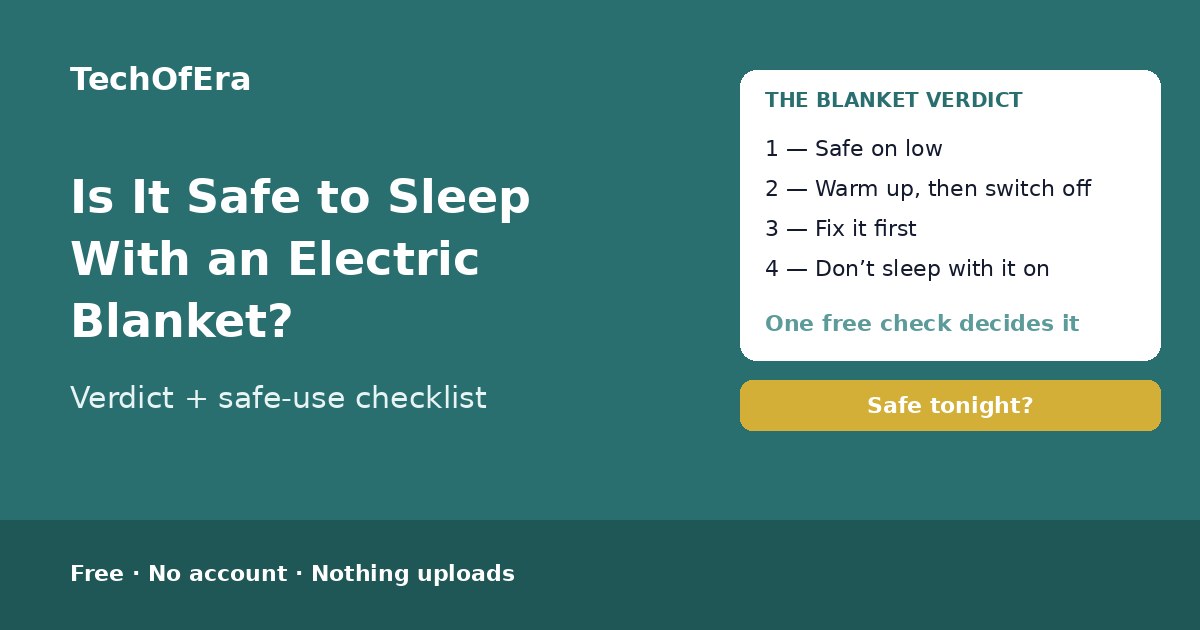
An electric blanket is one of the cheapest ways to stay warm in bed — a typical blanket draws 60–150 watts, so a night on low costs a few pence or cents, far less than heating the whole room. It is also one of the few bedroom items that can catch fire while you sleep. The danger is not the idea, it is the details: a blanket over 10 years old, folded wiring, a frayed cord, high heat all night, or someone who cannot feel heat properly. This checker weighs all of it — who uses the blanket, how old it is, what setting it stays on, what safety features it has, what state its cord and controller are in, how it lies in the bed, how it is plugged in, and what else shares the bed — and gives you a verdict: safe on low overnight, warm the bed then switch it off, fix it first then use it on low, or don't sleep with it switched on, plus a safe-use checklist.
To use it:
- Say who uses the blanket. A healthy adult, a child aged 5–12, a baby or toddler under 5, an older adult, someone with diabetes, nerve damage or poor circulation, or someone who is pregnant — each one changes the answer. Babies and people who cannot feel heat properly face the highest danger.
- Say how old the blanket is. New this winter, 1–5 years old and still in good shape, 6–10 years old or showing wear, or over 10 years old or damaged. Most makers say replace a blanket after about 10 years, and most blanket fires involve blankets over 10 years old.
- Say what setting it stays on. Preheat only, switched off before sleep; low all night; medium all night; or high all night. Low is the only overnight setting the guidance calls safe — never fall asleep with it on high.
- Say what safety features it has. Auto shut-off and overheat protection, auto shut-off only, or neither. Auto shut-off typically cuts power after 8–12 hours, and overheat protection cuts power if the blanket gets too hot.
- Say what state the cord and controller are in. Good, with the cord, controller and fabric all sound; some wear, such as a stiff cord or a controller that sticks sometimes; or damaged — a frayed cord, scorch marks, exposed wires, or a broken controller.
- Say how it lies in the bed. Flat, not folded or tucked, is the only safe way. Folded, creased or tucked under the mattress damages the wires and creates hot spots. Under heavy bedding, or with body weight on it, traps the heat.
- Say how it is plugged in. Straight into a wall outlet, or through an extension cord or a power strip. A blanket draws power all night, and a thin extension cord can overheat.
- Say what else shares the bed. Nothing else, a hot water bottle or heating pad as well, or pets that chew cords or sleep on the bed. Two heat sources together can overheat the bed, and chewed cords are one of the causes of blanket fires.
The four verdicts, and what each one means
Safe on low overnight
Low all night, a modern certified blanket with auto shut-off and overheat protection, in good condition, laid flat, plugged straight into a wall outlet, and a healthy adult: the one overnight pattern the safety guidance calls safe. Keep it on low, keep it flat, and check the cord and controller every month.
Warm the bed, then switch it off
The blanket itself is sound, but the overnight pattern is the risk: medium or high heat all night can overheat the body, dry the skin and disrupt sleep — and without auto shut-off there is nothing to stop it. Put it on 15–30 minutes before bed to warm the sheets, then switch it off before you nod off.
Fix it first — then use it on low
A fixable problem: folded or tucked, on an extension cord, layered with another heat source, a worn cord, an old blanket, pets that chew, or only one safety feature. Fix the setup — flat, wall outlet, one heat source, low — and the blanket is safe to use overnight.
Don’t sleep with this blanket switched on
Something about this setup is not fixable by a lower setting or a flatter blanket: a damaged or over-10-years-old blanket can catch fire, a baby can overheat, and someone who cannot feel heat properly can be burned without warning. Replace the blanket, warm a baby’s bed with the room heating instead, and talk to a clinician about safe ways to stay warm.
The safe-use checklist
Whatever the verdict, these are the rules that keep an electric blanket safe — the checklist the checker runs through, and the one to pin by the bed:
- Check the blanket before every use. Look for frayed or exposed wires, scorch marks, hot spots, a damaged controller, and a cord a pet has chewed. Any of those means stop using it at once.
- Replace it after about 10 years. Most makers give that figure, whatever the blanket looks like — the wiring and insulation age from the inside.
- Look for the safety mark. UL 964 or ETL in North America, or the equivalent standard where you live, plus auto shut-off and overheat protection on the label or controller.
- Preheat, then turn it down or off. Put it on 15–30 minutes before bed, then switch it off — or down to low — before you fall asleep. Never fall asleep with it on high.
- Lay it flat, every time. Never fold, crease or tuck it tightly while it is on, and never pile heavy bedding on it or sit or lie on it.
- Plug it straight into a wall outlet. Never use an extension cord or a power strip.
- One heat source at a time. Never use an electric blanket with a hot water bottle or a heating pad as well.
- Keep pets off the cord. Chewed cords are one of the causes of blanket fires — check the cord for chew marks before every use.
- Store it rolled, not folded. Roll the blanket loosely for the summer, in a cool, dry place — never fold it tightly or store it crumpled.
- Know the burn first aid. Cool a burn under cool running water for 20 minutes, cover it loosely, and get medical help if it blisters, is large, or is on a baby or young child.
What makes this checker different
The pages that rank for this search are articles — and they disagree with each other. One says modern blankets are safe every night, another says never sleep with one on, a third says preheat and switch off. None of them asks who uses your blanket, how old it is, what setting it stays on, whether it has auto shut-off, what state its cord is in, or how it is plugged in, and none of them gives you a verdict for your blanket. There is a cost calculator that works out what a night costs, but it answers the bill, not the safety question. There is no free, standalone checker that takes your person, blanket, setting, safety features, cord, placement and plug and turns them into a verdict with a safe-use checklist. This page is that answer: eight questions, an instant verdict, the blockers named, and the next steps. It is a self-assessment, so it says plainly what it cannot know: it cannot feel how hot your blanket is, check its wiring, or know how well you feel heat.
When is this the right check?
When the nights turn cold and the blanket comes out of the cupboard for the first time this winter — because a blanket that sat all summer may have been folded, chewed, or aged past 10 years. When someone in the house has diabetes or nerve damage and reaches for the blanket for cold feet — because they may not feel the heat building up. When a child wants the blanket on all night — because children need the bed warmed and the blanket off before sleep. And when you have been sleeping with the blanket on high for years — because high heat all night dries the skin, disrupts sleep, and is the setting most likely to damage an old blanket.
Honest limitations
A self-assessment, not medical advice
This checker cannot feel your blanket, check its wiring, or know how well you feel heat. It cannot tell whether a burn needs a clinician. If anyone using the blanket has diabetes, nerve damage or poor circulation, or a burn that blisters, talk to a clinician before using a blanket to stay warm.
Without the blanket's age, the verdict is weaker
The blanket's age decides whether it is safe at all, and guessing it wrong by a few years changes the answer from safe to replace. The checker still works without it, but it says so — the verdict drops to low confidence and the first step is to find the label or the year it was bought.
The safety features are only as good as the label
Most people do not know whether their blanket has auto shut-off or overheat protection until they read the label or the instructions. If the label is gone and the maker cannot be found, treat the blanket as having neither — and warm the bed, then switch it off.
The preheat time and wattage are planning estimates
The 15–30 minute preheat and the 60–150 W typical power figures on this page are the checker's own planning estimates drawn from the safety guidance, not a meter reading of your blanket. Your blanket, your cover and your bed all change them: check the label for the real wattage.
Heated mattress pads are different
This checker is built for the electric blanket that lies on top of you. Heated mattress pads sit under you, run at lower heat, and are often designed for all-night use — but the age, the cord, the flat lay and the plug rules still apply, and the same people should still be careful.
Rules from official sources, dated November 2026
The rules here are the electric blanket safety guidance from the US Consumer Product Safety Commission, the UL 964 safety standard, and the safety advice of US utilities and fire services, as they read in November 2026. Guidance changes: recheck with a clinician if anything about the person using the blanket changes.