How the overnight check works
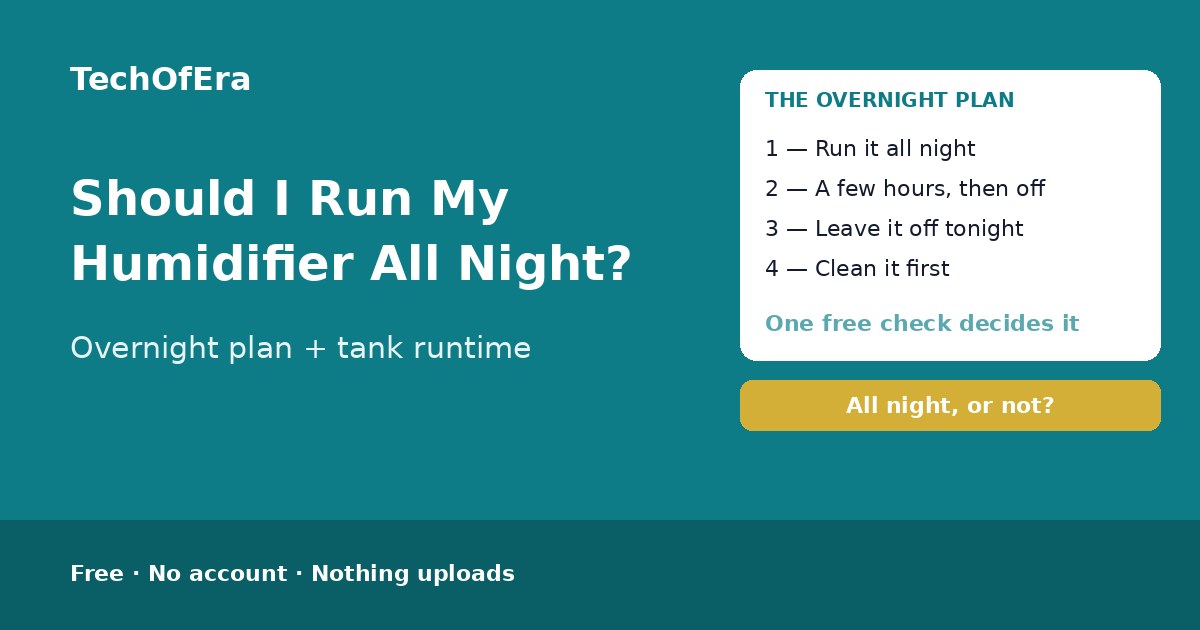
Running a humidifier all night is a balance, not a habit. Too little moisture and you wake up with a dry throat and cracked skin; too much and the room climbs past 50% while you sleep, the windows collect condensation, and mould and dust mites get the damp air they need. A dirty unit adds a second risk: bacteria and mould breeding in a tank that has not been cleaned in a week, carried into the room you sleep in by the mist. This checker weighs all of it — the room humidity if you know it, the room, who sleeps there, the type of humidifier, how it is controlled, when it was last cleaned, the signs of too much moisture, and the tank size — and gives you an overnight plan: run it all night, run it for a few hours, leave it off, or clean it first.
To use it:
- Say what the room humidity is, if you know it. A cheap hygrometer by the bed tells you in a day. Under 30% is very dry, 30–50% is the healthy range the US EPA and Health Canada recommend, and over 60% is too damp for a humidifier to help at all.
- Say which room it is. A small bedroom fills with moisture fast — a small unit on low is enough — while a large open-plan room needs a lot of water to move the humidity at all. A nursery is a room of its own: cool mist only, a few feet from the cot.
- Say who sleeps there. A baby under 12 months, a young child, someone with asthma or a dust-mite allergy, or an older adult — each one changes the answer. The American Academy of Pediatrics recommends cool-mist units for babies, and the American Lung Association says people with asthma or a dust-mite allergy should keep their home below 50% humidity.
- Say what type of humidifier it is. Cool-mist ultrasonic, cool-mist evaporative, warm-mist steam, or a whole-house unit plumbed into the heating. The type decides the scald risk — warm mist is boiling water — and the overnight output, from about 150 ml per hour for a small ultrasonic unit to about 250 ml for warm mist.
- Say how it is controlled. A humidistat that switches the unit off at a set humidity is the only control that can be trusted overnight. A timer stops on time, not on humidity, and an empty-tank shut-off responds to the water level, not to the room.
- Say when it was last cleaned. The US EPA says clean a humidifier every three days and empty the tank daily. A unit that has not been cleaned in over a week should not run overnight at all.
- Say whether there are signs of too much moisture. Condensation on the windows in the morning, damp bedding, a musty smell, white dust on furniture, or visible mould — or a cough that gets worse when the humidifier runs. The windows are the warning: if they are wet in the morning, last night was too damp.
- Say how big the tank is. Usable capacity is about 90% of the nominal size, so a 2-litre tank holds about 1.8 litres before the unit cuts off. At 150 ml per hour that lasts about 12 hours; at 250 ml per hour, about 7 — it will run dry before the night is over.
The four verdicts, and what each one means
Run it all night
The room is dry — under 40% — the unit is clean, and a humidistat will hold the room at 40–45%. Run it on low and let the humidistat do the watching while you sleep. Check the hygrometer and the windows in the morning.
Run it for a few hours
The room needs some moisture, but not all night: either it is already in the 40–50% range and only needs a top-up, or there is no humidistat to stop it overshooting while you sleep. Run it on low for two to three hours before bed, then switch it off.
Leave it off tonight
The room is already damp enough, or the signs say the moisture is doing harm — condensation on the windows, damp bedding, visible mould, or a warm-mist unit in a baby's room. Ventilate instead, and check the hygrometer again tomorrow night.
Clean it first
The unit has not been cleaned in over a week. A dirty humidifier can breed bacteria and mould that the mist carries into the room you sleep in — running it overnight is the worst time to find that out. Clean it, then re-run the check.
What makes this checker different
The pages that rank for this search are guides — an article on whether to leave a humidifier on all night, a guide to how long to run one, a baby-safety guide that lists the rules in prose. None of them asks what your room humidity is, what type of unit you have, how it is controlled, when it was last cleaned, or how big the tank is, and none of them gives you a verdict for your room. The calculators that do exist answer a different question: one works out how long a tank lasts, another prices the electricity. There is no free, standalone checker that takes your humidity, room, sleeper, unit type, controls, cleaning, signs and tank size and turns them into an overnight plan with a humidistat target and a tank runtime. This page is that answer: eight questions, an instant verdict, the blockers named, and the next steps. It is a self-assessment, so it says plainly what it cannot know: it cannot measure your room, test your humidity, or see inside the tank.
When is this the right check?
When you wake up with a dry throat every winter morning and wonder whether to leave the unit running — because the answer is only yes if the room is actually dry and a humidistat is holding it. When the windows are wet every morning and you are not sure whether the humidifier is the cause — because condensation on the glass is the sign the room was too damp overnight. When you have just bought a unit and are not sure whether the tank will last the night — because a 2-litre tank on warm mist runs dry at about 7 hours. And when a baby is sleeping in the room — because the unit type matters more than the humidity: cool mist only, a few feet from the cot, and the cord out of reach.
Honest limitations
A self-assessment, not medical advice
This checker cannot measure your room, test your humidity, or see inside the tank. It cannot tell whether a cough is the dry air or something else. If a baby's cough or breathing gets worse when the humidifier runs, stop using it and talk to a clinician.
Without a hygrometer, the verdict is weaker
How dry the air feels is a poor guide: a room can feel dry at 45% and comfortable at 30%. The checker still works without a reading, but it says so — the verdict drops to low confidence and the first step is to get a hygrometer.
Room humidity is not one number
A hygrometer by the thermostat can read 45% while a cold corner reads much higher — condensation happens at the coldest surface, not at the room average. Measure beside the bed, not in the middle of the room, and watch the windows.
The tank figure is a planning estimate
Usable capacity is about 90% of the nominal tank size, and the output figures — about 150 ml per hour for a small ultrasonic unit on low, 200 ml for evaporative, 250 ml for warm mist — are typical values, not your unit's exact numbers. Your manual's figures beat this page's: use them if you have them.
Cold weather lowers the target
In cold weather, aim for the lower end of the range — about 35–40% — so moisture does not condense on cold windows and walls. A room that is fine at 45% in mild weather can be too damp on a freezing night, and the windows will tell you first.
Rules from official sources, dated November 2026
The rules here are the US EPA indoor humidity guidance (30–50%, below 60%, clean every three days, empty the tank daily), the Health Canada indoor humidity range of 30–50%, the American Academy of Pediatrics cool-mist recommendation for babies, and the American Lung Association guidance to keep homes below 50% for asthma and dust-mite allergy, as they read in November 2026. Guidance changes: recheck with a clinician if anything about the sleeper changes.