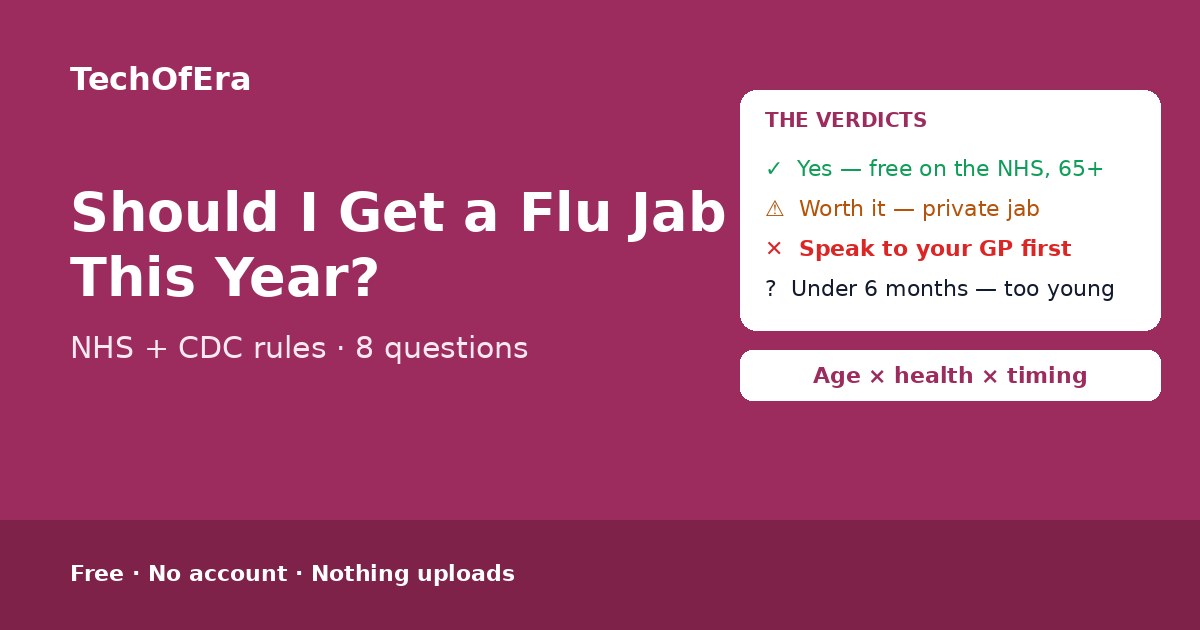
How to decide whether you should get a flu jab this year
The question sounds simple, but the answer turns on four things: your age, your health, whether you are pregnant, and who you care for or live with. And the rules are rebuilt every year — the eligible groups are confirmed fresh each winter on expert advice, so last winter's list is not a guide. This checker uses the NHS winter 2026-27 rules and the CDC flu vaccine guidance, as they read in November 2026, and it says plainly when the answer is to speak to your GP first.
To use it:
- Answer for the right person. The jab is for you, or for a child you care for — the questions are the same either way. Children under 6 months cannot have a flu vaccine at all; children aged 2 or 3 and school-aged children are offered it; adults 65 and over are in a free NHS group.
- Be honest about your condition. The NHS list is specific: asthma needing a steroid inhaler or tablets, COPD, heart disease, chronic kidney or liver disease, some neurological conditions, diabetes, a weakened immune system, spleen problems, a learning disability, or a BMI of 40 or above. Not every long-term condition counts — if you are not sure whether yours does, say so, and the checker will tell you to ask your GP rather than guessing.
- Do not hide an allergy or a past reaction. A mild egg allergy does not stop you having a flu vaccine. A severe egg allergy, a severe allergic reaction to a flu vaccine before, or Guillain-Barré syndrome after one, is different: for those, the verdict is always speak to your GP first, and the checker never gives a definitive yes or no.
- Mind the timing. The best time is in the autumn — September or October — before flu starts circulating, and protection builds in about 2 weeks. But it is still worth having later in winter while flu is circulating: eligible adults in the UK can still be vaccinated up to 31 March 2027.
- Check how you feel today. A mild cold with no fever is fine — you can get the jab. A fever, or being moderately to severely ill, is a reason to wait until you recover, then book it.
- Know what to do with the verdict. A free NHS group means book through your GP, a pharmacy, or the NHS App, or by calling 119 — you do not need to wait for an invitation. Not a free group means a private jab at a pharmacy, usually for a small fee, or through your employer.
Who is eligible, and what it means, at a glance
The table below is built from the same rules as the checker, so it can never disagree with your verdict. The groups, the country and the timing decide, together.
| Group | Verdict | What to know |
|---|
What makes this checker different
The pages that rank for this search are guides — thorough lists of who is eligible, the timing, and the general advice to get vaccinated — but they leave you to do the work yourself: to read a long list, work out whether your condition counts, judge whether your egg allergy matters, and decide whether being ill today changes the answer. The eligibility checkers that do exist are thin pages on local pharmacy websites: they cover the NHS list only, they exist to sell you a private jab if you are not eligible, and they say nothing about the US, about timing, about pregnancy, or about past reactions. This page is the answer as it is actually asked: “should I get a flu jab this year?” — your age, your country, your health, your pregnancy, your egg allergy, your past reactions, who you care for, and how you feel today, scored together, with a verdict for your exact situation — yes and free, worth getting privately, wait until you recover, or speak to your GP first — and the reason named. It is a self-assessment, so it says plainly what it cannot know: a web page cannot examine you or know your medical history, so anything you mark “Not sure” stays on the list until you confirm it.
When is this the right check?
Whenever the question comes up: the autumn, when the invitation lands or the pharmacy poster goes up and you are not sure whether it applies to you; the week you turn 65 and wonder whether the free offer starts now; the pregnancy when you are not sure whether the jab is safe for the baby; the year you develop a new condition and do not know whether it counts; the winter you are already ill and wondering whether to wait; the year you moved country and the rules changed; or the evening you realise you had the jab last year and cannot remember whether that still counts — it does not, you need it every year. Also whenever the conditions are borderline and the decision turns on something specific — whether a mild egg allergy matters, whether a sore arm last year counts as a reaction, whether being a carer puts you in a free group, or whether it is too late in the season to bother.
Honest limitations
A self-assessment, not medical advice
This checker works only from the answers you enter. It cannot examine you — no web page can read your medical history, know your medicines, or know how severe a past reaction really was. If an answer is wrong, the verdict is wrong. When in doubt, speak to your GP or pharmacist.
Some verdicts are always “ask your GP”
A severe allergic reaction to a flu vaccine before, Guillain-Barré syndrome after one, or a severe egg allergy are cases where only a clinician who knows your history can decide. This checker never gives a definitive yes or no for those — the verdict is speak to your GP first, and that is deliberate.
The rules change every year
The eligible groups are confirmed fresh every winter on expert advice, so last winter's rules are not a guide. This checker uses the NHS winter 2026-27 rules and the CDC guidance as they read in November 2026. Re-check if a new season's list appears.
The checker cannot read your records
The verdict is only as good as the answers you give. If you are not sure whether your condition counts, or cannot remember a past reaction, the checker says it cannot tell — ask your GP surgery, who hold your vaccination record and can check.
UK and US rules only
The free offer and the booking routes on this page are the UK NHS rules; the general recommendation is the US CDC one. Other countries have their own lists and their own free offers — the medical case for the jab is the same everywhere, but check your national health service for the local rules.
A jab does not stop every flu
The vaccine is reformulated every year to keep pace with the changing virus, and it does not stop every infection — but it reduces your chance of severe flu, hospital stays and missed work or school. That is the point of it, and why the advice is to get one every year.