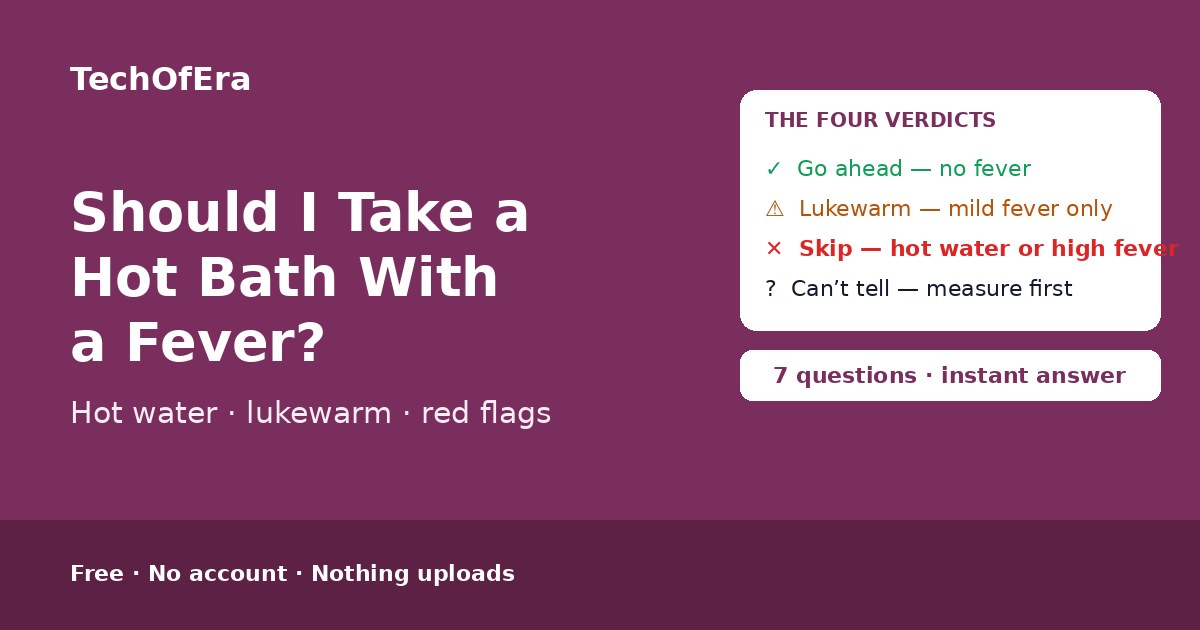
How to decide whether to bathe with a fever
Most pages that rank for this question give the same short answer — lukewarm is fine, hot and cold are not — and then leave you to work out what that means for the fever you have right now: how high is too high, what counts as lukewarm, whether feeling dizzy changes anything, and when the answer is not a bath at all but a doctor. The rules below are the ones mainstream guidance agrees on: a fever is 38°C (100.4°F) or higher; a hot bath adds heat to a body that is already overheated; cold water triggers shivering, which generates heat; and a lukewarm bath is a comfort measure, not a treatment. This checker asks exactly what decides it.
To use it:
- Take your temperature. Fever is the hard line: 38°C (100.4°F) or above. Feeling feverish is not a measurement — take your temperature before deciding, and do not use paracetamol or ibuprofen to make a fever “pass” the check.
- Decide the water. Lukewarm means 32–35°C (90–95°F) — neutral to the touch, tested with your wrist. Hot water (over 40°C) adds heat and worsens dehydration and dizziness; cold water or ice triggers shivering, which pushes your temperature up instead of down.
- Check you can stand safely. A hot, wet bathroom is a fall risk. If you are dizzy, very weak or shaky, skip the bath and rest. If you fainted recently or cannot stand safely, get medical help — a bathroom is the worst place to faint.
- Watch for the red flags. Chest pain, breathlessness, confusion, a stiff neck, or a rash that does not fade when pressed are not bath questions — they need a clinician today, whatever your temperature. So does a fever of 39.4°C (103°F) or higher, or one lasting more than three days.
- Keep it short. Ten to fifteen minutes, then dry off and dress lightly. Longer soaking adds dehydration and fatigue without adding benefit. Drink a glass of water before you get in and another one after you get out.
- Stop if shivering starts. Shivering means your body is generating heat to compensate — at that point the bath is doing more harm than good. Get out, dry off, and use a light blanket until the chills end.
Bathing situations and what to do at a glance
The table below is built from the same rules as the checker, so it can never disagree with your verdict. Your temperature, the water temperature and whether you can stand safely decide together.
| Bathing situation | Verdict | What to know |
|---|
What makes this checker different
The pages that rank for this search are guides — careful explanations of why lukewarm water is the right temperature, why hot water adds heat, and why cold water triggers shivering — but they leave you to apply a general rule to your own situation: whether your fever is mild or high, whether feeling dizzy changes the answer, whether being pregnant or over 65 changes how soon to call a clinician, and whether a shower is safer than a bath. They also rarely name the red flags — chest pain, breathlessness, confusion, a stiff neck, a non-fading rash — that override the bathing question entirely. This page is that answer: seven questions, an instant verdict, the reason named, and the red flags stated plainly instead of buried in the text — with nothing to install, no account, and nothing uploaded. It is a self-assessment, so it says plainly what it cannot know: a web page cannot take your temperature, check your pulse, or know your medical history, so anything you mark “Not sure” stays on the list until you confirm it.
When is this the right check?
Whenever you wake up with a fever and wonder whether a bath will help or hurt: the hot bath you usually take after a long day, the lukewarm soak a relative suggested, the cold shower someone swears by. Also whenever the fever is new and you are not sure what counts: feeling feverish versus a measured temperature, warm versus lukewarm water, tiredness versus being too weak to stand safely. And whenever the fever comes with something else — shivering, vomiting, dizziness — and you need to know whether the bath is still an option at all. If the answer is “skip the bath”, the checker names the safer comfort measure too: a damp lukewarm cloth on your forehead and neck, never cold water or ice.
Honest limitations
A self-assessment, not a diagnosis
This checker works only from the answers you enter. It cannot diagnose you — no web page can take your temperature, check your pulse, or know your medical history. If an answer is wrong, the verdict is wrong. When in doubt, skip the bath — or ask a clinician.
A bath treats comfort, not the fever
A lukewarm bath soothes aches and cools the skin, but it barely changes your core temperature — about 0.3°C more than fever medicine alone — because the brain's set point has not moved. Rest, fluids and fever medicine as the label directs are the treatment; the bath is only comfort.
Red flags override everything
Chest pain, breathlessness, confusion, a stiff neck, a rash that does not fade when pressed, repeated vomiting or signs of dehydration mean medical care, not a bath. Fainting with a fever needs medical help now. Those are not bath questions — do not try to bathe first and decide later.
Fever medicine does not clear you
Paracetamol and ibuprofen can lower a temperature, so do not use them to make a fever “pass” the check. If you took medicine, wait 20–30 minutes for it to start working before bathing — and remember the bath is for comfort, not treatment.
This checker is for adults
Children follow different rules: any fever in a baby under three months needs same-day medical care, and NHS guidance says do not sponge children with cool water to treat a fever. For a child with a fever, call your paediatrician or NHS 111 instead of using this checker.
Rules from Mayo Clinic, NHS and St John Ambulance guidance
The rules here follow Mayo Clinic fever first-aid guidance, NHS Healthier Together flu guidance and NHS fever-in-adults patient guidance, and St John Ambulance fever first aid, as they read in November 2026. Guidance can be revised, so re-check if a new edition appears.