Can you exercise with a fever — or should you rest today?

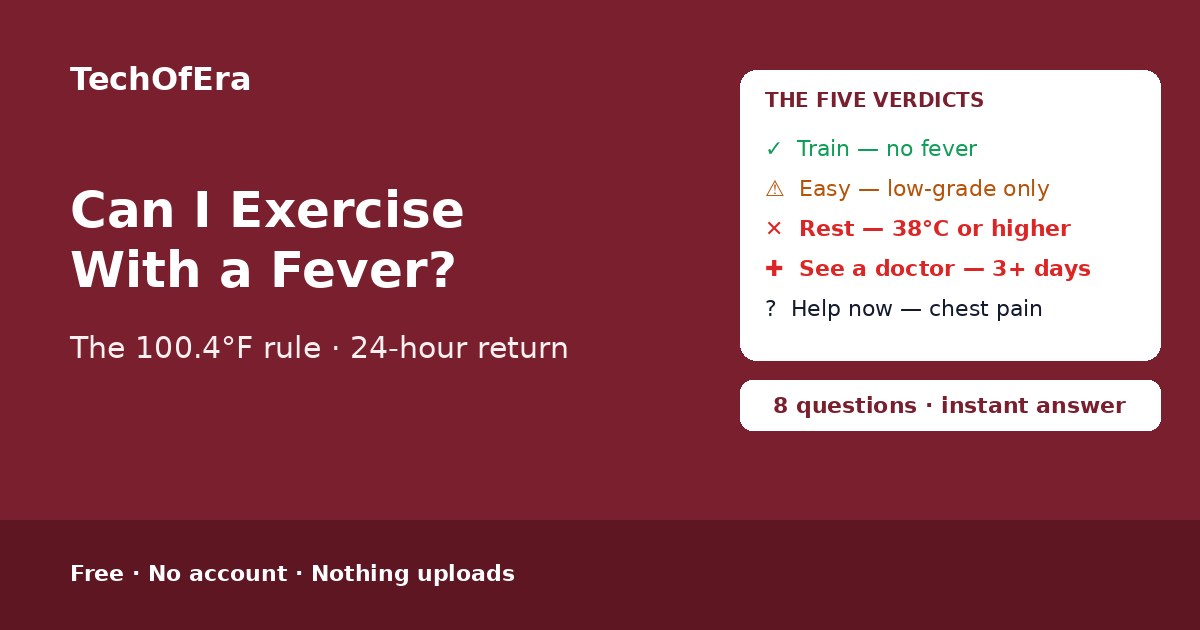
38°C (100.4°F) is the line: at or above it, rest — exercise raises your temperature further and adds dehydration and heart strain to a body already fighting an infection. Below it, a low-grade fever may allow 15–20 minutes of gentle movement, but only with no other symptoms. And chest pain, a racing heartbeat, unusual breathlessness or dizziness override everything: those need urgent medical help. Answer eight questions and get an instant verdict for the exact fever you have right now. Entirely in your browser.

  • Instant verdict — train, train easy, rest, see a doctor, or get help now
  • Fever-first — temperature band, duration, 24-hour return clock
  • Heart red flags named — chest pain, racing heartbeat, dizziness
  • Free, no account, nothing uploads
Can I exercise with a fever — or should you rest today?

Check before you train

Try a preset:
0 of 6 answered

Your result

Answer the questions Your verdict appears here as you answer.
What this combination can do

Answer the questions above and what this combination can do will appear here.

Blockers

Cautions

Still to confirm

Things to check

What to do next

    Your result summary


    Answer the questions above — the verdict updates live.

    Privacy you can verify, not just trust

    Checking a health question by uploading details of your symptoms to a website would be backwards — the check should never be the leak. This one can't: your answers are checked with plain JavaScript on your device, and they never leave the device — the only third-party requests are the site's own analytics, which count page views. Don't take our word for it:

    New cross-origin requests during use: 0
    1. Press F12 to open developer tools, then the Network tab.
    2. Answer a question above. Watch: apart from the site's analytics, nothing new is requested — no uploads, and no data ever leaves your device.
    3. Extra credit: disconnect your internet after this page loads — the checker still works.

    How to decide whether to exercise with a fever

    A fever is not a cold symptom to sort by the neck — it is the decision itself. Sports doctors use the neck check for colds: symptoms above the neck may allow light exercise, anything below the neck or whole-body means rest. A fever sits firmly in the second group: it means the infection has gone systemic, your whole body is fighting it, and exercise adds heat, dehydration and heart strain on top. The line is 38°C (100.4°F) — the clinical definition of a fever, agreed by Mayo Clinic, UNC Health, Henry Ford Health and the American Heart Association. Below it, a low-grade fever of 37.5–37.9°C may allow 15–20 minutes of gentle movement, but only with no other symptoms at all. This checker asks exactly what decides it: the temperature band, how long it has lasted, whether it has been gone for 24 hours without medicine, and the chest, body and fluid symptoms that change the answer.

    To use it:

    1. Take your temperature. The band decides the verdict: below 37.5°C (99.5°F) is no fever; 37.5–37.9°C is low-grade; 38°C (100.4°F) or above means rest; 39°C (102.2°F) or above is a high fever. Feeling feverish is not a measurement — take your temperature before deciding, and do not use paracetamol or ibuprofen to make a fever “pass” the check.
    2. Count the days. A fever that has run more than 3 days needs a clinician, even if it has started to come down. A temperature above 39.4°C (103°F) needs one too.
    3. Check the 24-hour clock. Has the fever been gone for a full 24 hours without fever-reducing medicine? If it broke less than a day ago, or is still there, rest — the return rule has not been met.
    4. Watch for the red flags. Chest pain or tightness, a racing or irregular heartbeat, unusual breathlessness, or dizziness or lightheadedness with a fever are not rest-day questions — they can be signs of heart inflammation (myocarditis). Stop exercising and seek urgent medical help.
    5. Check fluids. A fever pulls water out of your body, and a workout pulls out more. If you are vomiting, have diarrhoea, or are drinking less than usual, rest and sip fluids — dehydration can impair your ability to regulate your body temperature.
    6. Downgrade the session, not just the decision. With a low-grade fever, swap intervals, a long run, heavy lifting or a race for a gentle 15–20 minute session — a short walk, gentle stretching or light yoga. Use the ten-minute rule: if you feel worse after ten minutes, stop. Skip hot rooms, hot yoga and training in hot weather.
    7. Train solo. A feverish illness is still contagious. Skip the gym and group classes until you have been fever-free for 24 hours — a walk, a light jog outdoors, or gentle movement at home instead.
    8. Come back gradually. After a fever, wait at least 24 hours after it has fully gone, without fever-reducing medicine, and only when symptoms are improving. Start at about 50% intensity and build back over several days — symptoms often clear before the body has fully recovered. If the illness was more severe, like flu, ease back over 5–7 days.

    Fever situations and what to do at a glance

    The table below is built from the same rules as the checker, so it can never disagree with your verdict. Your temperature band decides, together with how long the fever has lasted and whether it has been gone for 24 hours.

    Fever situationVerdictWhat to know

    What makes this checker different

    The pages that rank for this search are guides — thorough explanations of the 38°C fever line, the neck check, and the 24-hour rule for coming back — but they leave you to work out what that means for the fever you have right now: whether 37.8°C counts, whether a fever that broke yesterday morning clears you for a session tonight, whether drinking less than usual matters, whether a heart condition changes the answer, and whether a gym session is different from a solo walk. They also rarely name the heart red flags — chest pain, a racing heartbeat, unusual breathlessness, dizziness — that override the rule entirely. This page is that answer: eight questions, an instant verdict, the reason named, and the temperature bands, the 24-hour clock and the red flags stated plainly instead of buried in the text — with nothing to install, no account, and nothing uploaded. It is a self-assessment, so it says plainly what it cannot know: a web page cannot take your temperature, listen to your chest, or know your medical history, so anything you mark “Not sure” stays on the list until you confirm it. It is also different from the cold checker: that one sorts a cold by the neck, while this one starts from the fever — the temperature bands, how long it has lasted, the 24-hour return clock, and the dehydration and heart-risk questions the cold checker never asks.

    When is this the right check?

    Whenever you wake up with a fever and a training session on the plan: the 38.5°C reading on a run day, the low-grade temperature the morning of a gym class, the fever that arrived overnight before a race. Also whenever the fever has broken and you want to know whether today is the day — the checker applies the 24-hour rule for you, and ramps you back at 50% instead of letting you jump straight into a hard session. And whenever you are not sure what counts: a low-grade fever versus a real one, drinking less than usual versus being properly hydrated, feeling wiped out versus just tired. If the answer is “see a doctor”, the checker names the return rule too — fever gone for 24 hours without medicine, symptoms improving, then easy sessions first.

    Honest limitations

    A self-assessment, not a diagnosis

    This checker works only from the answers you enter. It cannot diagnose you — no web page can take your temperature, listen to your chest, or know your medical history. If an answer is wrong, the verdict is wrong. When in doubt, rest — or ask a clinician.

    The 100.4°F rule is a clinical line, not a guarantee

    38°C (100.4°F) is the agreed definition of a fever, but a temperature below it does not prove you are well — and a temperature above it does not say what is causing it. The rule is sensible guidance from sports-medicine sources, not a medical clearance.

    Heart red flags override everything

    Chest pain or tightness, a racing or irregular heartbeat, unusual breathlessness, or dizziness with a fever can be signs of heart inflammation. Those are not rest-day questions — stop exercising and seek urgent medical help.

    Fever medicine does not clear you

    Paracetamol and ibuprofen can lower a temperature, so do not use them to make a fever “pass” the check. The return rule is 24 hours fever-free without medicine, with symptoms improving.

    Easy means easy

    Gentle movement with a low-grade fever means 15–20 minutes at low intensity — a short walk, gentle stretching, light yoga. A threshold session, a long run or a race with any fever is not gentle, and the checker never clears one.

    Rules from public-health sources

    The rules here follow Mayo Clinic exercise-and-illness guidance, UNC Health, Henry Ford Health and University of Miami sports-medicine guidance, the American Heart Association, IDEA Health & Fitness Association guidance and the 2022 IOC consensus statement, as they read in November 2026. Guidance can be revised, so re-check if a new edition appears.

    Frequently asked questions

    Can I exercise with a fever?

    No — not with a fever of 38°C (100.4°F) or above. At that temperature your body is fighting a systemic infection, and exercise raises your body temperature further while adding dehydration and heart strain. Rest until you have had no fever for at least 24 hours without paracetamol or ibuprofen masking it, and your symptoms are improving. A low-grade fever below 38°C is the one exception: gentle movement of 15–20 minutes may be considered, but only with no other symptoms — no aches, chills, chest symptoms, vomiting or dizziness — and you stop at once if you feel worse. If you are unsure, rest — or ask a clinician.

    What temperature is too high to exercise?

    38°C (100.4°F) is the line: at or above it, do not exercise. That is the clinical definition of a fever, and every major sports-medicine source agrees on it — Mayo Clinic, UNC Health, Henry Ford Health and the American Heart Association all say a fever means rest. A temperature of 39°C (102.2°F) or higher is a high fever: rest, drink fluids, and get medical advice if it lasts more than 3 days or goes above 39.4°C (103°F). Below 38°C, a low-grade fever of 37.5–37.9°C (99.5–100.3°F) may allow gentle movement only if you have no other symptoms at all. Feeling feverish without a thermometer is not a measurement — take your temperature before deciding.

    Can I exercise with a low-grade fever?

    Maybe — with strict conditions. If your temperature is below 38°C (100.4°F), you have no body aches, no chills, no chest symptoms, no vomiting and no dizziness, and you feel mostly functional, gentle movement may be considered: a short walk, gentle stretching or light yoga for 15–20 minutes at low intensity. Avoid high-intensity interval training, heavy weightlifting, long-distance running, competitive sport, hot yoga and exercising in hot weather. Stop immediately if symptoms worsen, you start shivering, or you feel dizzy. If any other symptom is present, rest instead — a low-grade fever plus aches or chills means the infection has gone systemic.

    How long should I wait after a fever before exercising?

    Wait until you have had no fever for at least 24 hours without paracetamol or ibuprofen masking it, and your symptoms are improving. When you do come back, start at about 50% intensity, keep the session short, and build back gradually over several days — do not jump straight back into a hard session or a race. If the illness was more severe, like flu, ease back over 5–7 days. If symptoms return, scale back again. Symptoms often clear before the body has fully recovered, so if your resting heart rate is still high, wait another day.

    Why is exercising with a fever dangerous?

    Three reasons. First, heat: exercise raises your body temperature, and a fever already has it raised — together they can push it into a dangerous range. Second, dehydration: a fever pulls water out of your body, and a workout pulls out more, which can impair your ability to regulate your temperature. Third, the heart: exercising with a fever can prolong the illness and put you at risk of heart problems such as myocarditis (inflammation of the heart) or arrhythmia, and in extreme cases strenuous exercise during a fever can be fatal. A fever also lowers your strength, endurance, speed, coordination and tolerance for exertion, so injury is more likely too.

    Can I go to the gym with a fever?

    No — never go to the gym with a fever. Apart from the risk to you, a feverish illness is contagious, and a gym spreads it through shared equipment and close quarters. Wait until you have been fever-free for 24 hours without medicine and your symptoms are improving, then come back at about 50% intensity. Even with only a low-grade fever below 38°C, train solo — a walk, a light jog outdoors, or gentle movement at home — and only if you have no other symptoms. If you really have to go to a gym, wash your hands, wipe down equipment, and do not go while you are still feverish.

    When should I see a doctor about a fever?

    See a clinician if your fever has lasted more than 3 days, or your temperature goes above 39.4°C (103°F). Get urgent help straight away — call your local emergency number or go to urgent care — if the fever comes with chest pain, trouble breathing, a severe headache, confusion, a stiff neck, persistent vomiting, fainting, or dizziness. Also see a clinician before training if you have a fever plus asthma, a heart condition, a weak immune system, or you are over 65 or pregnant. A fever that keeps coming back, or one that follows a recent bout of flu or COVID-19, deserves a check too.

    Does this checker diagnose me or upload anything?

    No to both. This checker is a self-assessment: it works only from the answers you pick, runs entirely in your browser with plain JavaScript, and nothing you enter leaves your device. It cannot diagnose you — a web page has no way to take your temperature, listen to your chest, or know your medical history — so every answer you are unsure about is reported as something to confirm, and the result says so plainly. The only third-party requests are the site's own analytics, which count page views. You can verify it yourself with the network-request counter in the privacy section below the checker.