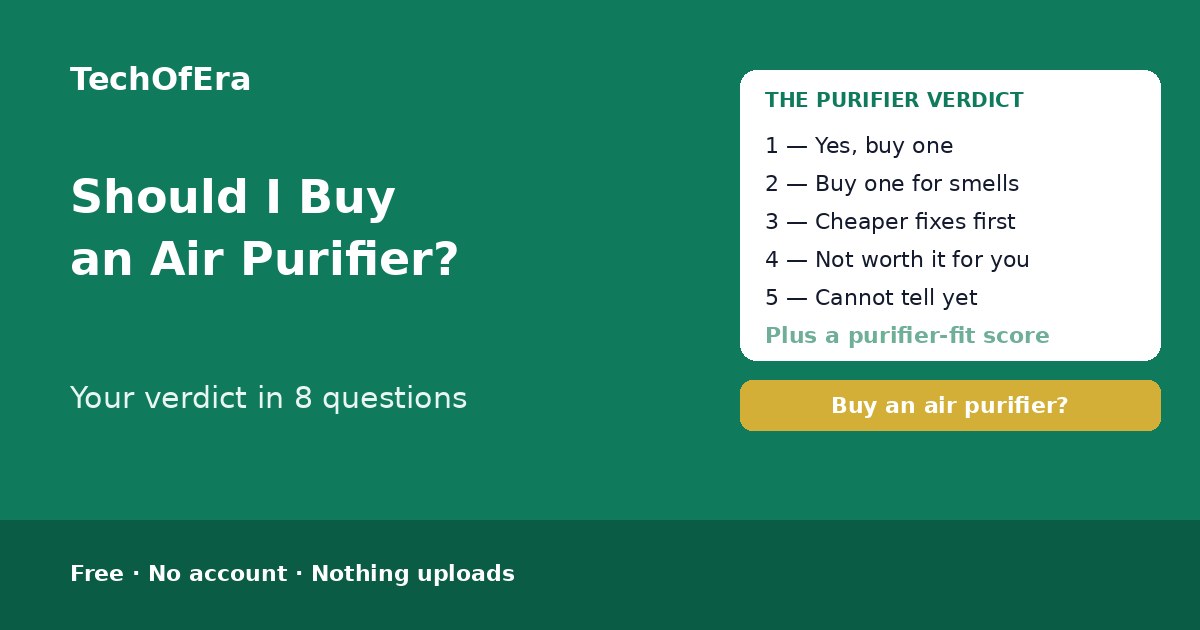
How the air purifier check works
An air purifier is a fan that pulls room air through a filter and blows it back out. A good one with a true HEPA filter removes most of the fine particles floating in a room: smoke, pollen, pet dander and dust. A 2024 systematic review of 83 field studies found portable air cleaners cut indoor fine-particle (PM2.5) levels by 49% on average — a real, measurable improvement in the air you breathe. But the health benefits are real but modest, and largest for people with asthma, allergies or high exposure to smoke and pollution. And a purifier only does one thing: it filters particles out of the air in one room. It does not remove gases, it does not catch dust that has already settled, it does not fix mould or stale air, and it does not clean a whole home. This checker weighs all eight questions and gives you a verdict: yes, buy one; yes, but buy one for smells; try cheaper fixes first; not worth it for you; or cannot tell yet — plus a purifier-fit score from 0 to 100 and the smoke CADR to look for.
To use it:
- Say what the main problem is. Allergies, asthma, pets, smoke, dust, smells, stuffy air — or just curious. A purifier only helps with airborne particles: if the problem is smells or stale air, the answer is different.
- Say how big the room is. Under 150 sq ft, 150–300, 300–500, or over 500 sq ft — or the whole home. A purifier is sized to one room, and the size decides the CADR you need.
- Say who breathes the air most. Someone with asthma or allergies, a baby, an older person, just you, or nobody in particular. People with asthma or allergies get the most from a purifier.
- Say how the ventilation is. Poor, with windows shut; outdoor air bad; sometimes open; or good, with fresh air coming in easily. Fresh air is the cheapest air cleaner there is — but only when the outdoor air is clean.
- Say whether the source can be fixed. Wildfire smoke, traffic and pollen cannot be removed; a smoking habit, a weak extractor fan or a dusty hobby can. The EPA puts source control first, before ventilation and before air cleaning.
- Say what the budget is. Under $100, $100–$250, or over $250. A small bedroom unit costs far less than a large-room one — but check the CADR, not just the price.
- Say how quiet it must be. It must be quiet while you sleep, some noise is fine, or noise does not matter. A purifier on high is loud, so the CADR on its quietest setting is the number that matters.
- Say how often it would run. All the time on auto, only on bad days, or rarely. A purifier only cleans the air while it is running — particles build up again within hours of switching it off.
The five verdicts, and what each one means
Yes — buy one
The problem is airborne particles, and a filter is the right tool for them. Buy a true HEPA purifier — not "HEPA-type" or "HEPA-like" — with a smoke CADR of at least two-thirds of the room's area in square feet. Put it in the bedroom, run it on auto, all the time, and skip anything that makes ozone.
Yes — but buy one for smells
Smells are gases, and a HEPA filter catches particles only — it will not touch them. What you need is a unit with a thick activated-carbon filter, not a thin carbon sheet, and even then the carbon saturates and needs replacing. Fixing the source — a better extractor fan, lids on pans — still does more than any filter.
Try cheaper fixes first
A purifier would help a little, but the cheaper fix does more: remove or cut down the source, open the windows when the outdoor air is clean, or pick the one room you use most. A portable purifier only cleans one room, so a whole home needs a different answer. Give the fix a week or two, then run this check again.
Not worth it for you
There is no particle problem a purifier can solve here: no real problem, stale air that a window would fix, or a purifier that would sit switched off. A purifier only helps while it is running, and one that is never switched on is money spent on a box. Save the money.
Cannot tell yet
Not enough answers to judge: the verdict needs to know the main problem, the room size, who breathes the air, the ventilation, and whether the source can be fixed. Answer the first questions and the verdict appears — and where the answer is unclear, the checker says so instead of guessing.
Which problems a purifier solves, and which it does not
The reference table the checker works from — problem on the left, the verdict and what to do on the right:
| Problem × situation | Verdict | What to do |
|---|---|---|
| Allergies, medium bedroom, poor ventilation | Yes — buy one | True HEPA, smoke CADR at least 200, run on auto in the bedroom |
| Wildfire smoke, closed room, outdoor air bad | Yes — buy one | True HEPA, sized to the room, windows shut, run all the time |
| Asthma in the house, purifier would run all the time | Yes — buy one | True HEPA in the bedroom, on auto — but it is not a treatment |
| Pets, dander in the air, bedroom | Yes — buy one | True HEPA in the room the pet sleeps in, plus a HEPA vacuum |
| Cooking smells, small flat | Yes — but buy one for smells | Thick activated-carbon filter — and fix the extractor fan too |
| Smells only, HEPA unit with no carbon | Yes — but buy one for smells | HEPA alone will not touch smells — carbon is what you need |
| Stuffy air, good ventilation | Not worth it for you | Open a window — fresh air does what a filter cannot |
| No real problem, just curious | Not worth it for you | Save the money; run this check again if a problem shows up |
| Would rarely run it | Not worth it for you | A purifier only helps while it is running — do not buy a box |
| Whole home, not one room | Try cheaper fixes first | Pick the room you use most — a portable unit only does one room |
| Source can be fixed (extractor fan, smoking) | Try cheaper fixes first | Fix the source first — a filter only mops up what it keeps producing |
| Large room, budget under $100 | Yes — buy one | Budget $150 or more, or clean one smaller room at a time |
Your step-by-step routine: buy the right size, then run it
Whatever the verdict, this is the routine the checker is aiming for — the plan it builds from your answers:
- Fix the source first, if you can. A better extractor fan, lids on pans, fewer candles, shoes off at the door. The EPA puts source control first, before ventilation and before air cleaning — a filter only mops up what the source keeps producing.
- Pick one room — usually the bedroom. A portable purifier only cleans the room it sits in, and the bedroom is where you spend a third of your life. Do not buy for the whole home.
- Size it by smoke CADR. Look for a smoke CADR of at least two-thirds of the room's area in square feet: 100 for a 150 sq ft bedroom, 200 for a 300 sq ft room, 333 for a 500 sq ft room. Buy a little more CADR than you need, so it can run quiet on low.
- Buy true HEPA — and carbon if smells are the problem. Look for the words true HEPA, not "HEPA-type" or "HEPA-like". For smells, you need a thick activated-carbon filter as well. Skip ionisers and anything that makes ozone.
- Run it on auto, all the time. Particles build up again within hours of switching it off. A modern unit on low uses about as much power as an LED bulb.
- Budget for the filters. HEPA filters need replacing every 6–12 months, and carbon filters saturate sooner. Check the replacement price before you buy — it is the real running cost.
What makes this checker different
The pages that rank for this search are guides — a productbible.com explainer on whether air purifiers are worth it, a stasishome.com guide on whether you need one, a homeairqualitylab.com decision guide, and a verywellhome.com list of reasons to buy one. They all answer the same question in words: yes, if you have allergies or smoke; no, if you want to fix dust mites or stale air. None of them asks what your room size is, who breathes the air, whether the windows can open, whether the source can be fixed, what your budget is, or how often you would run it — and none of them gives you a verdict for your exact home, or tells you which type to buy and what CADR to look for. This page is the answer the guides do not give: eight questions, an instant verdict, a purifier-fit score, the blockers named, and a buying plan built from your answers. It is a self-assessment, so it says plainly what it cannot know: it cannot see, test or measure your air.
This checker also answers a different question from the Humidifier or Dehumidifier? Checker — that one is about humidity, which device to use when the air is too damp or too dry; this one is about particles in the air, and whether a filter is worth buying at all. The Is My House Too Humid? Checker reads a humidity number and tells you whether the air is too damp, and the Should I Run My Humidifier All Night? Checker plans an overnight run for a humidifier you already own — neither of them decides whether to buy a purifier. The Should I Buy a Soundbar? Checker follows the same buy-or-not pattern for a different product entirely. The four go together: a home with damp air needs a dehumidifier, a home with particles in the air needs a purifier, and a home with both needs both — in different rooms, for different reasons.
When is this the right check?
When you are about to spend money on an air purifier and want to know whether it will actually help — because the answer genuinely changes with the problem, the room, the ventilation and whether you would run it. When wildfire smoke or high pollen is coming and you want the right size, not just any unit. When the problem is smells and you want to know whether a purifier can fix them (it cannot, unless it has real activated carbon). And when someone in the house has asthma or allergies and you want to know whether a filter is worth it, or whether the money is better spent elsewhere.
Honest limitations
A self-assessment, not health advice
This checker cannot see, test or measure your air. It cannot tell whether your air is safe. If anyone in the home has serious breathing trouble, talk to a doctor — a purifier is not a treatment.
The fit score is a comparison, not a measurement
The purifier-fit score from 0 to 100 is the checker's own judgement: it weighs your answers against each other so you can compare situations. It is not a reading from your air — no web page can read your air quality.
CADR figures are a rule of thumb
The two-thirds rule comes from the EPA and the AHAM Verifide directory, and it assumes 8-foot ceilings and a closed room. Open-plan rooms, high ceilings and doors left open all change what a purifier can do — treat the CADR target as a starting point, not a promise.
Filter prices and lifetimes vary
Replacement filters are a cost every 6–12 months, and the price varies by brand and by model — sometimes a cheap unit has expensive filters. Check the replacement price before you buy, not after.
One room at a time
This checker looks at one room at a time. It does not check the rest of the house, and it does not ask whether anyone else would move the purifier between rooms — so run it once per room, and buy for the room you use most.
Rules from official sources, dated November 2026
The rules here are the air-cleaner guidance from the US Environmental Protection Agency and the sizing guidance from the AHAM Verifide directory, as they read in November 2026. Guidance changes: recheck with the official sources if anything about the guidance, or about your home, changes.