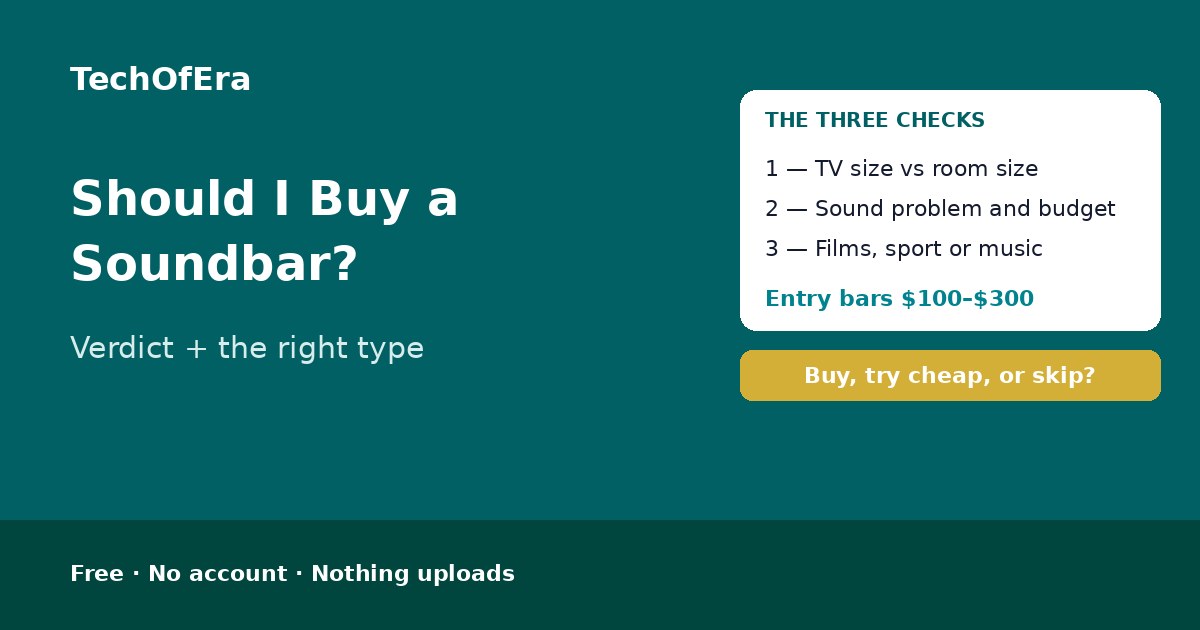
How the soundbar check works
Modern flat-panel TVs are thin by design, and that thinness leaves almost no room for a real speaker: the sound is thin, the bass is weak and dialogue gets lost, especially at lower volumes. A soundbar fixes exactly that weakness for the overwhelming majority of living rooms — clearer dialogue, stronger bass and a wider soundstage — with entry-level bars at roughly $100–$300 and high-end bars at roughly $400–$1,000 in the buying guides. This checker combines eight clues — how big your TV is, how big your room is, what is wrong with the sound now, what you can spend, what you watch, whether the TV is wall-mounted, whether you want a voice assistant, and whether you want a subwoofer — plus what else is true, and gives you a fit score out of 100, a verdict, the type to buy, and the budget range.
To use it:
- Say how big your TV is. Measure across the screen diagonally in inches — a 55-inch TV is about 140 cm across. The bar should be wider than half the TV so it does not look lost underneath it.
- Say how big your room is. A living room of 12–25 m² suits a soundbar best: the bar can fill the room, and an Atmos bar has walls close by to bounce sound off. A small bedroom needs only a compact bar, and a big open-plan room weakens the effect.
- Say what is wrong with the sound now. Dialogue you miss points to a centre channel; thin sound with no bass points to a subwoofer. If you are already happy with the sound, the checker says so instead of selling you a bar.
- Say what you can spend, and what you watch most. Entry-level bars run roughly $100–$300 and high-end bars roughly $400–$1,000 — and under $100 barely beats a TV’s own speakers. Films and gaming gain the most from a soundbar; casual news viewing gains the least, and music-first listening points to separate speakers.
- Say whether the TV is wall-mounted, whether you want a voice assistant, and whether you want a subwoofer. A wall-mounted TV with upward-firing drivers gains the most from Atmos, because the sound has a clear path to the ceiling. A subwoofer adds the bass TV speakers cannot make — it matters most for films.
- Tick what else is true. Finding dialogue hard to follow, thin walls, renting, or wanting Dolby Atmos shape which type to buy — a centre channel for dialogue, a night mode for neighbours, a wireless subwoofer for a rental with no cable run.
Which soundbar type fits which room
The table below is the checker’s own summary of the buying guidance — use it as a quick reference, then answer the questions for the verdict on your exact setup. Prices are the ranges in the buying guides; the mid-range figure is the checker’s estimate from those bands, not a quoted price.
| Soundbar type | Best room | Best TV size | Typical price |
|---|---|---|---|
| Compact bar | Under 12 m² — bedroom | Under 43 inches | $100–$300 |
| Bar + subwoofer | 12–25 m² — living room | 43–65 inches | $200–$500 (estimate) |
| Dolby Atmos bar | 12–40 m², walled + flat ceiling | 55 inches and up | $400–$1,000 |
What makes this checker different
The pages that rank for this search are guides — one audio site runs several near-identical articles asking the same question, a buying guide compares soundbars with speakers across price, room size and setup, and a recent guide walks through the difference a bar makes over built-in TV speakers. None of them asks how big your TV is, how big your room is, what is wrong with the sound now, or what you can spend, and none of them tells you whether to buy or which type fits your setup. There is no free, standalone checker that takes your TV size, room size, sound problem, budget, viewing habits, mounting, voice assistant and subwoofer need and gives you a fit score, a buy-or-skip verdict, the type to buy and the budget range. This page is that answer: eight questions, an instant verdict for your exact setup, the blockers named, and the next steps. It is a self-assessment, so it says plainly what it cannot know: it cannot hear your TV, and where you are already happy with the sound, or music comes first in a big room, it says skip or buy speakers instead of selling you a soundbar.
When is this the right check?
When you are standing in a shop — or on a sale page — wondering whether the soundbar in front of you is worth the money, and the answer depends on your TV and room, not the box. When you keep turning the volume up and down because the dialogue is too quiet and the explosions are too loud, and you want to know whether a bar would actually fix that or just make everything louder. When you have a small bedroom TV and a nagging feeling a soundbar would be an expensive way to fix a problem you do not have. And when music matters most to you — because that is where a soundbar is the wrong buy, and this checker says so.
Honest limitations
A self-assessment, not a showroom
This checker cannot hear your TV, measure your room, or know how much the dialogue really bothers you. It cannot check whether your room has the walls an Atmos bar needs, how thin your TV’s speakers really sound, or what a soundbar would do in your room. Try a model from a shop with a good returns policy before you commit.
The score is a guide, not a diagnosis
A score of 92 does not mean a soundbar will change your evenings, and a score of 58 does not mean your setup is wrong for one. The score weighs the TV size, the room, the sound problem, the budget and your viewing habits together — but only living with a bar for a month can say whether it earns its keep.
The prices are ranges, not quotes
The price bands are the ranges in the buying guides — entry-level bars roughly $100–$300, high-end bars roughly $400–$1,000 — and the mid-range $200–$500 figure for a bar with a subwoofer is the checker’s estimate from those bands, not a quoted price. Check the shelf price before you buy, and recheck the guidance before you spend.
The cheapest bars barely help
A bar under $100 barely beats a TV’s own speakers: a tiny amplifier and two small drivers run into the same size limits a TV does. This checker treats an under-$100 budget as a warning, not a green light — stretch to $100–$300 for a real upgrade, or save the money.
A soundbar is not a surround system
Every verdict on this page assumes you want better TV sound, not a home cinema. A soundbar cannot give you the authentic surround, scale or upgrade path of separate speakers — and in a big open-plan room, or for music-first listening, speakers are the better buy. This checker says so instead of selling you a bar.
Rules from the 2026 buying guidance, dated November 2026
The rules here are the 2026 buying guidance as it reads in November 2026: the thin-TV speaker problem, the $100–$300 entry level and $400–$1,000 high end, the cheapest-bar warning, and the speakers-win-on-music rule. Guidance and prices change: recheck before you buy.