How to tell whether you need a humidifier or a dehumidifier
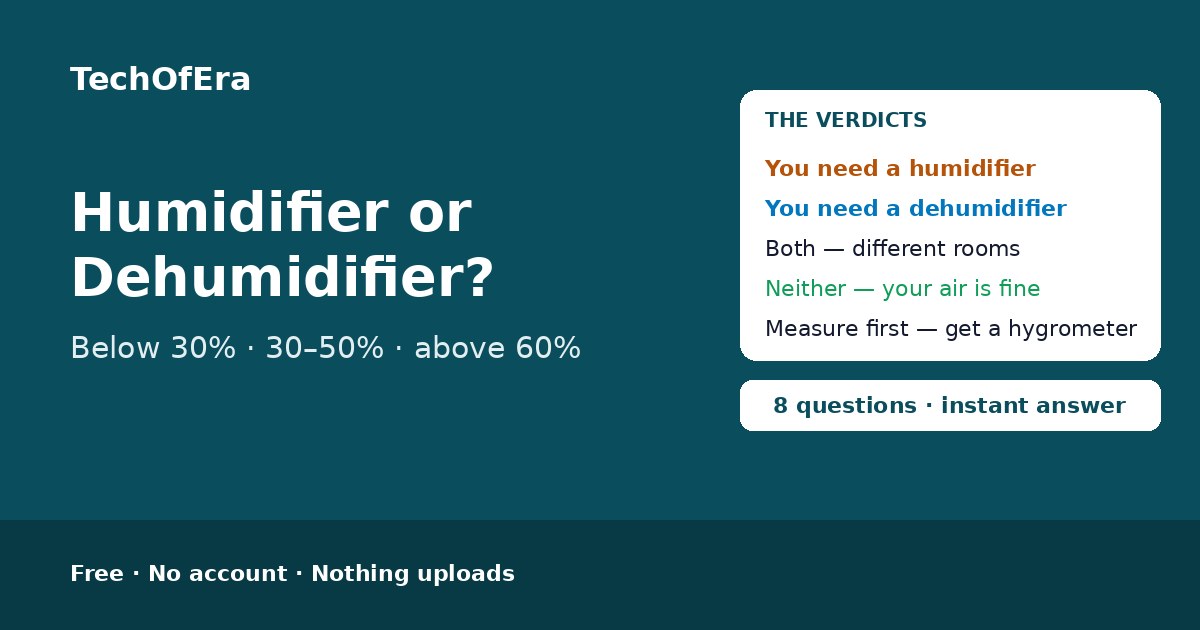
The US Environmental Protection Agency says to keep indoor relative humidity between 30% and 50%, and below 60%. Above 50% to 60% the excess moisture creates the conditions mould and dust mites need. The split is the same in every guide that ranks for this question — Carrier, Bryant, Deye and AlorAir all publish it: below 30% is the humidifier zone, above 50% to 60% is the dehumidifier zone. A humidifier adds moisture to dry air; a dehumidifier removes it from damp air. They do opposite things, so they should never run in the same room at the same time — but many homes use both, in different rooms or different seasons. This checker scores your reading and your signs together and gives you a verdict — it does not guess, and it says plainly what it cannot know.
To use it:
- Start with the humidity reading. A hygrometer costs a few pounds or dollars and gives a certain answer in a day. Below 30% means a humidifier; above 50% to 60% means a dehumidifier; 30% to 50% means neither. Without a reading, the signs have to decide it.
- Check for dry-air signs. Dry skin, chapped lips, a sore throat on waking, static shocks, and wood floors, furniture or instruments that crack or gap all point to air below 30% humidity. Several together are a strong case for a humidifier, even without a reading.
- Check for damp signs. Condensation or fog on the inside of windows, a musty smell that comes back after cleaning, mould spots, and air that feels clammy even when it is not hot all point to humidity above 50% to 60%. Several together are a strong case for a dehumidifier.
- Check the room and the season. A heated bedroom goes dry in winter; a basement stays damp in summer. One house can be dry in one room and damp in another — so measure each problem room separately, and never put both devices in the same room.
- Check for a moisture source first. A leak, a damp patch, laundry dried indoors, long showers with no extractor fan, and cooking with no extractor hood all add moisture. A dehumidifier that fights a leak is mopping the floor with the tap still running — fix the source, then decide about a device.
- Pick the right type. For a humidifier, evaporative units cost least to run and ultrasonic units are quietest. For a dehumidifier, a compressor unit suits a warm room, while a desiccant unit suits a cold basement — compressor coils frost up below about 18°C (65°F). Whatever you buy, get one with a humidistat and set it to 40% to 45%.
Humidity patterns and what they usually mean, at a glance
The table below is built from the same rules as the checker, so it can never disagree with your verdict. The reading, the dry signs and the damp signs decide together.
| Humidity pattern | Verdict | What to know |
|---|
What makes this checker different
The pages that rank for this search are guides — thorough explanations of how humidifiers and dehumidifiers differ, from Carrier, Bryant, Deye and AlorAir — but they leave you to work out what that means for the home you are standing in: whether a 55% reading with a musty smell is enough, whether dry skin upstairs and condensation downstairs mean one device or two, and when a damp patch stops being a device question and becomes a fix-the-source one. None of them is an interactive checker. This page is the missing answer: eight questions, an instant verdict scored from your reading and your signs, the reason named, and a fix-first warning for leaks and mould — with nothing to install, no account, and nothing uploaded. It is a self-assessment, so it says plainly what it cannot know: a web page cannot measure your home's humidity, so anything you mark “Not sure” stays on the list until you confirm it.
When is this the right check?
Whenever you are about to spend money on a humidifier or a dehumidifier and are not sure which one you need: the bedroom that leaves you with a sore throat every winter morning, the basement that smells musty every summer, the windows that fog up overnight, or the house where one room feels dry and another feels clammy. Also whenever the season changes — winter heating dries air out and summer brings moisture in, so the right answer in January can be the wrong one in July. And whenever you are deciding whether a damp problem is a device question at all: if there is a leak, a damp patch, or standing water, fix that first.
Honest limitations
A self-assessment, not a measurement
This checker works only from the answers you enter. It cannot measure your home's humidity — no web page has a hygrometer — so if an answer is wrong, the verdict is wrong. A cheap hygrometer left in the room for a day is the certain answer.
The reading decides it, not one symptom
No single sign proves you need a device. Dry skin, static, condensation and musty smells each count, but the verdict comes from the reading and the signs together — which is why the checker scores eight questions, not one.
Leaks and mould come first
A leak, a damp patch, or spreading mould is a fix-first problem, not a device question. A dehumidifier cannot dry a room that is still taking in water, and mould that keeps coming back needs a professional.
One house, different rooms
A heated bedroom can be dry in winter while the basement in the same house stays damp. This checker gives one verdict for the room you describe — measure each problem room separately rather than trusting one reading for the whole house.
A device is not a treatment
A humidifier or dehumidifier is a comfort device, not a treatment. It does not remove allergens from the air, and it does not treat asthma or any other condition. Breathing symptoms need a doctor.
Rules from EPA guidance
The rules here follow the EPA guidance to keep indoor humidity between 30% and 50%, and below 60%, as it reads in November 2026. Guidance can be revised, so re-check if a new edition appears.