How the Christmas ham check works
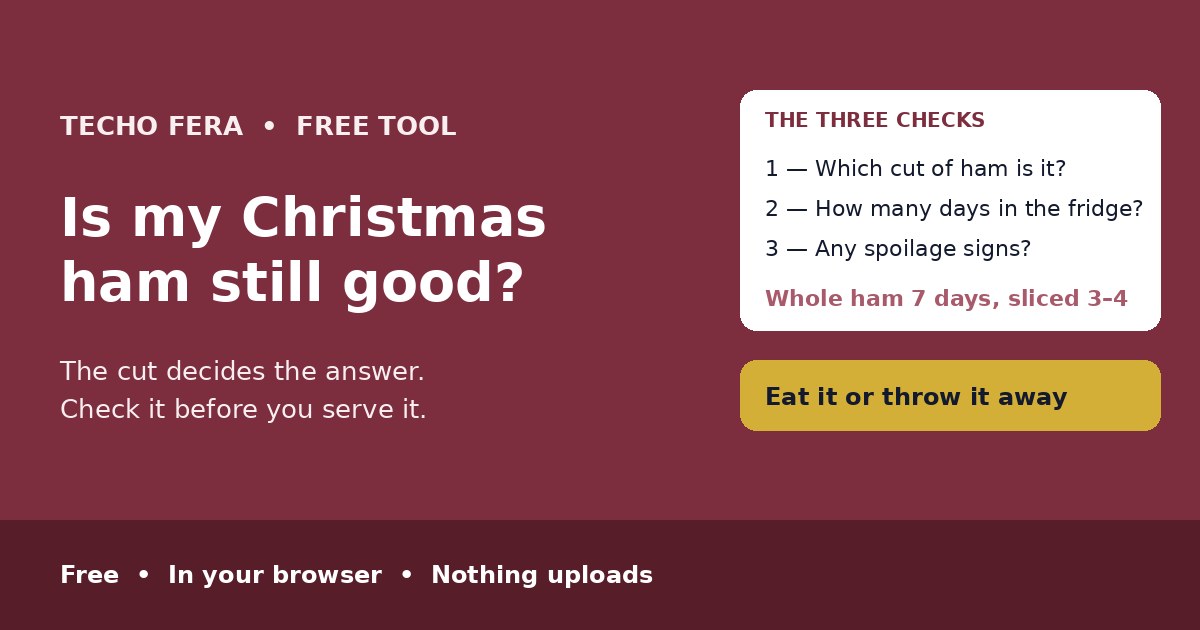
The rule depends on the cut: a whole cooked ham keeps 7 days in the fridge, a half ham 3–5 days, spiral-cut ham 3–5 days, sliced or diced ham 3–4 days, and ham in a dish 3–4 days. Canned ham, unopened and labelled "Keep Refrigerated", keeps 6–9 months, and 3–5 days once opened. Raw fresh ham keeps 3–5 days — and it must be cooked, never eaten as it is. All of it is in a fridge at 40°F (4°C) or below, counted from the day the ham was cooked. This checker asks six questions — which ham, how many days it has been in the fridge, how it is stored, any spoilage signs, who will eat it, and optionally the date it was cooked — and gives one verdict: safe, caution, or throw it away. If you enter the date, it works out the exact days and your use-by date as well.
To use it:
- Pick the ham. Choose it from the list — whole, half, spiral-cut, sliced, ham in a dish, canned unopened, canned opened, or raw fresh ham. The list covers 8 hams, grouped by type: cooked, canned, and raw.
- Say how many days it has been in the fridge. Less than 1 day, 2 to 3 days, 4 to 5 days, 6 to 7 days, 8 to 14 days, more than 14 days, or not sure. Count from the day the ham was cooked — or the day it was opened, for canned ham.
- Say how it is stored. In an airtight container, wrapped tight in foil or cling film, vacuum-sealed, or loose on a plate uncovered. Loose, uncovered ham spoils faster — the checker takes 1 day off the limit for it, and says so.
- Say whether it shows any spoilage signs. A slimy or sticky surface, a sour or ammonia-like smell, grey, green or black spots, visible mould, or more than one of these. Any one of them means throw it away, whatever the calendar says.
- Say who will eat it. A healthy adult, someone pregnant, someone over 65 or under 5, or someone with a weakened immune system. People at higher risk get the stricter answer when the ham is near the end of its life.
- Optionally, enter the date it was cooked. The checker works out the exact days in the fridge and your use-by date. Leave it blank to use the day band above.
The hams at a glance
| Ham | Fridge | Freezer | Why |
|---|---|---|---|
| Whole cooked ham (unsliced) | 7 days | 1–2 months | One uncut piece, least surface exposed — the longest of the cooked hams |
| Half ham (cut, cooked) | 3–5 days | 1–2 months | The cut face is the weak spot — keep it covered tight, cut side down |
| Spiral-cut ham | 3–5 days | 1–2 months | The spiral cuts open up a lot of surface, so it dries out and spoils faster |
| Sliced or diced ham | 3–4 days | 1–2 months | Most surface exposed — spoils fastest of all the cooked hams |
| Ham in a dish — soup, casserole or sandwich | 3–4 days | 2–3 months | The dish spoils at the speed of its fastest part |
| Canned ham, unopened | 6–9 months | Not needed | Sealed in the tin — but throw it away if the tin is swollen, rusted or leaking |
| Canned ham, opened | 3–5 days | 1–2 months | Tip it out of the tin into an airtight container — the tin is not storage |
| Raw (uncooked) fresh ham | 3–5 days | 4–6 months | Must be cooked before anyone eats it — cook it to 145°F (63°C) with a 3-minute rest |
What makes this checker different
The pages that rank for this search are guides — a government tip sheet and a run of near-identical articles from one content site — and every one of them gives you the same static answer: "3–4 days". None of them asks which cut of ham it is, how many days it has actually been in the fridge, how it is stored, whether it shows any spoilage signs, or who will eat it — and none of them gives you a use-by date. The two generic food-storage checkers that do exist cover every food at once, with one number per food and no ham-specific rules: they do not know that a whole ham keeps 7 days while sliced ham keeps 3–4, that an unopened canned ham keeps 6–9 months, or that a slimy surface ends the argument at any age. There is no free, standalone checker that takes a ham cut, a day count, a storage method, spoilage signs and an eater and gives you one verdict with the days left, the use-by date, and the next steps. This page is that answer: six questions, an instant verdict for your exact ham, the blockers named, and the next steps. It is general information, so it says plainly what it cannot know: it cannot see your fridge, your thermometer or your ham, and where the guidance is thinner — how long the ham has really been in the fridge, how it is stored — it tells you to throw it away instead of guessing.
When is this the right check?
When the Christmas ham has been sitting in the fridge for a few days and you are not sure whether it is still safe to serve — because a whole ham keeps 7 days and sliced ham only 3–4, and guessing wrong can mean food poisoning. When you open the fridge on Boxing Day and the ham smells slightly off — because the answer decides whether it goes on the plate or in the bin, and a sour smell ends the argument at any age. When you are about to serve ham to someone pregnant, over 65, under 5, or with a weakened immune system — because they get the stricter answer, and the checker says so before anyone eats. And when you are deciding whether to freeze what is left — because cooked ham keeps 1–2 months in the freezer for best quality, and the checker tells you whether it is still worth freezing.
Honest limitations
General information, not food-safety advice
This checker cannot see your fridge, your thermometer or your ham. It cannot tell you how long the ham has really been in the fridge, how cold your fridge is, or whether the ham shows any spoilage signs — only you can. If you cannot confirm the time, the honest answer is to throw it away.
The days left are an estimate
The checker works from the day band you pick — 2 to 3 days, 4 to 5 days, and so on — and takes the middle of the band to work out the days left. Enter the date the ham was cooked for the exact count and your use-by date. The exact clock is the one on your wall: if you know the ham went in the fridge on Christmas Day, trust that, not the band.
Not sure means the cautious answer
If you are not sure how long the ham has been in the fridge, the checker does not guess — it tells you to eat it today or throw it away. That is deliberate: the safe mistake is to throw away ham that was actually fine.
The loose-storage day is the checker's own estimate
The USDA gives one fridge limit per cut, whatever the wrapping. This checker takes 1 day off the limit when the ham has been sitting loose and uncovered, because uncovered ham dries out and spoils faster — but that 1 day is the checker's own estimate, and it says so. Airtight and wrapped ham gets the full limit.
The smell test cannot be trusted
A sour smell means throw the ham away — but a fine smell does not mean the ham is safe. Listeria can grow in ham without any smell at all, which is why the calendar limit still applies to ham that looks and smells fine. If it is past its limit, throw it away even if it seems fine.
Rules from the USDA and FSIS, dated November 2026
The rules here are the USDA FoodSafety.gov and FSIS ham storage rules as they read in November 2026: a whole cooked ham 7 days, a half ham 3–5 days, spiral-cut ham 3–5 days, sliced ham 3–4 days, ham in a dish 3–4 days, canned ham 6–9 months unopened and 3–5 days opened, raw ham 3–5 days, the 2-hour rule, and the 165°F reheat temperature. Guidance changes: recheck with your local food-safety authority if anything changes.