How the turkey thaw check works
Thawing is the step people miss, because it starts days before anyone feels like cooking. A frozen turkey cannot be rushed: in the refrigerator, the USDA says to allow about 24 hours for every 4 to 5 pounds, at 40°F or below. That means a 12- to 16-pound turkey needs 3 to 4 days, a 16- to 20-pound turkey needs 4 to 5 days, and a 20- to 24-pound turkey needs 5 to 6 days. This checker does the counting for you: it takes your turkey's weight, the method you plan to use, and the day and time you plan to cook, and works back to the latest safe start date. It uses the cautious end of the fridge range — 24 hours per 4 pounds — so the date it gives is the latest safe start, not the optimistic one. If your fridge is crowded or runs very cold, it adds an extra day, because a packed fridge thaws more slowly.
To use it:
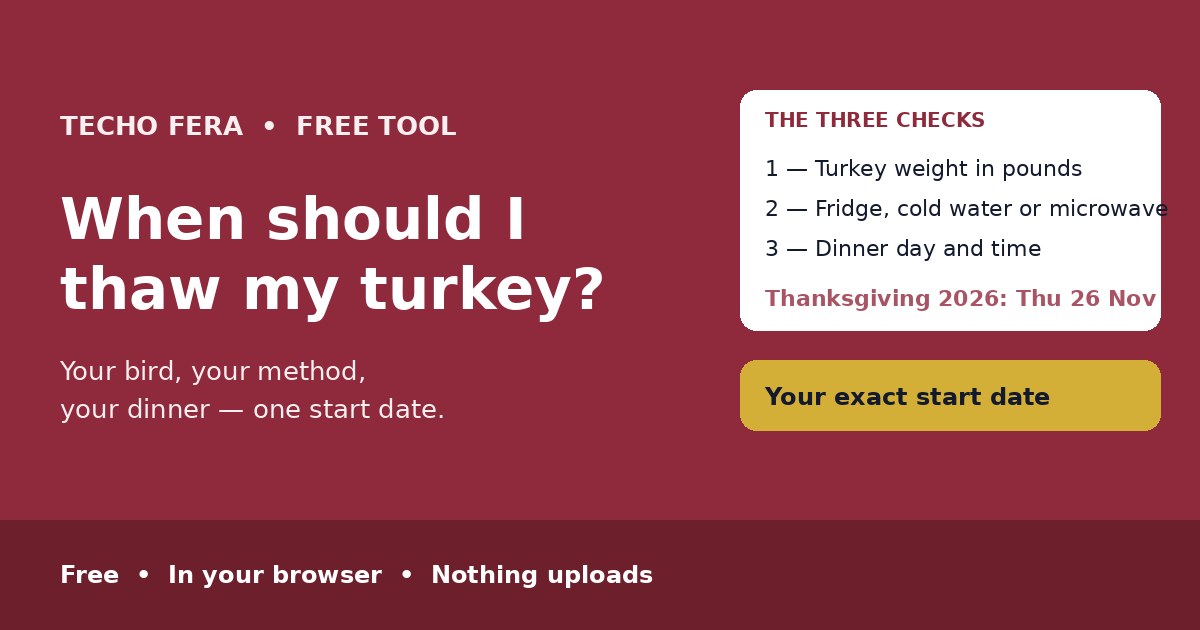
- Enter the turkey's weight. It is printed on the packaging label. A typical Thanksgiving turkey is 12 to 20 pounds, and the weight is what decides the thawing time — every 4 pounds is another day in the fridge, or another 2 hours in cold water.
- Pick how you plan to thaw it. The refrigerator is the safest and needs no attention once the bird is in. Cold water is faster — about 30 minutes per pound, changing the water every 30 minutes — but the bird must be cooked immediately after thawing. The microwave is fastest, about 6 minutes per pound, and the bird must also be cooked immediately.
- Enter the day and time you plan to cook. Thanksgiving 2026 is Thursday, November 26, and the cooking time is set to 2:00 PM by default. Change either if your dinner is different — the checker works back from the time you give it.
- Say whether your fridge is crowded or very cold. A packed fridge thaws more slowly because cold air cannot circulate, so the checker adds an extra day to the fridge time when you tick this.
- Read the start date — and the rescue plan, if you left it late. If the fridge window has already passed, the checker tells you whether cold water or the microwave still fits before dinner. If nothing fits, it tells you to cook from frozen, which the USDA says is safe at about 50% longer in the oven.
What makes this checker different
The pages that rank for this search are guides — a Thanksgiving guide with a thawing table, a dinner timeline with the same table, a food blog's thawing chart, a recipe page with a thawing section. Every one of them gives you the same static table and leaves you to count back from your dinner date yourself. None of them asks how much your turkey weighs, which method you plan to use, whether your fridge is crowded, or what time dinner is — and none of them tells you what to do if the fridge window has already passed. There is no free, standalone checker that takes your bird, your method and your dinner time and gives you one exact start date, plus a cold-water rescue plan when you are late. This page is that answer: five questions, an instant start date for your exact turkey, the blockers named, and the next steps. It is a planning aid, so it says plainly what it cannot know: it cannot see your fridge temperature, and where your fridge is crowded it adds a day instead of guessing.
When is this the right check?
When you have a frozen turkey and a dinner date — because thawing starts days before cooking, and the start date depends on the bird, not the calendar. When you are not sure whether to use the fridge or cold water — because the fridge needs days and cold water needs hours, and the right answer depends on how much time is left. When you think you may have left it too late — because the checker tells you honestly whether cold water still fits, or whether the bird has to be cooked from frozen. And when someone tells you to thaw the turkey on the counter to speed things up — because that is the one method the USDA never allows, and this checker will never suggest it.
Honest limitations
A planning aid, not food-safety advice
This checker cannot see your fridge temperature or your turkey. It cannot tell you whether your fridge is really at 40°F or below, or whether your bird is fully thawed — only a fridge thermometer and a check of the cavity can. If you are unsure, check both before you cook.
The times are the cautious end of the range
The USDA gives a range — 24 hours for every 4 to 5 pounds — and this checker uses the 4-pound end, so the start date it gives is the latest safe start. Your bird may thaw sooner, especially a smaller one. Check that the cavity is free of ice and the legs and wings move freely before you roast.
Whole turkeys only
The times here are for a whole turkey. A turkey breast, a boneless roast or a spatchcocked bird thaws faster, and a stuffed bird cooks differently. If yours is not a whole bird, treat the start date as cautious and check the bird, not the calendar.
Cold water and microwave mean cook immediately
A turkey thawed in cold water or in the microwave cannot go back in the fridge for a day or two — it must be cooked straight away. Only a fridge-thawed turkey can wait, for 1 to 2 more days. Do not start a cold-water thaw the night before and cook the next day.
Never thaw on the counter
The outside of the bird warms into the danger zone between 40°F and 140°F while the inside is still frozen. That is true however cold your kitchen feels, and however short the time seems. The USDA allows only the refrigerator, cold water and the microwave.
Rules from the USDA, dated November 2026
The rules here are the USDA Food Safety and Inspection Service safe-thawing rules as they read in November 2026: 24 hours per 4 to 5 pounds in the fridge, 30 minutes per pound in cold water, 6 minutes per pound in the microwave, a 1- to 2-day hold for a fridge-thawed bird, and 165°F as the done temperature. Guidance changes: recheck with the USDA if anything about your plans changes.