How the Christmas dinner check works
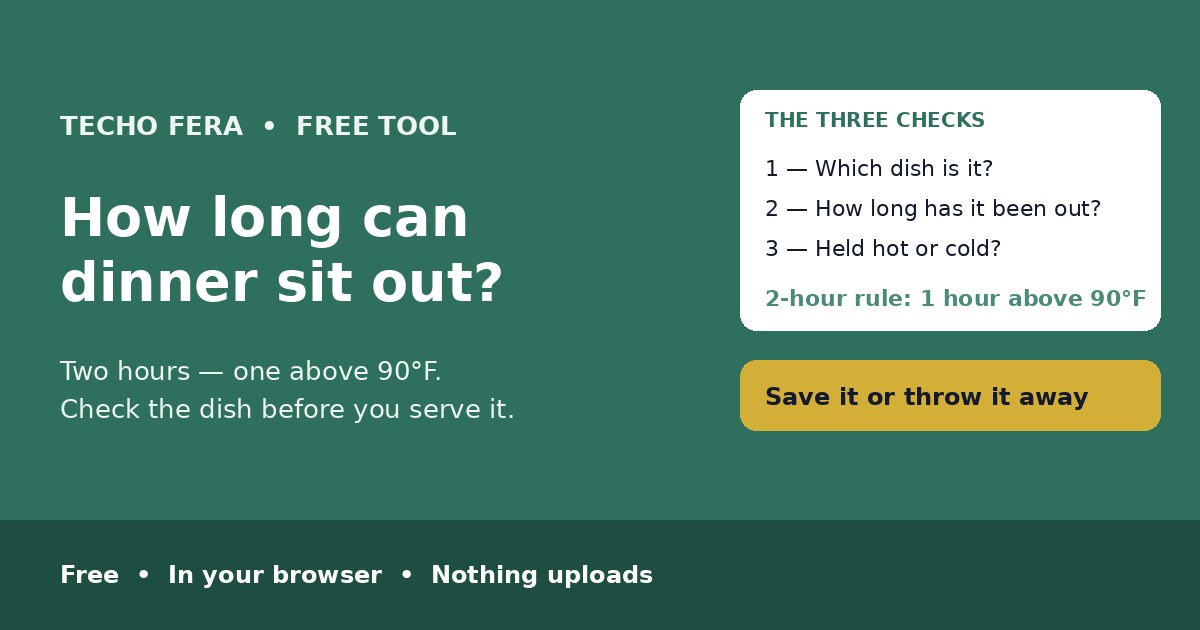
The rule is the 2-hour rule: perishable food must not sit at room temperature for more than 2 hours — 1 hour if the room is above 90°F (32°C). The clock starts when the food comes out of the oven or fridge, not when guests start eating, and it includes time on the carving board, on the buffet table and while everyone has seconds. But the answer changes with the dish: gravy, stuffing, cream desserts and cooked rice spoil fastest; turkey, ham, potatoes, vegetables and sausages follow the standard rule; cranberry sauce, Christmas pudding and hard cheese are lower risk and get a cautious answer instead of a throw-away one. And food kept hot above 140°F (60°C) or cold at 40°F (4°C) or below is on a different clock entirely — while it is held, the clock is paused. This checker asks five questions — which dish, how long it has been out, the room temperature, how it is being held, and what you plan to do with it — and gives one verdict: safe, caution, or throw it away.
To use it:
- Pick the dish. Choose it from the list — gravy, stuffing, a cream dessert, cooked rice, roast turkey, ham, mashed potatoes, cooked vegetables, pigs in blankets, cranberry sauce, Christmas pudding or a cheese board. The list covers 12 dishes, grouped by risk: high-risk, standard, and lower-risk.
- Say how long it has been out. Under 1 hour, 1 to 2 hours, 2 to 3 hours, 3 to 4 hours, over 4 hours, or not sure. The clock starts when the food comes out of the oven or fridge — not when guests start eating.
- Say how warm the room is. A cool room below 70°F (21°C), a normal room of 70 to 90°F (21 to 32°C), or a warm room above 90°F (32°C). Above 90°F the limit drops from 2 hours to 1 hour — a cool room does not extend it.
- Say how it is being held. Out on the table with no holding, kept hot in an oven, slow cooker or chafing dish above 140°F (60°C), or kept cold on ice or back in the fridge between servings. While food is held hot or cold, the clock is paused.
- Say what you plan to do with it. Eat it now, refrigerate it now, reheat it and eat it later, or send guests home with it. Reheating only works if the dish is still inside its limit — reheating will not save food that has been out too long.
The dishes at a glance
| Dish | Verdict | Why |
|---|---|---|
| Gravy | Throw it away past the limit | High-risk: warm, moist and rich — one of the fastest dishes to spoil; only 1–2 days in the fridge |
| Stuffing or dressing | Throw it away past the limit | High-risk: moist, dense and slow to cool — the middle stays in the danger zone longest |
| Trifle, custard or cream dessert | Throw it away past the limit | High-risk: dairy and eggs spoil fast at room temperature |
| Cooked rice or a rice dish | Throw it away past the limit | High-risk: Bacillus cereus spores survive cooking and produce toxins that reheating cannot destroy |
| Roast turkey or chicken | Throw it away past the limit | Standard: carve off the bone, pack shallow, refrigerate within 2 hours; keeps 3–4 days in the fridge |
| Ham, roast beef or carved meat | Throw it away past the limit | Standard: slice what is left and pack it shallow so it cools fast |
| Mashed or roast potatoes | Throw it away past the limit | Standard: potatoes cool slowly in a big bowl — spread them shallow |
| Cooked vegetables | Throw it away past the limit | Standard: vegetables in butter or sauce cool slowly — pack them shallow |
| Pigs in blankets or sausages | Throw it away past the limit | Standard: cooked meat — the same 2-hour rule as the turkey |
| Cranberry sauce | Cautious past the limit | Lower-risk: high in acid and sugar, so bacteria grow slowly; refrigerate now, eat it today |
| Christmas pudding or cake | Cautious past the limit | Lower-risk: rich in sugar and alcohol, low in moisture; refrigerate now, eat it today |
| Cheese board (hard cheese) | Cautious past the limit | Lower-risk: hard cheese is routinely served at room temperature; soft cheese is perishable — throw that away |
What makes this checker different
The pages that rank for this search are guides — the FDA's buffet fact sheet, university extension pages, a health-department blog and a Christmas dinner planner. Every one of them gives you the same static answer — "2 hours" — and leaves you to work out what it means for your dish, your room and your timing. None of them asks which dish it is, how long it has been out, whether the room is above 90°F, whether the food is being held hot or cold, or what you plan to do with it — and none of them tells you how many minutes you have left, or what to do next when the answer is bad. There is no free, standalone checker that takes a dish, a time out, a room temperature and a holding method and gives you one verdict with the reason, the minutes left, and the next steps. This page is that answer: five questions, an instant verdict for your exact dinner, the blockers named, and the next steps. It is general information, so it says plainly what it cannot know: it cannot see your table or your thermometer, and where the guidance is thinner — how long the food has really been out, how warm the room is — it tells you to throw it away instead of guessing.
When is this the right check?
When dinner has been sitting on the table and you are not sure whether it is still safe to serve — because the 2-hour clock started when the food came out of the oven, not when guests sat down, and guessing wrong can mean food poisoning. When you are about to pack up the leftovers — because the answer decides whether they go in the fridge or in the bin, and gravy only keeps 1–2 days even when it is put away in time. When guests are leaving with doggy bags — because the bags must be refrigerated within 2 hours of serving, and the checker says so before they leave. And when the food has been kept hot in the oven or cold on ice all afternoon — because the clock is paused while it is held, and this page is the quick check that confirms it.
Honest limitations
General information, not food-safety advice
This checker cannot see your table, your thermometer or your kitchen. It cannot tell you how long the food has really been out, how warm the room is, or whether the food was kept hot or cold — only you can. If you cannot confirm the time, the honest answer is to throw it away.
The minutes left are an estimate
The checker works from the time band you pick — under 1 hour, 1 to 2 hours, and so on — and takes the middle of the band to work out the minutes left. The exact clock is the one on your wall: if you know the food went out at 1 o'clock, trust that, not the band.
Not sure means the cautious answer
If you are not sure how long the food has been out, the checker does not guess — it tells you to throw it away unless you can confirm it was out less than 2 hours. That is deliberate: the safe mistake is to throw away food that was actually fine.
The lower-risk dishes are a judgement, not a rule
The FDA's 2-hour rule is written for perishables. Cranberry sauce, Christmas pudding and hard cheese get a cautious answer instead of a throw-away one because they are high in acid, sugar or alcohol and low in moisture — but that is the checker's own judgement, and it says so. If any of them smells off or has mould, throw it away.
Reheating cannot save food that is past its limit
Reheating kills most bacteria, but some leave behind toxins that heat does not destroy — and cooked rice carries Bacillus cereus spores that survive cooking. If the food is past its limit, no amount of heating makes it safe, so the checker says throw it away instead of reassuring you.
Rules from the FDA and USDA, dated November 2026
The rules here are the FDA "Serving Up Safe Buffets" guidance and the USDA FoodSafety.gov 2-hour rule as they read in November 2026: the 2-hour limit, the 1-hour limit above 90°F, the 40–140°F danger zone, the 140°F hot-holding and 40°F cold-holding lines, and the 165°F reheat temperature. Guidance changes: recheck with your local food-safety authority if anything changes.