How the leftovers check works
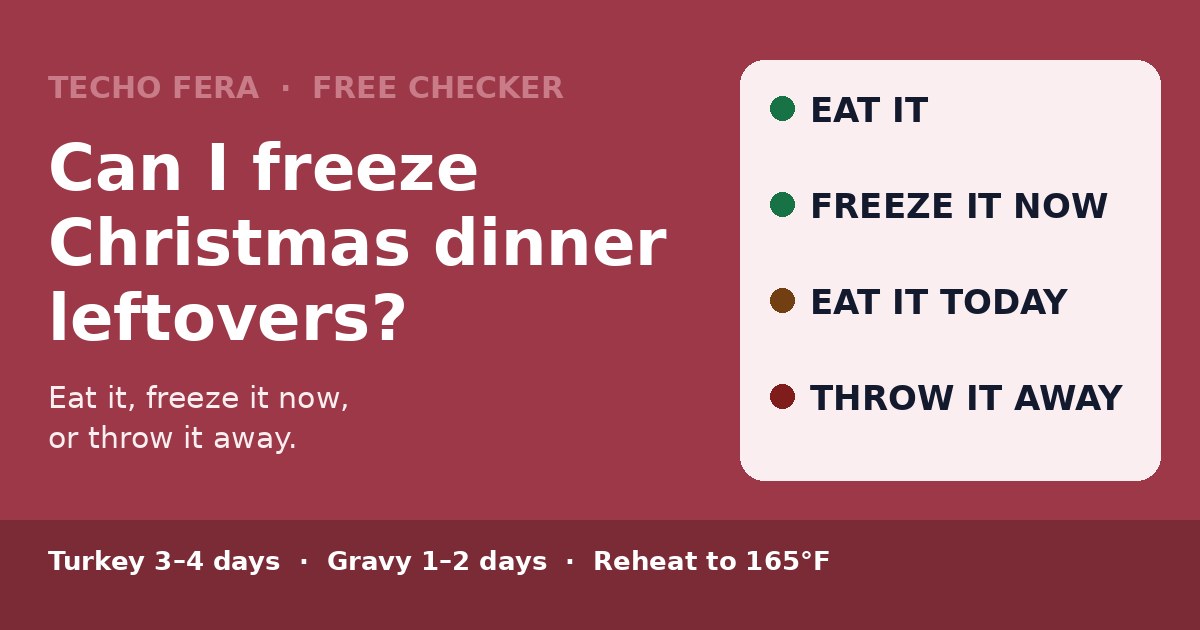
Christmas dinner leaves a fridge full of food with different clocks. Cooked turkey keeps 3–4 days, gravy only 1–2, cranberry sauce 10–14 — and the clock starts the moment the food comes out of the oven, not when it goes into the fridge. This checker weighs all of it — which dish it is, how long ago it was cooked, how it was stored and packed, how you will reheat it, any signs of spoilage, who is eating it, and whether it has already been frozen once — and gives you a verdict: eat it, freeze it now, eat it today or freeze it today, or throw it away.
To use it:
- Say which leftover it is. Turkey, ham, stuffing, gravy, roast potatoes, vegetables, cranberry sauce, pigs in blankets, Christmas pudding or mince pies. Each dish has its own fridge window, and the window is the first thing the verdict depends on: gravy lasts 1–2 days, turkey 3–4, cranberry sauce 10–14.
- Say how long ago it was cooked. Count from the day it was cooked: Christmas Day is day 0, Boxing Day is day 1. A turkey cooked on Christmas Day is on its last day on 29 December — and on day 5 it goes in the bin, whatever it looks like.
- Say how it was stored. The 2-hour rule: perishable leftovers must be refrigerated or frozen within 2 hours of cooking — 1 hour if the room is above 90°F (32°C). Food left out on the table overnight is already past saving, and reheating will not fix it.
- Say how it is packed. Airtight containers or sealed freezer bags are best; a covered plate is good enough for the fridge but not for the freezer; uncovered food dries out, picks up fridge smells, and can drip onto other food. Shallow containers cool fast — a big deep container of hot turkey stays warm in the middle for hours.
- Say how you will reheat it. Reheat leftovers right through to 165°F (74°C) — steaming hot all the way through, checking the middle, not the edges — and reheat gravy and sauces to a rolling boil. Lukewarm is not a reheat: it is the danger zone. Never reheat leftovers more than once.
- Say whether there are signs of spoilage. Look at it and smell it: mould, a sour smell, a slimy feel, or a changed colour. Spoilage signs overrule the date — food can be unsafe without looking or smelling off, which is why the fridge window matters, and food that looks off is off whatever the date says.
- Say who is eating it. A healthy adult gets the standard windows. A child under 5, someone who is pregnant, an older adult, or someone with a weakened immune system gets stricter rules: serve leftovers early in the window, reheat to 165°F (74°C) every time, and never serve last-day leftovers to a higher-risk eater.
- Say whether it has already been frozen once. Cooked food should be frozen once, thawed once in the fridge, reheated once, and eaten. Food thawed on the worktop should not be refrozen or eaten, and food frozen twice has spent too long in the danger zone.
The four verdicts, and what each one means
Eat it
The dish is inside its fridge window, it was stored within the 2-hour rule, and it will be reheated right through to 165°F (74°C). Eat it, reheated hot, and do not reheat it again.
Freeze it now
The dish is still safe, but its fridge window is nearly closed and you will not eat it in time. Freeze it today, in meal-sized portions, labelled with the date — freezing does not make old food fresh again, so a day-4 turkey frozen today is still a day-4 turkey when you thaw it.
Eat it today, or freeze it today
The dish is on the last day of its window, or it needs a proper reheat before it is safe to eat. Eat it today, reheated to 165°F (74°C), or freeze it today — do not leave it in the fridge overnight.
Throw it away
The dish is past its window, was left out too long, shows signs of spoilage, or was thawed the wrong way. Do not taste it to check: the bacteria that cause food poisoning do not always change the smell or taste.
What makes this checker different
The pages that rank for this search are guides — a university extension article on safe handling of leftovers, a food blog's turkey storage chart, a magazine piece on freezing cooked turkey. All of them print the same table: turkey 3–4 days, gravy 1–2 days, freezer 2–6 months. None of them asks which dish you have, how many days ago it was cooked, whether it sat out overnight, how you will reheat it, or who is eating it — and none of them gives you a verdict for your leftovers. The lookup tools that do exist answer a different question: they tell you where a food belongs, or whether a food can be frozen at all. There is no free, standalone checker that takes your dish, the days since cooking, the storage, the packing, the reheating, the spoilage signs, the eater and the freeze history and turns them into an eat, freeze or throw-away verdict with the days of fridge life left. This page is that answer: eight questions, an instant verdict, the blockers named, and the next steps. It is a self-assessment, so it says plainly what it cannot know: it cannot smell, taste or test your leftovers.
When is this the right check?
On Boxing Day, when the fridge is full and you are not sure which dishes are still safe — because gravy is already on borrowed time while the cranberry sauce has another week. On 28 or 29 December, when the turkey is on day 3 or 4 and the question is whether to eat it tonight or freeze it now — because freezing on the last day is fine and freezing after it is not. When someone left the turkey on the table overnight and wonders whether reheating will save it — because it will not: some bacteria leave behind toxins that heat does not destroy. And when a pregnant family member or a grandparent is eating with you — because the same leftovers need stricter rules for a higher-risk eater.
Honest limitations
A self-assessment, not food-safety advice
This checker cannot smell, taste or test your leftovers. It cannot tell whether the turkey that looks fine on day 5 is actually safe — the windows are the answer, and the windows say it is not. If someone who ate the leftovers develops vomiting, diarrhoea or a fever, talk to a clinician.
The windows assume a cold fridge
Every fridge time here assumes a fridge at 40°F (4°C) or below and a freezer at 0°F (−18°C). A fridge that runs warm shortens every window on this page — if you are not sure your fridge is cold enough, check it with a thermometer.
Freezer times are about quality, not safety
Frozen food stays safe indefinitely; the freezer times — turkey 2–6 months, gravy 2–3 months, vegetables 10–12 months — are for best quality. A turkey frozen for a year is safe to eat once thawed and reheated, but it will be dry and tired.
The 2-hour rule has a 1-hour exception
If the room is above 90°F (32°C) — a hot kitchen on Christmas Day with the oven going — the window shrinks to 1 hour. This checker uses the 2-hour rule and says so where it matters, but a very hot kitchen needs the stricter hour.
Some dishes are estimates, not USDA tables
Turkey, ham, stuffing, gravy and vegetables follow USDA FoodSafety.gov windows. Christmas pudding and mince pies do not have USDA tables: their windows — pudding up to 2 weeks in the fridge, mince pies 5–7 days — are the published figures for those dishes, and the checker says so.
Rules from official sources, dated November 2026
The rules here are the USDA FoodSafety.gov guidance on cooked turkey and leftovers (3–4 days in the fridge, 2–6 months in the freezer, the 2-hour rule, reheat to 165°F / 74°C, thaw in the fridge), as they read in November 2026. Guidance changes: recheck with your local food-safety authority if anything about the dish changes.