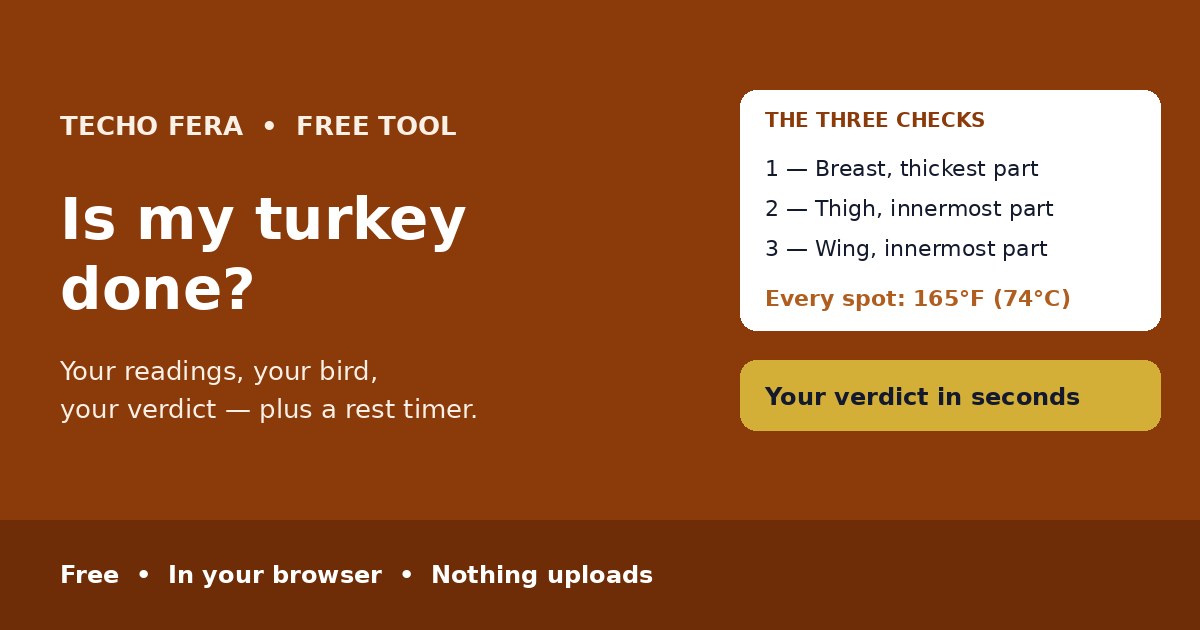
Is your turkey done?

A turkey is done at 165°F in the breast, thigh and wing — but the clock, the colour and the pop-up timer all lie. Enter the temperatures you measured and this checker gives you the verdict: done, almost there, or back in the oven — with a rest timer for the finish. Free, in your browser, nothing uploads.

  • USDA rule: 165°F in breast, thigh and wing
  • Thanksgiving 2026: Thursday, November 26
  • Carryover estimate + rest timer included
  • Free, no account, nothing uploads
Is my turkey done? Enter your thermometer readings and get the verdict in seconds.

Check whether your turkey is done

Try a preset:
0 of 9 answered

No thermometer? Answer these instead

These signs are less reliable than a thermometer — but if you have no thermometer at all, they are the best you have. Leave them on "Not sure" if you used a thermometer above.

Your result

Answer the questions Your verdict appears here as you answer.
Recommended action

Enter your thermometer readings above and the recommended action will appear here.

Blockers

Things that do not fit

Things to check

Still to confirm

What to do next

    Your result summary


    Rest timer 20:00

    Answer the questions above — the verdict updates live.

    Privacy you can verify, not just trust

    Checking whether your turkey is done by uploading your readings to a website would be backwards — the check should never be the leak. This one can't: your answers are checked in your browser, and they never leave the device — the only third-party requests are the site's own analytics, which count page views. Don't take our word for it:

    New cross-origin requests during use: 0
    1. Press F12 to open developer tools, then the Network tab.
    2. Answer a question above. Watch: apart from the site's analytics, nothing new is requested — no uploads, and no data ever leaves your device.
    3. Extra credit: disconnect your internet after this page loads — the checker still works.

    How the turkey doneness check works

    A turkey is done at 165°F (74°C) — not at a time on the clock, not when the skin looks brown, and not when the pop-up timer pops. The USDA safe minimum for all poultry is 165°F, measured with a food thermometer in the thickest part of the breast, the innermost part of the thigh, and the innermost part of the wing. If the bird is stuffed, the centre of the stuffing must reach 165°F too. This checker takes the readings you measured and gives you the verdict: done, almost there, or back in the oven — plus a carryover estimate for the rest, and a rest timer for the finish.

    To use it:

    1. Pick what you are cooking. A whole bird needs three readings — breast, thigh and wing — because different parts cook at different speeds and the thigh is usually the last to get done. A breast, thighs or ground turkey needs one reading, in the thickest part.
    2. Match the thermometer's unit. If your thermometer reads in Celsius, switch the unit above to °C. 165°F is 74°C: a thermometer set to Celsius showing 165 would mean 329°F, and this checker flags a reading that cannot be a real turkey temperature.
    3. Enter the temperatures you measured. Insert an instant-read thermometer into the thickest part of each spot, keeping the tip away from bone — bone conducts heat and gives a false reading. The checker only judges the spots this cut needs, and it tells you which ones they are.
    4. Read the verdict — and what to do next. Done means rest it and carve. Almost there means the rest should finish it, and the checker tells you to re-check after resting. Underdone means back in the oven, re-checking every 20 minutes. Overdone means safe but dry, with instructions to save it.
    5. Start the rest timer. A whole turkey rests for at least 20 minutes before carving — 30 for a bird over 16 pounds. The timer counts down the recommended rest, and the checker reminds you to re-check 165°F when it finishes.

    What makes this checker different

    The pages that rank for this search are guides — The Kitchn's how-to-check guide, Real Simple's no-thermometer guide, food blogs with a temperature chart, a university extension's food-safety tips. Every one of them tells you the same number, 165°F, and leaves you to compare your own readings against it. None of them asks what your thermometer actually says, which cut you are cooking, or how you cooked it — and none of them tells you what to do with a bird at 162°F, or one at 183°F, or one whose stuffing is still under. There is no free, standalone checker that takes your readings and gives you a verdict, a carryover estimate and a rest timer. This page is that answer: six questions, an instant verdict for your exact bird, the blockers named, and the next steps. It is a doneness aid, so it says plainly what it cannot know: it cannot see your turkey, your thermometer or your oven, and where a reading looks impossible it says so instead of trusting it.

    When is this the right check?

    When the turkey is in the oven and you have a thermometer in your hand — because the question is not what temperature a turkey should be, but whether yours is there yet. When the breast reads 165°F but the thigh reads 158°F — because the bird is not done until the slowest spot gets there. When you have no thermometer at all — because the no-thermometer signs (clear juices, a loose leg) are the best you have, and this checker weighs them honestly instead of pretending they are a guarantee. And when the bird is already out of the oven and cooling — because resting adds 5–10°F, and a bird at 162°F may already be on its way to done.

    Honest limitations

    A doneness aid, not food-safety advice

    This checker cannot see your turkey, your thermometer or your oven. It cannot tell you whether your thermometer is calibrated, whether you measured the thickest part, or whether your bird is really at the temperature you entered. If you are unsure, measure again — in a different spot, with the tip away from bone.

    Carryover is an estimate, not a guarantee

    A large turkey often rises another 5–10°F as it rests, but ovens, birds and rest times vary. This checker uses the conservative end — 5°F for a roasted or smoked whole bird, 3°F for a fried bird or for parts — and always tells you to re-check with the thermometer after resting. Never serve a bird on the strength of the estimate alone.

    One spot is never enough

    For a whole bird, the checker needs all three readings. A breast at 170°F says nothing about a thigh at 155°F, and the thigh is usually the last spot to get done. If you only measured one spot, the checker says so instead of guessing the rest.

    The no-thermometer signs are a fallback, not a proof

    Clear juices and a loose drumstick are the best signs without a thermometer, but neither proves the bird reached 165°F. Some birds still look pink in the juices when they are safe, and some look done when they are not. If you are feeding children, older guests or anyone pregnant, get a thermometer reading before you serve.

    Stuffing is its own check

    Stuffing cooked inside the bird must reach 165°F in the centre, even when the meat is done — the stuffing heats more slowly than the meat around it. If the meat is done but the stuffing is not, scoop the stuffing into a dish and bake it separately until the centre reaches 165°F.

    Rules from the USDA, dated November 2026

    The rules here are the USDA Food Safety and Inspection Service safe minimum internal temperatures as they read in November 2026: 165°F for all poultry in the breast, thigh and wing, and 165°F in the centre of any stuffing; dark meat more tender at 175–180°F; rest a whole bird at least 20 minutes; reheat leftovers to 165°F. Guidance changes: recheck with the USDA if anything about your plans changes.

    Frequently asked questions

    What temperature is turkey done?

    Turkey is done at 165°F (74°C) in the thickest part of the breast, the innermost part of the thigh, and the innermost part of the wing. If the bird is stuffed, the centre of the stuffing must reach 165°F too. Every spot has to reach 165°F — the bird is not done until the slowest spot gets there, and the thigh is usually the last. This checker works out the verdict from the readings you enter.

    How do I know if my turkey is done without a thermometer?

    Pierce the thickest part of the thigh with a fork or skewer: if the juices run clear, with no pink or red at all, the turkey is probably done. A drumstick that moves freely in its socket is another good sign. But neither is as reliable as a thermometer — only a reading of 165°F in the breast, thigh and wing proves the bird is done. A pop-up timer is not a substitute: it only measures one spot in the breast, and it often pops late.

    Is turkey done at 160°F?

    No — 160°F is under the USDA safe minimum of 165°F. But a turkey at 160–164°F is close: a large bird keeps cooking after it leaves the oven, and the temperature often rises another 5–10°F as it rests. Take the bird out, rest it for at least 20 minutes, then measure the same spots again. If every spot is at 165°F or above, it is done. If any spot is still under 160°F, put the bird back in the oven — resting cannot fix that.

    How long should a turkey rest before carving?

    A whole turkey should rest for at least 20 minutes before carving — 30 minutes for a bird over 16 pounds. A turkey breast needs 10 to 15 minutes, and turkey parts about 10 minutes. Resting lets the juices redistribute so the meat stays moist, and lets carryover finish the job: the internal temperature often rises another 5–10°F while the bird rests. Tent the bird loosely in foil while it rests, and re-check 165°F before carving.

    What temperature should turkey thighs be?

    Turkey thighs must reach 165°F (74°C) in the innermost part, away from the bone — that is the safe minimum, the same as the breast. But dark meat is more tender at 175–180°F, because the connective tissue breaks down and the meat turns juicy instead of chewy. A thigh at 165°F is safe to eat; a thigh at 175°F is safe and more tender. This checker calls a thigh done at 165°F and flags it as overdone only at 190°F.

    What should I do if my turkey is underdone?

    Put it back in the oven — set to no lower than 325°F — and measure the same spots again in 20 minutes. Do not serve it and do not carve it yet: carving lets the heat out before the meat is safe. If the meat is done but the stuffing is not, scoop the stuffing into a dish and bake it separately until the centre reaches 165°F. A turkey under 160°F needs the oven, not the resting board — resting only adds about 5°F.

    What if my turkey is overdone?

    It is still safe to eat, as long as every spot reached 165°F — overdone is a texture problem, not a safety problem. Rest it for 20 minutes, slice the breast thin across the grain, and serve it with plenty of hot gravy. Save the leftovers for sandwiches, soup or turkey pie, and reheat them gently to 165°F. Next time, pull the bird out a few degrees earlier: the breast dries out fast past 180°F, and resting adds a few more degrees.

    What temperature is turkey done in the UK?

    In the UK, guides quote 75°C in the thickest part of the bird — the thickest part of the thigh, checked away from the bone. The USDA figure is 165°F, which is 74°C, so the two are effectively the same: a bird that passes this checker at 165°F also passes the UK figure when the thermometer reads 75°C. Use the °C setting above if your thermometer reads in Celsius.

    Does this checker give food-safety advice?

    No. This checker is a doneness aid: it runs your thermometer readings against the USDA safe minimum of 165°F as it reads in November 2026, entirely in your browser, and nothing you enter leaves your device. A web page cannot see your turkey, your thermometer or your oven, so it says plainly what still needs checking — above all, that every required spot was actually measured, and that your thermometer is set to the right unit.