How the humidifier-with-a-cold check works
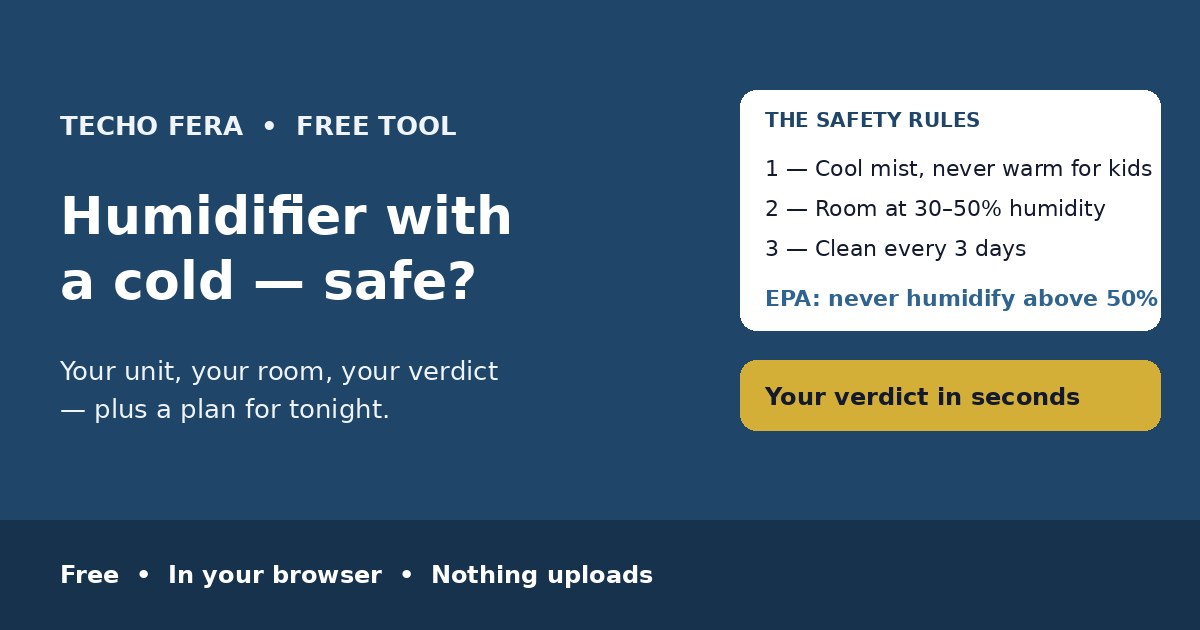
A cool-mist humidifier may ease a stuffy nose and cough from a cold — but only when the room is dry, the unit is clean, and the water is right. The EPA says to keep indoor humidity between 30% and 50%, and not to humidify above 50%. It also says to empty the tank and dry all surfaces daily, to clean portable humidifiers every 3 days, and to use distilled or low-mineral water. The Mayo Clinic says to always use cool mist for children, because warm mist and steam can burn a child. This checker takes who has the cold, the worst symptom, the type of humidifier, the room humidity, how recently the unit was cleaned, what water goes in it, any breathing condition, and where it runs — and gives you a verdict: safe to run, safe with a few fixes, clean it first, not worth running, or do not use it.
To use it:
- Say who has the cold. Babies, children and older adults need different care — a warm-mist unit that is fine for an adult is a burn risk for a baby, and a baby with a fever needs a clinician, not a humidifier.
- Pick the worst symptom. A stuffy nose is what a humidifier can help. Trouble breathing is a safety flag — it needs a clinician, not a humidifier.
- Pick the kind of humidifier. The type decides the risks: warm mist can burn a child, ultrasonic units spray minerals from hard water, and evaporative units release mostly water vapour. If you are not sure, check the label, the manual, or the maker's site.
- Say what the room humidity is. Measure it with a hygrometer if you can. Below 30% is dry enough for a humidifier to help; 30–50% is already fine; above 50% is too damp.
- Say when the unit was last cleaned, and what water goes in it. A tank of standing water grows bacteria and mould, and hard tap water in an ultrasonic unit leaves mineral dust in the air. If you cannot remember cleaning it in the last 3 days, clean it before you run it.
- Read the verdict — and the plan. Safe to run means run it tonight on a low setting. Clean it first means fix the unit, then check again. Do not use it means ask a clinician first. Not worth running means the air is already fine — leave it off.
What makes this checker different
The pages that rank for this search are guides — the Mayo Clinic's cool-mist versus warm-mist answer, a close look at the trial evidence, a congestion guide, and a guide to whether a humidifier really helps a cough or a stuffy nose. They agree on the facts: cool mist may ease congestion, warm mist does not help more, a dirty unit is its own hazard, and no trial has shown a humidifier shortens a cold. But every one of them gives you the same general advice and leaves you to work out whether it fits your unit, your room and your family. None of them asks who has the cold, what kind of humidifier you own, how recently you cleaned it, what water you fill it with, or whether anyone in the house has asthma. There is no free, standalone checker that takes your answers and gives you a safe-to-use verdict, the blockers named, and the next steps. This page is that answer: eight questions, an instant verdict for your exact situation, and the plan. It gives guidance only, never a diagnosis — it cannot hear your breathing, measure your temperature, or see inside the tank, and where an answer is missing it says so instead of guessing.
When is this the right check?
When someone in the house has a cold and you are standing over the humidifier wondering whether to switch it on — because the question is not whether humidifiers help colds in general, but whether yours is safe to run tonight. When the baby is stuffy and the only unit in the house is a warm-mist one — because the checker tells you the burn risk before you run it. When the unit has sat in the cupboard since last winter and you cannot remember cleaning it — because the checker tells you to clean it first. And when the windows are already fogging up — because the checker tells you the room is too damp and the humidifier would only make it worse.
Honest limitations
Guidance only, never a diagnosis
This checker cannot hear your breathing, measure your temperature, or see inside the tank. It cannot tell you whether a cough is a cold or something else, or whether a fever needs a clinician. If breathing gets harder, a fever lasts more than 3 days, or a baby will not feed, ask a clinician promptly.
Comfort, not cure
No trial has shown a bedroom humidifier shortens a cold or clears the infection faster. The 2017 Cochrane review of heated, humidified air found low-quality, inconsistent evidence: neither a benefit nor a harm. Use a humidifier to make a stuffy night more bearable — and rest, drink fluids, and use saline nose drops while the cold runs its course.
Warm mist does not help more
The FDA says warm mist can cause nasal passages to swell and make breathing harder, and the Mayo Clinic says heated, warm-mist air does not seem to deliver the same relief for cough and congestion as cool mist. Warm mist also uses more electricity and is a burn risk around children. For a cold, cool mist is the better choice.
A dirty unit can make things worse
The EPA warns that bacteria and moulds often grow in humidifiers with standing-water tanks and can be dispersed in the mist. A unit that has not been cleaned in over a week — especially an ultrasonic one run on hard tap water — can put bacteria, mould spores and mineral dust into the air you breathe. Clean it every 3 days.
Humidity is a range, not a target to overshoot
Below 30% is dry enough for a humidifier to help; 30–50% is already fine; above 50% feeds dust mites and mould. In very cold weather, aim for the lower end of the range — warm, moist air condenses on cold windows and walls. Measure the room before you run the unit, and turn it down if windows start to fog.
This is the safety question, not the overnight question
This checker answers whether it is safe to run your humidifier with a cold, right now. It does not answer whether to run it all night — that is the Should I Run My Humidifier All Night? Checker — or which device to buy, whether the house is too humid, or what to take for a cold. Those are different questions, with their own checkers, linked below.