How the steaming-up check works
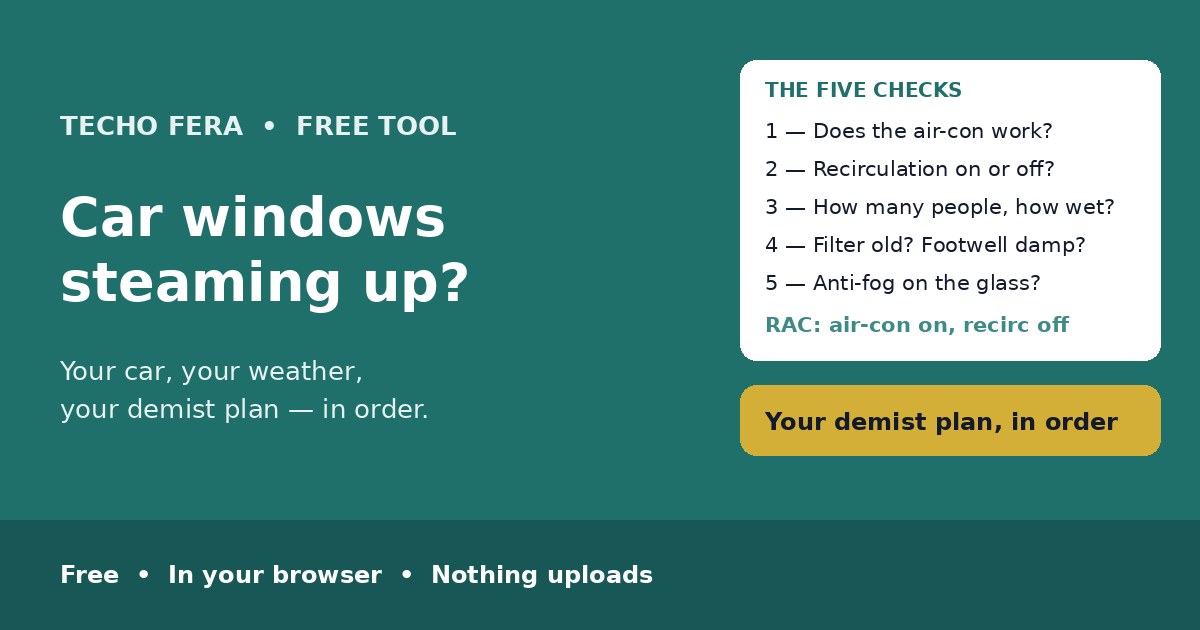
It is 7:20 on a cold, wet morning, four of you are in the car, and every window is white inside. The demister has been running for five minutes and the windscreen is still misted. The problem is not the demister — it is the settings, and the moisture in the cabin. This checker asks ten questions — how cold it is outside, what the weather is doing, how many people are in the car, what wet things are in it, whether the air conditioning works, whether recirculation is on, how old the cabin filter is, whether water is getting in through a seal, whether the glass has an anti-fog treatment, and where you are — and turns the answers into a verdict and a step-by-step plan, in the order you should do the job.
To use it:
- Say how cold it is outside, and what the weather is doing. The colder the glass, the faster warm, moist cabin air condenses on it — and rain loads the cabin air with moisture before you even start.
- Say how many people are in the car, and what wet things are in it. Every breath adds water vapour, and damp coats, umbrellas and mats release it for hours. The RAC and Halfords both call wet items left in the cabin the biggest repeat cause.
- Say whether the air conditioning works. The air conditioning is what dries the air — heat alone warms it without drying it. If it feels weak, it has probably lost its charge and needs a service, roughly every two years.
- Say whether recirculation is on. The button with the car and the U-turn arrow. With it on, the car keeps reheating the same humid cabin air — the single most common reason a demister seems not to work. Outside air, even when cold, is usually drier.
- Say how old the cabin filter is, and whether the footwells are dry. An old filter restricts airflow and can hold water, and a damp footwell points to a leak around a door or window seal, or a blocked drain. Either one means the mist keeps coming back until it is fixed.
- Say whether the glass has had an anti-fog treatment. A spray leaves a thin coating that spreads water into a clear film instead of droplets. It slows the misting down — it does not stop the moisture getting in.
- Read the verdict — and the plan. The verdict tells you whether air-con and fresh air will clear it fast, whether recirculation is the trap, whether you need to wipe and ventilate because there is no working air conditioning, or whether the filter and seals are feeding the mist. The plan lists the steps in order, so you can walk through them one by one.
What makes this checker different
The pages that rank for this search are guides — the RAC, Auto Express, Aviva, Allstate — and they all give the same six steps and leave you to judge your own car. None of them asks whether your air conditioning actually works, whether recirculation is on, how many people are breathing in the car, or whether water is getting in through a seal. This page is that answer: ten questions, five verdicts, and a plan that changes with the answers — including the one-button fix when recirculation is the trap, the wipe-and-ventilate plan for a car with no working air conditioning, and the filter-and-seals warning when the mist returns every single trip. This checker is about stopping interior misting — condensation on the inside of the glass. It is not about ice on the outside: if the windscreen is frozen, see the Should I Use Hot Water to De-Ice My Windscreen? Checker, which covers whether to pour water on a frozen windscreen. And if you want to stop the screen icing up in the first place, see the Should I Cover My Car in Winter? Checker and the Should I Warm Up My Car in Winter? Checker.
When is this the right check?
When the windows steam up every cold morning and the demister never seems to work fast enough — because the answer depends on the air conditioning, the recirculation setting and the moisture in the cabin, and a blanket list of six steps does not tell you which one is wrong in your car. When the mist comes back within minutes of clearing, every single trip — because that is when the cause is a wet cabin, an old filter or a leak, not the weather. When the car has no air conditioning, or the air conditioning feels weak — because that changes the plan completely, from air-con and fresh air to wipe and ventilate. And when you are not sure what the recirculation button even does — because that one button is the most common reason a demister seems not to work.
Honest limitations
A planning aid, not car advice
This checker cannot see your windows, your car or your thermometer. It cannot tell you whether your air conditioning has actually lost its charge, or whether the damp in the footwell is a leak or a spilled bottle. If the glass will not clear at all after ten minutes of demisting, pull over safely and get the car checked.
Clear times are estimates
The clear times on this page are the checker's own estimates, labelled as estimates: the RAC and the guides describe the method as clearing the glass in a few minutes, not in seconds, and the exact time depends on how cold the glass is and how wet the cabin is. Nothing here is a measured time for your car.
The leak you cannot see
A leak around a door or window seal, or a blocked drain under the windscreen scuttle panel, can let water in for weeks before anyone notices — the first sign is often a musty smell, or a footwell carpet that is damp to the touch. If the mist returns every morning no matter what you do, the cause is water getting in, not the weather.
Anti-fog is a delay, not a cure
An anti-fog spray spreads water into a clear film instead of droplets, so the glass stays see-through — but it does nothing about the moisture in the cabin. On a wet morning with four people in the car, the film is overwhelmed in minutes. Treat the glass, and dry the cabin too.
The legal line
In the UK, Highway Code Rule 229 and Regulation 30 of the Road Vehicles (Construction and Use) Regulations 1986 require a full, clear view before setting off — a cleared peephole is not enough. A misted windscreen is a legal issue, not just an inconvenience, and driving with impaired vision can bring a fine.
Rules from the RAC, Auto Express, Aviva and Allstate, dated November 2026
The rules here are the published guidance as they read in November 2026: the RAC on the demist steps, the recirculation warning and the wet-items cause; Auto Express on the six steps; Aviva on heater and air conditioning together and cracking the windows; Allstate, citing Road & Track, on heat, air conditioning and fresh air. Guidance changes: recheck with those sources if anything about your plans changes.