How the warm-up check works
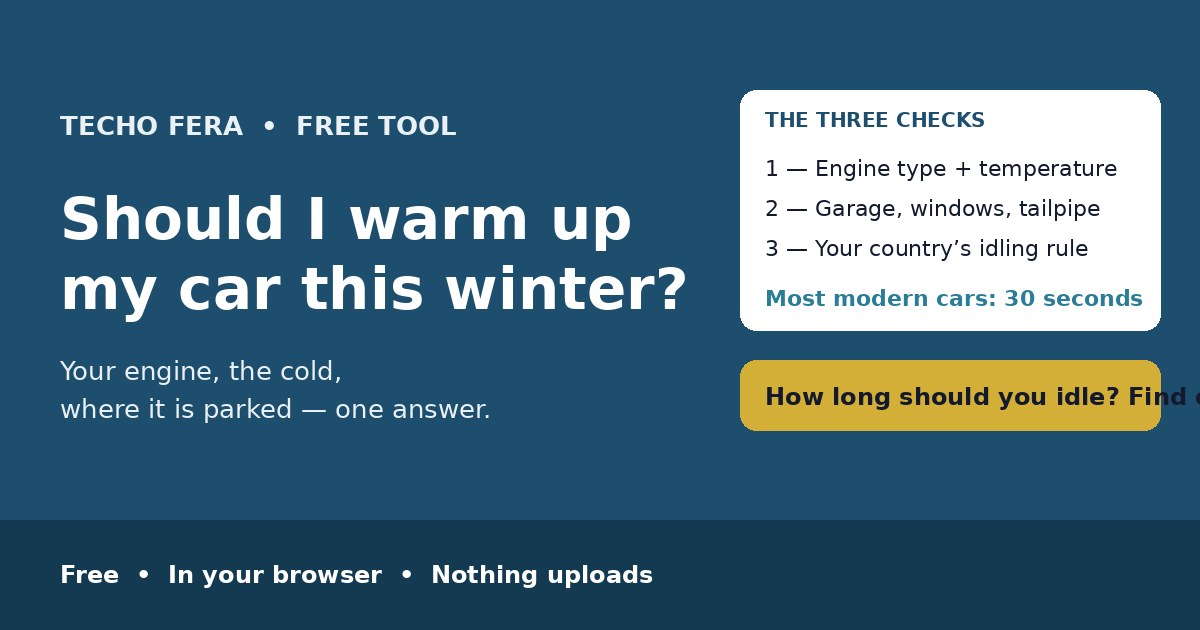
The warm-up habit comes from the carburettor era, when an engine genuinely needed several minutes of idling before it would run smoothly. Modern cars use electronic fuel injection, which adjusts the fuel-air mixture automatically from sensors — so the engine is ready to drive almost immediately. The U.S. Department of Energy says that even on the coldest days, most manufacturers recommend driving off gently after about 30 seconds of idling. Driving puts the engine under light load and warms it far faster than sitting still, and the catalytic converter starts working sooner when the car is driven. This checker does the arithmetic for your exact car: your engine type, the temperature band, where the car is parked, whether the windows and tailpipe are clear, and your country — and gives you an idle time, a fuel-waste figure, and the safety checks that come before any of it.
To use it:
- Pick your engine. Modern petrol, diesel, hybrid, electric, or an older carburettor car. The answer is completely different for each: about 30 seconds for a modern petrol car, a minute after the glow plug light for a diesel, nothing at all for an electric car, and a few minutes for a carburettor car.
- Pick the temperature band. Above freezing, light freeze, deep freeze, or extreme cold below −18°C (0°F). Only extreme cold justifies more than a minute of idling — and even then, a block heater does more than extra idling.
- Say where the car is parked. A car inside a garage must never be warmed up indoors, whatever the engine: carbon monoxide builds up quickly in an enclosed space and can seep into the house. This answer outranks every other one.
- Check the windows and the tailpipe. Do not drive until every window is clear of ice and fog, and do not idle until the tailpipe is clear of snow — a buried tailpipe can push exhaust into the cabin.
- Pick your country to see the local idling rule — the UK's Highway Code rule 123, the US state limits, or Environment Canada's 60-second guidance — and optionally say how long the car has already been idling, so the checker can show the fuel you have already wasted.
What makes this checker different
The pages that rank for this search are guides — a motoring blog that explains the 30-second rule, an oil company's blog, and three near-identical question-and-answer pages. None of them asks what engine you have, how cold it is, where the car is parked, or whether the windows and tailpipe are clear — and none of them gives you a personal idle time, a fuel-waste figure, or a verdict that says "do not idle in a garage" before it says anything about the engine. There is no free, standalone checker that takes your engine, your temperature, your parking spot and your country — and gives you an idle time in seconds, a cold-start score, and a recommended action built on your own answers. This page is that answer: seven questions, an instant verdict for your exact car, the blockers named, and the next steps. It is a self-assessment, so it says plainly what it cannot know: it cannot see your car, and where an answer is unknown it says so instead of guessing.
When is this the right check?
When you are standing in the cold wondering whether to let the car run — because the answer is usually 30 seconds, not five minutes, and the fuel you save adds up over a winter. When you drive a diesel or an older car — because those two genuinely need more time, and the checker tells you how much. When the car is in a garage or the tailpipe is buried in snow — because those are safety questions, not engine questions, and getting them wrong is dangerous. And when someone tells you to "let it warm up properly" — because for a modern fuel-injected car, driving gently warms the engine faster than idling ever will.
Honest limitations
A self-assessment, not mechanical advice
This checker cannot see your car, your engine, or your owner's manual. It cannot tell you what your manufacturer actually recommends, or diagnose a car that struggles to start. Your owner's manual has the final word for your car.
Your owner's manual comes first
Most modern manuals say much the same thing — no extended warm-up, drive moderately until the engine is warm — but some cars differ. If your manual says something different from this checker, follow the manual.
The fuel figure is a range, not an exact number
The checker uses the 0.5 to 1 gallon per hour figure for a typical passenger car at idle. Your car's real consumption depends on its engine size, the heater and the heated seats — so the waste is shown as a range, not a precise figure.
Idling laws change by place
The checker names the headline rules — the UK's £20 fixed penalty, the US state limits, Environment Canada's 60-second guidance — but fines and enforcement vary by city and council. Check the local rule where you park.
Windows are a safety rule, not a warm-up rule
However long you idle, do not drive off until every window is clear of ice and fog. A warm engine does not make a half-cleared windscreen safe, and in the UK driving with an obscured windscreen is an offence in its own right.
Rules from official sources, dated November 2026
The rules here are the U.S. Department of Energy's guidance on vehicle idling, Environment Canada's 60-second recommendation, and the UK's Highway Code rule 123, as they read in November 2026. Guidance changes: recheck with your manufacturer if anything about your car changes.