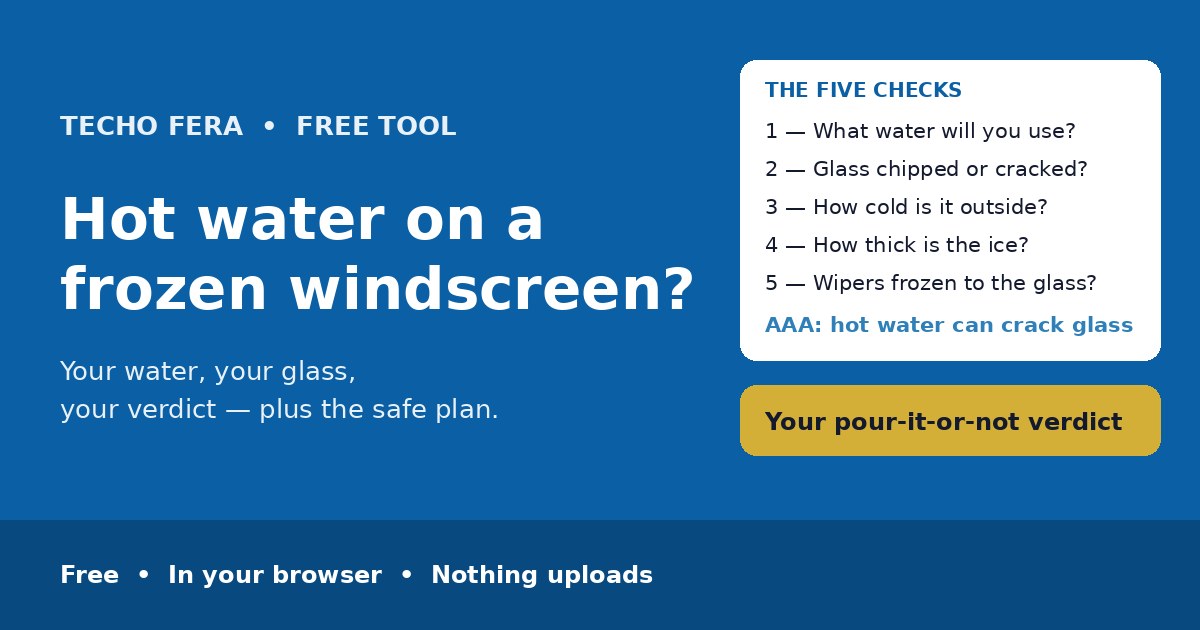
Should you pour hot water on a frozen windscreen?

The kettle feels faster than waiting — until the glass cracks. Answer eight questions about the water, the glass, the cold and what kit you have, and this checker tells you whether to pour it, whether it is a gamble, or whether to skip the water entirely — with the fastest safe way to clear the screen. Free, in your browser, nothing uploads.

  • AAA: hot water can crack glass
  • AA: avoid even lukewarm water
  • Safe de-icing plan included
  • Free, no account, nothing uploads
Should I use hot water to de-ice my windscreen? Check before you pour.

Check whether the water is safe to pour

Try a preset:
0 of 8 answered

Your result

Answer the questions Your verdict appears here as you answer.
Recommended action

Answer the questions above and the recommended action will appear here.

Your plan

    Blockers

    Things that do not fit

    Things to check

    Still to confirm

    What to do next

      Your result summary


      Answer the questions above — the verdict updates live.

      Privacy you can verify, not just trust

      Deciding whether to pour hot water on your windscreen by uploading your car details to a website would be backwards — the check should never be the leak. This one can't: your answers are checked in your browser, and they never leave the device — the only third-party requests are the site's own analytics, which count page views. Don't take our word for it:

      New cross-origin requests during use: 0
      1. Press F12 to open developer tools, then the Network tab.
      2. Answer a question above. Watch: apart from the site's analytics, nothing new is requested — no uploads, and no data ever leaves your device.
      3. Extra credit: disconnect your internet after this page loads — the checker still works.

      How the hot-water check works

      It is 6:40 in the morning, you are late, and the windscreen is white. Someone's voice in your head says, “Just pour the kettle on it.” Do not. It is the classic mistake, and it can put a crack across the glass right in front of you. This checker asks eight questions — what water you were going to use, what state the glass is in, how cold it is outside, how thick the ice is, how much time you have, what de-icing kit you own, whether the wipers are frozen to the glass, and where you are — and turns the answers into a verdict and a step-by-step plan, in the order you should do the job.

      To use it:

      1. Say what water you were going to use. Boiling water is the worst case — the temperature jump is what cracks the glass. If you have not decided, say so: the safest method needs no water at all, and the checker will show you that plan.
      2. Look at the glass. A crack, or a chip right in front of the driver, changes the answer completely — even lukewarm water can make the glass crack when it already has damage. A chip too small to have worried anyone is where a crack starts.
      3. Say how cold it is outside. The gap between the water and the glass is the whole question. In deep cold the jump is bigger, and any water you pour refreezes fast — warm water freezes faster than cold water.
      4. Say how thick the ice is. Water will not clear thick ice: it cools as it runs off and refreezes lower down the glass. Light frost is the only case where water does anything at all.
      5. Say how much time you have. Being late is when the kettle feels fastest. A cracked windscreen costs hundreds of pounds and days off the road; the defroster and a scraper take about ten minutes.
      6. Say what kit you have. A can of de-icer or a plastic scraper clears the screen faster than any jug of water — and a de-icer keeps working where water refreezes. If you have nothing, the checker gives you the homemade mix: one part rubbing alcohol to two parts water.
      7. Check the wipers. If they are frozen to the glass, make sure they are switched OFF before you start the car — switching them on tears the rubber or blows the wiper fuse. Refrozen water can glue them down again.
      8. Read the verdict — and the plan. The verdict tells you whether to pour the water, whether it is a gamble, or whether to skip the water entirely. The plan lists the steps in order, so you can walk through them one by one.

      What makes this checker different

      The pages that rank for this search are news articles and guides that all say the same thing — never pour hot water on a frozen windscreen — and leave you to judge your own car. None of them asks what water you were actually going to use, whether the glass already has a chip, how cold it is, or how thick the ice is. This page is that answer: eight questions, five verdicts, and a plan that changes with the answers — including the least-risky water option for sound glass in mild cold, the gamble warning for warm water on a chipped screen, and the emergency plan for a crack that is already spreading. This checker is about the de-icing method — whether to pour water on a frozen windscreen. It is not about driving with a windscreen that is already damaged: for that, see the Can I Drive With a Cracked Windscreen? Checker and the Is It Safe to Drive With a Cracked Windshield? Checker. And if you want to stop the screen icing up in the first place, see the Should I Cover My Car in Winter? Checker and the Should I Warm Up My Car in Winter? Checker.

      When is this the right check?

      When the kettle is in your hand and the windscreen is white — because the answer depends on the water, the glass and the cold, and a blanket “never” does not tell you what to do instead. When the glass already has a chip — because that is when even lukewarm water becomes a gamble, and the defroster has to be ramped up gradually. When it is deep cold — because water refreezes before it finishes the job, and a de-icer is the tool that keeps working. And when you have no scraper and no de-icer — because that is when the kettle looks tempting, and the homemade alcohol mix is the answer that actually works.

      Honest limitations

      A planning aid, not car advice

      This checker cannot see your windscreen, your car or your thermometer. It cannot tell you exactly how hot your water is, or whether a chip you cannot see is already spreading. If the glass cracks, stop, do not pour anything on it, and call a windscreen repairer.

      The crack you cannot see

      A stone chip too small to have worried anyone is where a crack starts. If you have not looked at the glass closely, the checker says so instead of guessing — and a chip in the driver's view is a different problem from a chip at the edge.

      Lukewarm is not safe, just less risky

      Lukewarm water on sound glass in mild cold is the least risky way to use water — but the AA still advises against it. It is hard to judge “lukewarm” from a jug at dawn, and guessing wrong is how glass cracks. The defroster is still the safer call.

      The refreeze problem

      On a very cold day the water can turn to ice again before you know it — and warm water freezes faster than cold water. A refreeze leaves a fresh layer of ice on the windscreen, and it can glue the wipers to the glass and risk the wiper motor.

      The MOT line

      In the UK a crack of 10mm or more fails the MOT when it sits in Zone A, the 290mm strip of windscreen centred on the steering wheel; 40mm or more anywhere else on the glass also fails. A chip the size of a five-pence piece in the driver's eyeline is enough to fail the test.

      Rules from AAA, the AA and the glass repairers, dated November 2026

      The rules here are the published guidance as they read in November 2026: AAA on thermal shock and the defroster steps, the AA on avoiding even lukewarm water and the refreeze warning, Glass Doctor and Safelite on chips and the homemade de-icer mix, and Prestone on lukewarm water and wax. Guidance changes: recheck with those sources if anything about your plans changes.

      Frequently asked questions

      Can you pour hot water on a frozen windscreen?

      No. Hot water on a frozen windscreen is thermal shock: the spot the water hits warms and expands fast while the glass around it stays cold and does not move, and that uneven stress can crack the glass in seconds. AAA says hot water "can crack glass by causing thermal shock", and Glass Doctor agrees that rapid temperature changes in glass can cause it to crack. A small stone chip gives the crack a starting point. Use the defroster, a plastic scraper and a de-icer instead — this checker turns your water, your glass and the cold into a verdict.

      Is lukewarm water safe on a frozen windscreen?

      The AA says even lukewarm water should be avoided: glass expands quickly when hot or even warm water touches it, and that flexing can make the glass crack — especially if it had small chips or cracks already. Lukewarm water on sound glass in mild cold is the least risky way to use water, and Prestone notes it is less likely to crack the glass than hot water. But it is hard to judge "lukewarm" from a jug at dawn, and on a very cold day the water can refreeze and glue the wipers to the glass. The defroster, a scraper and a de-icer are still the safer call.

      Why does hot water crack a windscreen?

      Glass expands as it warms. Pour hot water on a windscreen that has been sitting below freezing all night and the surface heats much faster than the rest of the glass — that uneven stress is called thermal shock, and it is how windscreens crack. A small chip or nick from a stone gives the crack a starting point, which is why a windscreen that already has damage is at the most risk. The same sudden change is why Safelite warns that a full blast of defroster heat can make small chips spread.

      What is the fastest safe way to de-ice a windscreen?

      Start the engine, set the heater to defrost at full heat with the air conditioning on to dry the air, and once the ice softens clear it with a plastic scraper or a de-icer spray. Brush loose snow off first, work the scraper from the top down so meltwater does not refreeze lower down the glass, and wait until the whole windscreen is clear — every window, mirror and light, not just a peephole. It takes about ten minutes, and it carries none of the crack risk of hot water.

      Can I use a homemade de-icer spray?

      Yes. AAA's mix is one part rubbing (isopropyl) alcohol to two parts water with a few drops of dish soap; Safelite uses two parts alcohol to one part water. Rubbing alcohol freezes far below water, so it melts ice on contact and does not refreeze the way water does. Spray it on, give it a minute, then scrape. Do not use vinegar on a frozen windscreen: it is an acid, it can corrode chrome and paint, and spraying it on already-frozen glass does not help.

      What if my windscreen already has a chip or a crack?

      Do not pour any water on it — even lukewarm water can make the glass crack when it already has damage, and a chip is where a crack starts. Ramp the defroster heat up gradually instead of blasting it straight away, clear the ice with a scraper, and get the damage checked. In the UK a crack of 10mm or more in Zone A — the 290mm strip centred on the steering wheel — fails the MOT, and 40mm or more anywhere else on the glass also fails.

      Can I drive with part of the windscreen still icy?

      No. In the UK the Highway Code and section 41D of the Road Traffic Act 1988 make it a legal requirement to be able to see the road ahead clearly before setting off, and AAA counts at least 11 US states that legally require snow and ice removal before driving. A cleared peephole is not enough — clear every window, mirror and light, and clear the snow off the roof so it does not slide down over the windscreen when you brake.

      Does this checker give car advice?

      No. This checker is a planning aid: it runs your answers against the published guidance as it reads in November 2026, entirely in your browser, and nothing you enter leaves your device. A web page cannot see your windscreen, your car or your thermometer, so it says plainly what still needs checking — above all, whether the glass has a chip or a crack, and how cold it really is outside.