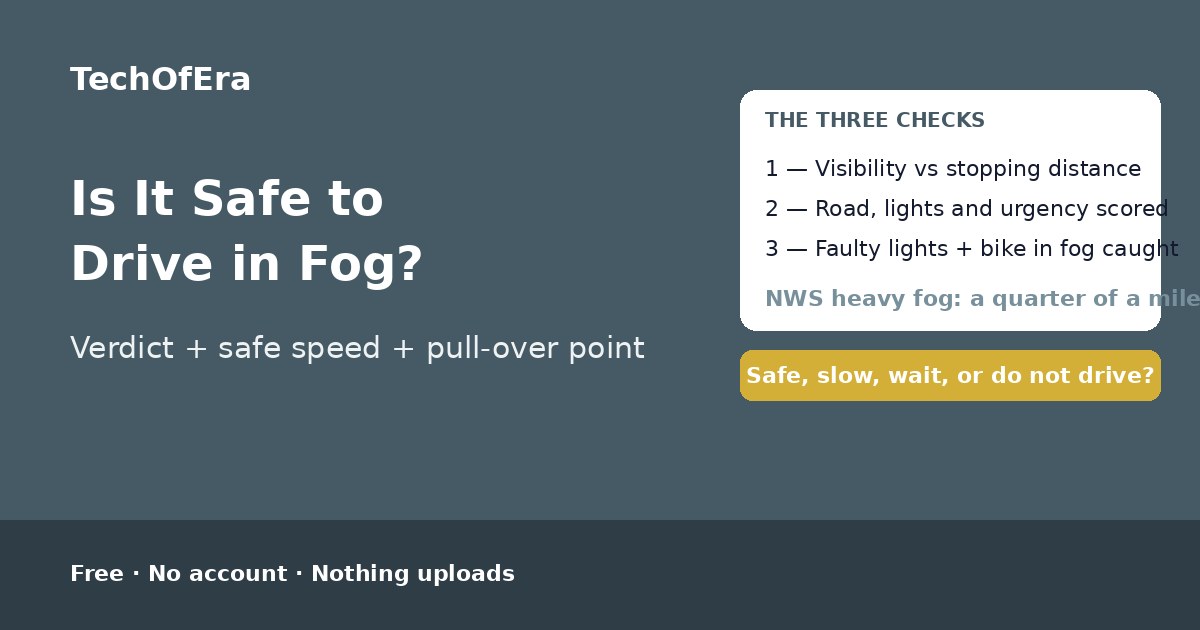
How the fog driving check works
Fog causes more than 38,700 crashes a year in the USA, about 600 deaths and more than 16,300 injuries, according to Amica — and the danger is not the fog itself, it is the stopping distance. At 70 mph you need 96 metres to stop, so if you can only see 50 metres ahead you are already driving faster than you can stop. Whether it is safe to drive depends on one number first — how far you can see — and then on the trip, the road, the time of day, your lights, your vehicle, and whether a fog advisory is in force. This checker turns those answers into a risk score, names the verdict, and works out the fastest speed that still lets you stop inside what you can see, from the Highway Code stopping distances.
To use it:
- Judge how far you can see. Pick the furthest thing you can still see clearly — a road sign, a lamp post, a building — and judge the distance. A lamp post is about 30 metres from the next one; a football pitch is about 100 metres long. Heavy fog, by the National Weather Service definition, means visibility of a quarter of a mile (about 400 metres) or less.
- Say how urgent the trip is. The safest choice in fog is not to drive at all — but whether you can wait depends on the trip. An emergency is different from a visit you could skip, and the checker treats it differently: it still names the risk, but it does not tell you to stay put when someone is in danger.
- Say what roads you will use and what time it is. Motorways and rural lanes are the worst places to be in fog, and fog at night is worse than fog in daylight: darkness cuts contrast and depth perception on top of the fog.
- Check your lights. Low beams and fog lights are what other drivers see you by. High beams reflect off the fog and make it worse — never use them in fog. A faulty light in fog is a blocker: do not drive until every light works.
- Say what you are driving, and whether an advisory is in force. A motorcycle or a towing vehicle in fog is a different risk from a car, and a dense fog advisory means the authorities expect visibility at or below a quarter of a mile across the whole area, not just where you are standing.
- Tick the extra hazards. Rain, freezing temperatures, thickening fog, tiredness and close traffic each make the same visibility more dangerous — and a tired driver in fog has no margin for a slow reaction.
What makes this checker different
The pages that rank for this search are guides — State Farm’s dense-fog tips, Amica’s fog safety guide, AAA’s driving-in-fog advice, the Georgia driver handbook, and a driving-school guide. All of them say the same things: slow down, use low beams, leave extra space, pull over if it gets too bad. None of them asks how far you can see, what roads you will use, what lights you have, or how urgent the trip is — and none of them gives you a verdict for your exact drive, or a speed. There is no free, standalone checker that takes your visibility, road, lights and urgency and gives you a score, a verdict (safe, drive slowly, wait, or do not drive), the fastest speed that still lets you stop inside what you can see, and the point at which to pull off and wait. This page is that answer: seven questions, an instant verdict for your exact drive, the blockers named, and the next steps. It is a self-assessment, so it says plainly what it cannot know: it cannot see the fog where you are, and where the fog is too thick it says wait instead of guessing.
When is this the right check?
When you look out of the window in the morning and the street has disappeared — because the question is not whether there is fog, it is whether your exact trip is safe in it. When you are already on the road and the fog closes in — because the checker tells you the speed that still lets you stop inside what you can see, and the point at which to pull off. When the weather service has issued a dense fog advisory and you are wondering whether it really applies to you — because an advisory means the whole area, not just your street. And when someone in the car says “it will be fine” and you want a number — because a risk score and a stopping distance settle the argument better than a feeling.
Honest limitations
A self-assessment, not a forecast
This checker cannot see the fog where you are, measure the visibility ahead of you, or know whether the fog is thickening. Fog is local: a clear street can turn into a white wall in a dip or near water, and the fog ahead can be far worse than the fog where you are standing.
The safe speed is an estimate, not a limit
The fastest safe speed comes from the Highway Code stopping distances on a dry road — 12 metres at 20 mph, 23 at 30 mph, 36 at 40 mph, 53 at 50 mph, 73 at 60 mph and 96 at 70 mph. A wet road doubles stopping distances, and the posted limit always wins: never exceed it, and go slower still if the road is wet.
Visibility is your judgement, not a measurement
The checker takes your word for how far you can see. If you are guessing, guess low: pick the shorter band. A lamp post is about 30 metres from the next one, and a football pitch is about 100 metres long — use those as your ruler.
Rules differ by place
Hazard-light rules, fog-light rules and advisory thresholds differ by state and country. The guidance here follows the National Weather Service, the UK Highway Code and the state driver handbooks as they read in November 2026 — check your local rules before you drive.
A faulty light is a stop sign, not a warning
In fog, your lights are how other drivers see you — and how you see the road edge. A faulty low beam, fog light, tail light or indicator in fog is a reason not to drive at all, not a reason to drive more carefully.
Rules from official sources, dated November 2026
The rules here are the National Weather Service definition of heavy fog (a quarter of a mile or less), the UK Highway Code rules 226–237 (headlights below 100 metres, fog lights below 100 metres, never high beams, pull off if it gets too bad), the Georgia driver handbook, and State Farm’s 5-second following distance, as they read in November 2026. Guidance changes: recheck with your local weather service if anything about your route changes.