How the pipe-freeze check works
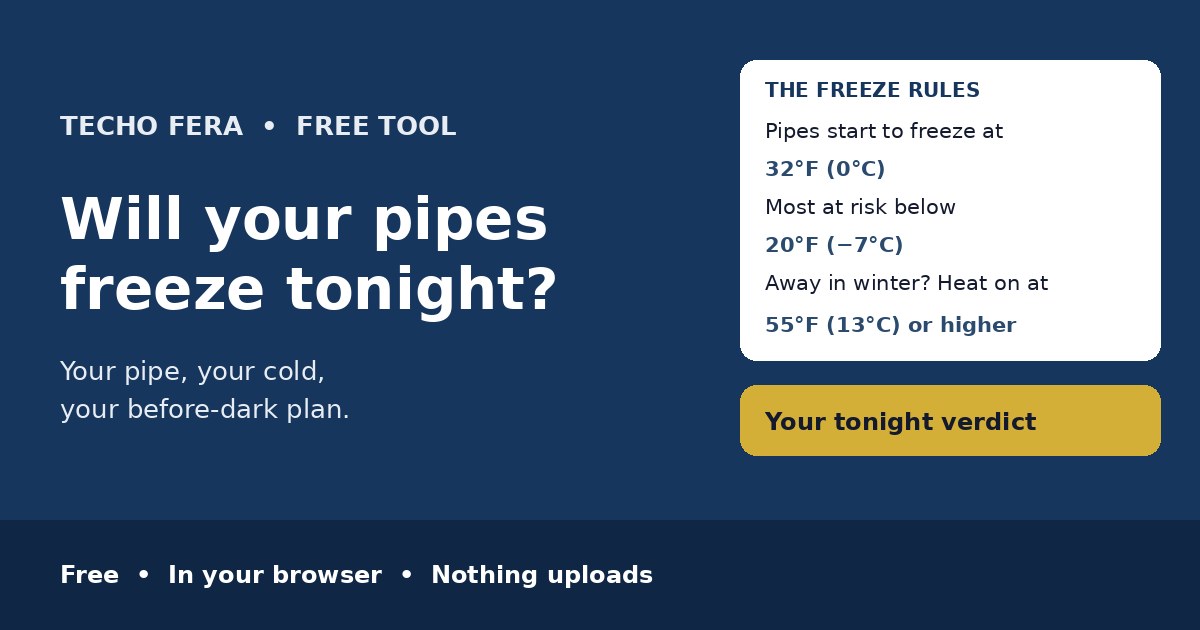
This checker is about prevention: whether a pipe that is still flowing will freeze tonight. Pipes can begin to freeze when the temperature outside drops to 32°F (0°C), and they are most at risk below 20°F (−7°C) for an extended period — that 20°F line, from Chubb and Texas A&M AgriLife Extension, is the warning this checker is built around. The checker asks six questions — where the pipe is, how cold it gets tonight, how long the cold lasts, whether the pipe is insulated, whether the heating is on, and whether a tap is left dripping — and turns the answers into a verdict for tonight, what fails first, and a before-dark plan, in the order you should do the job.
To use it:
- Say where the pipe is. Outdoors, in a garage, in an unheated basement or crawl space, in a loft, or under a sink on an exterior wall. Where the pipe is decides most of the risk — an outdoor hose bib freezes first, a pipe under a sink on an inside wall freezes last.
- Say how cold it will get tonight. The overnight low, not the daytime high. Above 32°F the water cannot freeze at all; 20 to 32°F is the watch zone; 0 to 20°F is the danger zone; below 0°F even a protected pipe is tested.
- Say how long the cold lasts. One cold night is survivable for most pipes. Four or more nights in a row is when the ice forms through the whole pipe — the ground, the walls and the pipe itself all cool down together.
- Say whether the pipe is insulated. A foam sleeve buys hours in a freeze; heat tape actively warms the pipe. A bare pipe has nothing between it and the night. If you are not sure, say so — the checker treats that as unknown, not as average.
- Say whether the heating is on. Keep every thermostat at least 65°F (18°C) all winter, and no lower than 55°F (13°C) if you go away. Setting the heating back overnight is the classic burst-pipe mistake.
- Say whether a tap is left dripping. A steady trickle through the pipe keeps the water moving and helps prevent freezing — the tap the exposed pipe feeds, not a random one. Read the verdict — and the plan. A safe verdict means keep the habits that got you here; an at-risk verdict means drip the tap and keep the heat on before dark; a freeze-likely verdict means act now, or shut off and drain.
What makes this checker different
The pages that rank for this search are guides from the Red Cross, insurers and water companies. Every one of them gives the same list of tips — insulate, drip, keep the heat on — and leaves you to judge your own house. None of them asks where your pipe is, how cold it gets tonight, how long the cold lasts, or whether a tap is dripping — and none of them tells you which of those is the thing that will fail first, or when the answer stops being "drip the tap" and starts being "shut off and drain". The freeze-time calculators that exist are a different tool for a different person: they compute hours-to-freeze from pipe diameter, length and insulation thickness, for engineers sizing heat trace — not a homeowner asking whether tonight is the night. This page is that answer: six questions, three kinds of verdict, what fails first, and a plan that changes with the pipe — including the shut-off-and-drain result for an empty house in a long cold snap. It is a planning aid, so it says plainly what it cannot know: it cannot see your pipes, and where your answers are uncertain it says so instead of guessing.
When is this the right check?
When the forecast shows a cold night coming and you want to know whether tonight is the night to worry — because the first question is where the pipe is, and the answer decides whether it is a drip-the-tap night or a shut-off-and-drain night. When you are going away in winter and wondering whether to leave the heat on — because the answer is yes, at no lower than 55°F, unless you drain the pipes instead. When the cold snap has already lasted three nights and you want to know whether the fourth is the dangerous one. And when a pipe has already frozen — because that is not this checker: if your tap already gives only a trickle, use the thaw estimator to work out how long it will take to thaw.
Honest limitations
A planning aid, not plumbing advice
This checker cannot see your taps, your pipes or your forecast. It cannot tell you exactly where the ice will form, or whether a pipe you cannot see is already damaged. If you can see water where it should not be, or a pipe that has burst, call a plumber.
The verdict is an estimate, not a promise
The verdict comes from a simple points model — cold, exposure, duration and heating, minus the protection from insulation, heat tape and a dripping tap — scored against the published 20°F warning line. It is labelled as the checker's own estimate everywhere it appears. A draughty crack in a wall can freeze a pipe warmer than 20°F, and a well-insulated pipe with the heat on can survive colder.
The 20°F line is a warning, not a guarantee
Chubb, Texas A&M and the International Code Council all use 20°F as the line where unprotected pipes start to freeze — but the same sources say pipes exposed to cold air through cracks, missing insulation or an outdoor location can freeze when it is warmer than 20°F. Treat a verdict of "safe" at 25°F with a bare outdoor pipe as a warning, not a pass.
A drip is not a cure-all
A dripping tap helps, but it does not save a bare outdoor pipe at 0°F, and it does not save an empty house with the heating off. The checker counts the drip as protection and still says freeze-likely when the cold and the exposure outweigh it — because that is what the guidance says.
Never thaw a frozen pipe with a flame
If a pipe has already frozen, open the tap it feeds and warm the section slowly with a hair dryer, a heating pad, or towels soaked in hot water. Never use a torch or an open flame, and never use a propane or kerosene heater indoors — the fire risk is worse than the frozen pipe.
Rules from the Red Cross, Chubb and Texas A&M, dated November 2026
The rules here are the published guidance as they read in November 2026: the American Red Cross on dripping, cabinet doors, the 55°F floor and draining outdoor lines; Chubb on the 32°F start and the 20°F danger line, the 65°F thermostat rule and shutting off and draining an unused building; Texas A&M on the 20°F freeze-and-burst line; and State Farm on dripping warm water overnight. Guidance changes: recheck with those sources if anything about your plans changes.