How the faucet drip check works
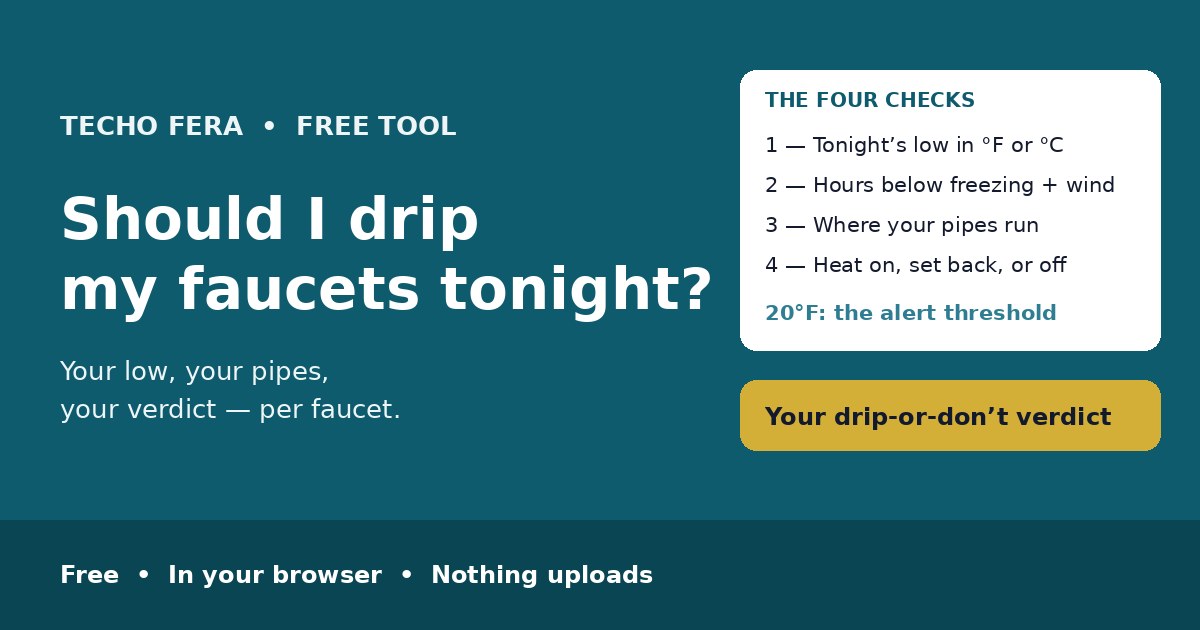
Water freezes at 32°F, but a pipe does not freeze the moment the air hits 32°F. What matters is how cold it gets, how long it stays there, and whether cold air can reach the pipe. The alert threshold for pipes in unheated spaces is 20°F, from the 1996 University of Illinois study: bare pipes in an unheated attic started forming ice at 20°F outside, and a pipe with cold air blowing on it through a crack can freeze at warmer temperatures. This checker scores tonight on six things — the forecast low, how long it stays below freezing, the wind, where your pipes run, how they are insulated, and whether the heat is on — and turns the score into a verdict: leave the faucets closed, drip one faucet, drip every faucet on an exposed pipe, or drip every faucet in the house. It also gives each pipe location its own verdict, because a crawl-space pipe and an interior pipe do not face the same night, and it works out how much water the dripping uses, so you can see the trade in cents.
To use it:
- Enter tonight's forecast low. The coldest temperature expected overnight, from your weather app — not the daytime high. Pick °F or °C. If the low stays above 32°F, water cannot freeze tonight, and the checker says so.
- Say how long it stays below freezing. A short dip below freezing rarely freezes a pipe; a long freeze gives the cold time to reach the water. Over 12 hours below freezing is a different night from under 4 hours, at the same low.
- Say how windy it is. Wind drives cold air through cracks and around pipes faster, so a windy freeze is worse than a calm one at the same temperature. Wind chill does not drop a pipe below the air temperature — it cools the pipe faster.
- Tick every place your pipes run. Exterior walls, crawl space, garage, attic, unheated basement, outdoor faucets — or "only inside heated walls" if none of those apply. Each location gets its own verdict, because the crawl-space pipe may need a trickle while the basement pipe needs nothing.
- Say how the pipes are insulated and whether the heat is on. Foam sleeves buy hours in a freeze; a night setback lets the walls cool down; heat off or away is when pipes freeze worst, because nobody is there to notice a drip stopping.
- Read the verdict — and the per-faucet list. The verdict tells you whether to drip at all; the per-faucet list tells you which faucets, how hard, and what it costs in water. If a faucet stops dripping in the morning, ice may be forming — leave it open and warm the pipe gently.
What makes this checker different
The pages that rank for this search are guides — a local plumber's prevention guide, a water-damage company's freeze page, a first-freeze checklist. Every one of them gives you the same rule of thumb and leaves you to judge your own house. The two tools that exist are thinner still: one asks for your ZIP code and pulls a live forecast to answer whether your pipes will freeze — a different question, and one that needs your location and a live forecast feed; the other takes three inputs, the low, the home type and the heat, and gives one generic verdict. None of them asks where each pipe runs, how long the freeze lasts, how windy it is, or how the pipes are insulated — and none of them tells you which faucet to drip, how hard to drip it, or what the water costs. This page is that answer: eight questions, a verdict per faucet, the drip rate, and the overnight water use in gallons and cents. It is a planning aid, so it says plainly what it cannot know: it cannot see your pipes, and where your forecast is uncertain it says so instead of guessing.
When is this the right check?
When a freeze warning comes in and you are not sure whether to drip — because the answer depends on your house, not the warning. When the low is borderline, around 28°F to 32°F — because that is where most people drip for nothing, or fail to drip a pipe that needed it. When your pipes run through a crawl space, garage or attic — because those are the pipes that freeze first, and the ones a generic rule of thumb gets wrong. And when you are leaving the house in a freeze — because an empty house with the heat off is when pipes freeze worst, and the checker says so plainly instead of giving you a drip verdict for a house nobody is watching.
Honest limitations
A planning aid, not plumbing advice
This checker cannot see your pipes, your insulation or your forecast. It cannot tell you whether a specific pipe is already frozen, or whether your house has a draft you have not found. If a faucet has stopped running, or you can see frost on a pipe, call a plumber.
The 20°F threshold is an alert, not a guarantee
The University of Illinois study found bare pipes in an unheated attic forming ice at 20°F — but a pipe with cold air blowing on it through a crack can freeze at warmer temperatures, and a well-insulated pipe can still freeze in a long freeze. The threshold tells you when to act, not when you are safe.
Forecasts change
The verdict is only as good as the low you enter. Forecasts move, and a low that drops by five degrees before bed changes the answer. Recheck the forecast before bed, and if it drops, drip more faucets.
Outdoor faucets are drained, never dripped
A dripping outdoor faucet does not protect the pipe behind the wall. Disconnect the hose, close the inside valve that supplies the bib, open the outside bib so the water drains, and leave it open so any remaining water can expand without breaking the pipe.
A drip that stops is a warning
If a faucet you left dripping has stopped by morning, ice may be blocking the pipe. Leave the faucet open, warm the pipe gently with a hair dryer, a heating pad or towels soaked in hot water — never an open flame — and call a plumber if you cannot find or thaw the frozen section.
Rules from the Red Cross, NWS and others, dated November 2026
The rules here are the published freeze-prevention rules as they read in November 2026: the American Red Cross on which pipes freeze and the 55°F rule for an empty house, the National Weather Service on the 32°F freeze definition and slow dripping, the 1996 University of Illinois study on the 20°F threshold, and the Insurance Institute for Business & Home Safety and the CDC on dripping every faucet in extreme cold. Guidance changes: recheck with those sources if anything about your plans changes.