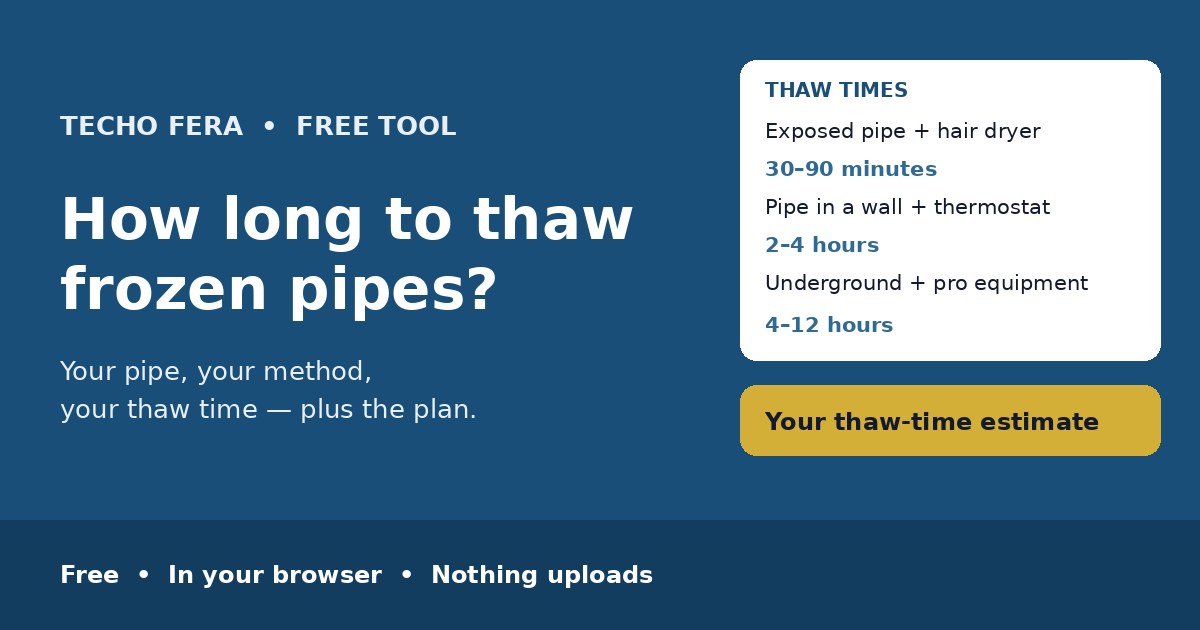
How long will your frozen pipe take to thaw?

An exposed pipe thaws in 30–90 minutes with a hair dryer — but a pipe in a wall takes hours, and an underground pipe takes a plumber. Answer six questions about where your pipe is, how you will thaw it, and how cold it is, and this estimator gives you a thaw time, a step-by-step plan, and the moment to stop and call a plumber. Free, in your browser, nothing uploads.

  • 30–90 min for an exposed pipe
  • 2–4 hours in a wall
  • 4–12 hours underground
  • Free, no account, nothing uploads
How long to thaw frozen pipes? Get your thaw-time estimate in seconds.

Estimate your pipe's thaw time

Try a preset:
0 of 6 answered

Your result

Answer the questions Your estimate appears here as you answer.
Recommended action

Answer the questions above and the recommended action will appear here.

Your plan

    Blockers

    Things that do not fit

    Things to check

    Still to confirm

    What to do next

      Your result summary


      Answer the questions above — the estimate updates live.

      Privacy you can verify, not just trust

      Estimating a thaw time by uploading your home details to a website would be backwards — the estimate should never be the leak. This one can't: your answers are checked in your browser, and they never leave the device — the only third-party requests are the site's own analytics, which count page views. Don't take our word for it:

      New cross-origin requests during use: 0
      1. Press F12 to open developer tools, then the Network tab.
      2. Answer a question above. Watch: apart from the site's analytics, nothing new is requested — no uploads, and no data ever leaves your device.
      3. Extra credit: disconnect your internet after this page loads — the estimator still works.

      How the frozen-pipe thaw estimate works

      A frozen pipe is not one job — it is four different jobs, and the thaw time depends on which one you have. An exposed pipe in the basement thaws in 30 to 90 minutes with a hair dryer. The same pipe inside an exterior wall takes 2 to 4 hours with the thermostat raised, because the heat has to get through the wall first. An underground or slab pipe takes 4 to 12 hours even with professional thawing equipment, and no DIY method can reach it at all. And a pipe left to thaw on its own takes days, not hours — within a day at 50°F or higher, 2 to 4 days at 30 to 40°F, and four days to over a week at 20 to 30°F. This estimator asks six questions — where the pipe is, how you plan to thaw it, the pipe size, how long the frozen stretch is, how cold it is outside, and where you are — and turns the answers into a thaw-time estimate and a step-by-step plan, in the order you should do the job.

      To use it:

      1. Say where the frozen pipe is. Exposed indoors, inside an exterior wall, underground or in a concrete slab, or a long exterior run. Where the pipe is decides the whole answer — a hair dryer works on a pipe you can touch and does nothing for a pipe in a wall.
      2. Say how you plan to thaw it. A hair dryer, a heating pad, a space heater, a raised thermostat, a heat cable, professional equipment, or waiting it out. If the method cannot reach the freeze, the estimator says so plainly and tells you to call a plumber instead of guessing a time.
      3. Say how wide the pipe is. A wider pipe holds more ice and thaws slower: ½ inch is about 15 mm across, ¾ inch about 22 mm, 1 inch about 28 mm. If you are not sure, say so — the estimator treats that as unknown, not as average.
      4. Say how long the frozen stretch is. Follow the pipe back from the dry tap and feel for the coldest stretch. A long frozen run thaws much slower than a short one, and the estimate stretches with it.
      5. Say how cold it is outside. The colder it is, the more solid the ice and the slower the thaw. Below 0°F, waiting it out can take weeks to months — at that temperature the estimator says waiting is not a plan.
      6. Read the estimate — and the plan. The estimate is a time range, not a promise: the published figures, adjusted for your pipe. The plan lists the steps in order, starting with opening the tap and finding the main shut-off valve — because a split pipe starts leaking when it thaws, not while it is frozen.

      What makes this estimator different

      The pages that rank for this search are guides from insurers and local plumbers. Every one of them gives the same answer — "30 to 45 minutes", or "30 minutes to a couple of hours" — and leaves you to judge your own house. None of them asks where your pipe is, what you plan to thaw it with, how wide it is, or how long the frozen stretch is — and none of them tells you when your method cannot work at all, or when waiting it out will take weeks. This page is that answer: six questions, three kinds of result, and a plan that changes with the pipe — including the call-a-plumber result for a buried pipe, and the days-not-hours result for waiting it out. It is a planning aid, so it says plainly what it cannot know: it cannot see your pipes, and where your answers are uncertain it says so instead of guessing.

      When is this the right check?

      When a tap gives nothing on a cold morning and you want to know how long you will be without water — because the first question is where the pipe is, and the answer decides whether it is an hour or a day. When you are choosing between a hair dryer and raising the thermostat — because the fastest method depends on whether you can touch the pipe. When the pipe is inside a wall or underground — because that is the moment the answer stops being a time and starts being a phone call. And when you are tempted to just wait for it to thaw — because at 20°F that wait is four days to over a week, and below 0°F it can be weeks to months.

      Honest limitations

      A planning aid, not plumbing advice

      This estimator cannot see your taps, your pipes or your forecast. It cannot tell you exactly where the ice is, or whether a pipe you cannot see has already split. If you can see water where it should not be, or a pipe that has burst, call a plumber.

      The estimate is a range, not a promise

      The ranges are the published figures, adjusted for pipe size, frozen length and outdoor temperature — and labelled as the checker's own estimate. A three-foot freeze in a warm basement thaws faster than a ten-foot freeze in a crawl space at 0°F, and no page can know which one you have without seeing it.

      The two-hour rule

      If nothing is moving after about two hours of steady, gentle heat, stop and call a plumber. Two hours with no change means the freeze is longer, deeper or further away than the estimate assumed — and more heat will not fix that, it will only waste your afternoon.

      The split you cannot see

      A frozen pipe often splits inside a wall, where you cannot see it. The damage shows only when the ice thaws and the water starts spraying — which is why the main shut-off valve matters more than the thawing. Find the valve before you thaw anything.

      Never thaw with a flame

      If a pipe is already frozen, open the tap it feeds and warm the section slowly with a hair dryer, a heating pad, or towels soaked in hot water. Never use a torch or an open flame, and never use a propane or kerosene heater indoors — the fire risk is worse than the frozen pipe.

      Rules from the Red Cross and the plumbers, dated November 2026

      The rules here are the published guidance as they read in November 2026: the American Red Cross on keeping the faucet open while you thaw and never using an open flame, True Plumbing Solutions in Minnesota on the thaw times by location and method, and the guides on the natural thaw times by temperature. Guidance changes: recheck with those sources if anything about your plans changes.

      Frequently asked questions

      How long does it take to thaw a frozen pipe?

      With gentle heat on a pipe you can reach, usually 30 to 90 minutes — most guides put the range at 30 minutes to a couple of hours. A pipe inside an exterior wall takes 2 to 4 hours with the thermostat raised, and an underground or slab pipe takes 4 to 12 hours with professional thawing equipment. Left to thaw on its own, a pipe takes days: within a day at 50°F or higher, 2 to 4 days at 30 to 40°F, and four days to over a week at 20 to 30°F. This estimator turns your pipe's location, method, size, frozen length and the temperature outside into one of those ranges.

      How do I thaw a frozen pipe myself?

      Open the tap the frozen pipe feeds and keep it open — running water helps melt the ice and relieves pressure as it melts. Find the main water shut-off valve before you thaw anything, because a split pipe starts leaking when it thaws. Then warm the frozen section slowly with gentle heat — a hair dryer, an electric heating pad, or towels soaked in hot water — starting at the end closest to the tap and working back toward the blockage. Keep heating until full water pressure comes back, and watch for leaks as it thaws. Never use a torch or an open flame, and never use a propane or kerosene heater indoors.

      What is the fastest way to thaw a frozen pipe?

      A hair dryer on an exposed pipe is the fastest DIY method most guides name: 30 to 90 minutes for a short, accessible stretch. A heating pad takes 1 to 2 hours, and a space heater 1 to 3 hours. For a pipe inside a wall, raising the thermostat to 78–80°F takes 2 to 4 hours. The fastest of all is professional electric thawing equipment, which a plumber uses to restore flow in minutes to hours — and it is the only option for an underground or slab pipe, which takes 4 to 12 hours even with that equipment.

      How long does it take a pipe inside a wall to thaw?

      With the thermostat raised to 78–80°F, a pipe inside an exterior wall usually takes 2 to 4 hours. A space heater or an infrared panel aimed at the wall takes 1.5 to 3 hours. A hair dryer, a heating pad or a heat cable cannot reach a pipe inside a wall, so they do not work at all for this one. Left to thaw on its own, a pipe inside a wall can take more than a day, and sometimes never thaws without help.

      How long does it take an underground pipe to thaw?

      An underground or slab-embedded pipe takes 4 to 12 hours with professional electric thawing equipment, and often longer if the frozen stretch is long or deep. No DIY method can reach it: a hair dryer, a heating pad, a space heater, a raised thermostat and a heat cable all work on pipes you can touch. Left to thaw on its own, an underground pipe can take weeks to months, and may never thaw while the cold lasts. Call a plumber.

      How long does it take a frozen pipe to thaw on its own?

      It depends on the temperature outside: at 50°F or higher, within a day; at 40 to 50°F, 24 to 48 hours; at 30 to 40°F, 2 to 4 days; at 20 to 30°F, four days to over a week; at 10 to 20°F, over a week to several weeks; and below 10°F, several weeks to months. A pipe inside a wall or underground takes longer still, and sometimes never thaws without help. If you cannot wait that long, a plumber with thawing equipment can do it in hours.

      When should I call a plumber instead of thawing it myself?

      Call a plumber if the frozen pipe is underground or in a concrete slab, or inside a wall and you cannot reach it with a raised thermostat or a space heater. Call one too if nothing is moving after about two hours of steady, gentle heat, if you cannot find the frozen section, or if you see a bulge, a crack or water where it should not be — shut off the main water valve first, and do not try to thaw a pipe that has split.

      Does this estimator give plumbing advice?

      No. This estimator is a planning aid: it runs your answers against the published guidance as it reads in November 2026, entirely in your browser, and nothing you enter leaves your device. The ranges are the published figures adjusted for pipe size, frozen length and outdoor temperature, and every result is labelled as the checker's own estimate. A web page cannot see your pipes, your house or your forecast, so it says plainly what still needs checking — above all, whether the frozen section can be reached at all.