Do you need a hat today — or can your head go bare?

The temperature alone does not decide it — the wind does. The CDC says to wear a hat in cold weather, and the Canadian Centre for Occupational Health and Safety says to cover your head and ears below about 4°C. Enter the temperature and wind speed and get an instant verdict for the outing you actually plan, with the real wind chill and frostbite time for your ears worked out. Entirely in your browser.

  • Instant verdict — no hat, sun hat, light beanie or balaclava
  • Real NWS wind chill + frostbite time, not a guess
  • Activity, duration, hair, ears, rain and sun scored too
  • Free, no account, nothing uploads
Do I need a hat today — or can your head go bare?

Check before you head out

Try a preset:
4 of 7 answered

Your result

Enter the weather Your verdict appears here once you enter the temperature and wind speed.
What this combination needs

Enter the temperature and wind speed above and what this combination needs will appear here.

Blockers

Cautions

Still to confirm

Things to check

What to do next

    Your result summary


    Enter the temperature and wind speed above — the verdict updates live.

    Privacy you can verify, not just trust

    Checking a health question by uploading details of your body to a website would be backwards — the check should never be the leak. This one can't: your answers are checked with plain JavaScript on your device, and they never leave the device — the only third-party requests are the site's own analytics, which count page views. Don't take our word for it:

    New cross-origin requests during use: 0
    1. Press F12 to open developer tools, then the Network tab.
    2. Enter a temperature and wind speed above. Watch: apart from the site's analytics, nothing new is requested — no uploads, and no data ever leaves your device.
    3. Extra credit: disconnect your internet after this page loads — the checker still works.

    How to decide whether you need a hat today

    The temperature on the thermometer is only half the story — the wind is the other half. Wind strips heat away from your head and ears, so a 2°C day with a 40 km/h wind feels like about −6°C, and your ears go numb on that feels-like number, not the thermometer one. The official wind-chill formula, adopted jointly by the US National Weather Service and Environment and Climate Change Canada in 2001, combines the two into one number — the temperature your exposed skin actually feels — and the National Weather Service chart then turns that number into a frostbite time: about 30 minutes at wind chills of −1 to −19°F, about 10 minutes at −20 to −34°F, and about 5 minutes or less at −35°F and below. Ears are among the first parts to freeze, because they are thin, stick out and have little blood flow. The CDC adds the practical line: wear a hat in cold weather, and cover your head and ears below about 4°C — with full face covering in severe cold. This checker asks exactly what decides it.

    To use it:

    1. Enter the temperature and wind speed. Use the forecast for the time you will actually be out, where you will actually be — not an indoor reading, and not the morning low if you go out at midday. If either is missing, the checker says it cannot tell yet, rather than guessing.
    2. Read the wind chill and frostbite time. The verdict shows both. Compare the frostbite time with how long you plan to be out: if your outing is longer than the frostbite time for exposed ears, cover them for the whole outing — not just most of it.
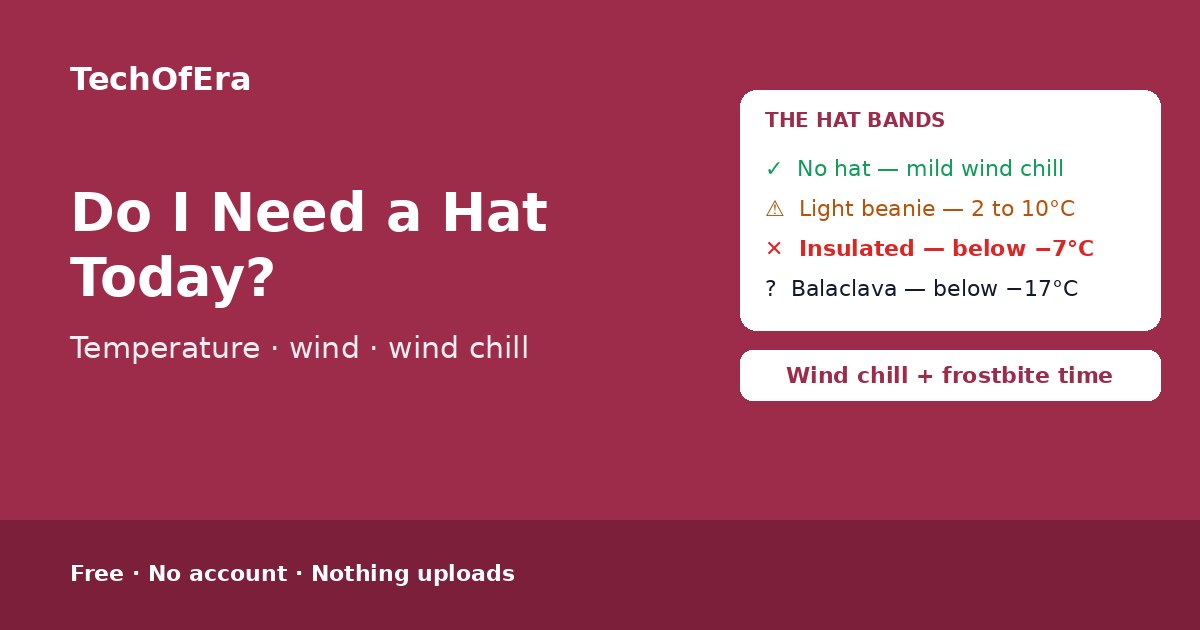
    3. Match the hat to the wind chill, not the season. A light beanie at 2 to 10°C, an insulated beanie at −7 to 2°C, an insulated beanie with full ear coverage at −17 to −7°C, and a balaclava with an insulated beanie below −17°C. A beanie only works if it is pulled right down over the tops of your ears — perched on top of the head, it leaves the ears exposed, which is the whole point of wearing it.
    4. Warm your head before you go out. A cold head put into a cold beanie stays cold. Put the beanie on before the door, not after — if your ears are already stiff before you leave, the beanie cannot catch up.
    5. Keep it dry, and keep a spare. Rain and wet snow soak beanies, and a wet beanie against your scalp loses its insulation. Choose a waterproof hood or hat when it is raining, and take a dry spare beanie if you will be out for hours — a beanie damp from sweat loses its insulation too.
    6. Know the warning signs. Numbness, tingling, or white or grey ears are the first signs of frostbite — go inside and warm them slowly with body heat or warm (not hot) water, and do not rub them. Shivering that stops, confusion, or slurred speech are signs of hypothermia — a medical emergency. Call your local emergency number.

    Conditions and what to do at a glance

    The table below is built from the same rules as the checker, so it can never disagree with your verdict. The wind chill decides, together with activity, duration, wetness, hair and ears.

    ConditionVerdictWhat to know

    What makes this checker different

    The pages that rank for this search are guides — thorough explanations of wind chill, the CDC hat guidance, and the frostbite chart, plus running-cap guides that list a cap for every temperature and style guides that argue beanie versus felt hat — but they leave you to do the maths yourself: to look up the wind-chill formula, work out what 2°C with a 25 km/h wind actually feels like, compare it with the hat thresholds, and then judge whether cycling, an hour outside, rain, baldness, or cold-triggered migraines changes the answer. The general what-to-wear tools that do exist answer the whole outfit in one line — a hat as an afterthought, with no frostbite time, no hat type, and no account of whether your ears run cold. This page is the hat answer: the temperature and wind speed in, the real wind chill and frostbite time for your ears worked out, and a verdict for the exact outing you plan — which hat, waterproof or not, sun hat or beanie, and why, with activity, duration, wetness, hair and ears scored alongside the weather. It is a self-assessment, so it says plainly what it cannot know: a web page cannot measure the weather where you are or feel your head, so anything you mark “Not sure” stays on the list until you confirm it.

    When is this the right check?

    Whenever you are about to go out and the weather makes you hesitate over your head: the 5°C morning with a biting wind, the day the forecast calls “feels like −10°C”, the cycle commute when the wind is up, the first cold snap of the season when you have not needed a beanie for months. Also whenever the conditions are borderline and the decision turns on something specific — whether a ten-minute walk needs a hat at all, whether standing at a bus stop changes a day that would be fine walking, whether rain means a waterproof hood, whether baldness means a beanie on a day most people go bare-headed, or whether a sunny 26°C afternoon means a sun hat after all. And whenever your ears go numb faster than other people’s and you want a straight answer instead of a table to interpret.

    Honest limitations

    A self-assessment, not a diagnosis

    This checker works only from the temperature, wind speed and answers you enter. It cannot diagnose you — no web page can measure the weather where you are, feel your head, or know your medical history. If an answer is wrong, the verdict is wrong. When in doubt, wear the warmer hat — or ask a clinician.

    The wind chill is a population average

    The NWS formula is calibrated on heat loss from an average adult face walking at 3 mph. Your own heat loss differs with body size, fitness, clothing and how hard you work — which is why the checker scores activity, duration, hair and ears alongside the weather, and why it is stricter when an answer is unknown.

    Frostbite times assume exposed skin

    The National Weather Service times are for bare skin. A proper hat cuts the real risk well below the chart — and a wet or thin beanie raises it. The checker scores the hat type, but it cannot see how well your beanie actually fits or how worn it is.

    Wet changes everything

    Rain, wet snow and heavy sweat all strip insulation from headwear. Ears can go numb well above freezing when they are wet — so a mild-looking rainy day can still be a hat day, and a cold wet day can be a balaclava day.

    Warning signs override the verdict

    Numbness, tingling, or white or grey ears mean frostbite is starting, whatever the checker said. Shivering that stops, confusion or slurred speech mean hypothermia — a medical emergency. Go inside and get help; do not try to finish the outing.

    Rules from public-health sources

    The rules here follow the National Weather Service wind-chill formula and frostbite chart, the CDC cold-weather guidance, CCOHS cold-weather guidance and World Health Organization sun-protection guidance, as they read in November 2026. Guidance can be revised, so re-check if a new edition appears.

    Frequently asked questions

    At what temperature do you need a hat?

    It depends on the wind chill, not the temperature alone. The CDC says to wear a hat in cold weather, and the Canadian Centre for Occupational Health and Safety says to cover the head and ears below about 4°C (39°F), with full face covering in severe cold below about −17°C (1°F). As a rough guide: above 15°C wind chill you do not need a hat; 10 to 15°C it is optional; 2 to 10°C you want a light beanie; −7 to 2°C an insulated beanie; −17 to −7°C an insulated beanie with full ear coverage; below −17°C a balaclava with an insulated beanie. Wind, rain, snow, how long you are out, your hair and whether your ears run cold all move the answer by a band — which is why this checker asks about them. In warm sun, the question flips: the World Health Organization says to wear a wide-brimmed hat when the UV index is 3 or higher.

    What is wind chill, and why does it decide the verdict?

    Wind chill is the temperature your exposed skin feels in moving air — it describes how fast your body loses heat, not the air temperature itself. The official formula, adopted jointly by the US National Weather Service and Environment and Climate Change Canada in 2001, combines air temperature and wind speed: even a modest breeze meaningfully lowers the feels-like temperature. The formula is valid for temperatures at or below 50°F (10°C) and wind speeds of 3 mph (5 km/h) or more. This checker uses that exact formula, so a −5°C day with a 40 km/h wind — a wind chill near −14°C — is judged as the cold day it really is, and your hat is chosen for the wind chill, not the thermometer.

    How quickly can your ears get frostbite?

    Ears are among the first parts to freeze, because they are thin, stick out and have little blood flow. On the National Weather Service chart, exposed skin can freeze in about 30 minutes at wind chills of −1 to −19°F (−18 to −28°C), in about 10 minutes at −20 to −34°F (−29 to −37°C), and in about 5 minutes or less at −35°F (−37°C) and below. Above 0°F (−18°C), frostbite is unlikely in normal exposure. A proper hat cuts the real risk well below the chart — which is why this checker scores the hat type, not just the weather. If your planned outing is longer than the frostbite time, the checker says so and tells you to cover your ears for the whole outing.

    Do I need a hat in the sun?

    Yes, when the sun is strong and you will be out for a while. The World Health Organization says to wear a wide-brimmed hat when the UV index is 3 or higher: a wide brim shades your face, ears and neck, while a cap leaves the ears and neck exposed. A light-coloured hat also keeps your head cooler than bare skin in direct sun. This checker recommends a sun hat or cap when it is sunny and at least 20°C and you will be out for 30 minutes or more — or at 28°C and above even for a shorter outing. A hat is only part of sun protection, though: add sunscreen on exposed skin and sunglasses, and take shade in the middle of the day.

    Does hair length change whether I need a hat?

    A little, on mild days. Bald or very short hair leaves the scalp with no insulation at all, so the head loses heat fastest — this checker scores bald or very short hair one band colder. Long, thick hair insulates the scalp a bit, which is worth one band on a mild day. But hair does not cover the ears, and in real cold the ears are what freeze first — so in severe cold, everyone needs ear coverage whatever their hair. And if hat hair worries you, wear the beanie over dry hair, take it off indoors to let your hair breathe, and keep a little dry shampoo handy — a loose, silk-lined beanie flattens hair less than a tight wool one. Never skip the hat in real cold for the sake of your hair.

    Do I need a hat for running in the cold?

    Usually a lighter one than you would wear standing still. Running warms your head once you are moving — coaches say to dress as if it were 10 to 20°F warmer — so you can start with a light beanie or a headband and carry the warmer beanie. But your ears are cold for the first ten minutes, and they chill fast again when you stop, so do not leave the warm beanie at home. This checker scores running one band warmer than standing still at the same wind chill, once the outing is longer than ten minutes. Below about −17°C wind chill, wear a balaclava with an insulated beanie even for a run, and shorten it.

    Does this checker diagnose me or upload anything?

    No to both. This checker is a self-assessment: it works only from the temperature, wind speed and answers you enter, runs entirely in your browser, and nothing you enter leaves your device. It cannot diagnose you — a web page has no way to measure the weather where you are, feel your head, or know your medical history — so every answer you are unsure about is reported as something to confirm, and the result says so plainly. The only third-party requests are the site's own analytics, which count page views. You can verify it yourself with the network-request counter in the privacy section below the checker.