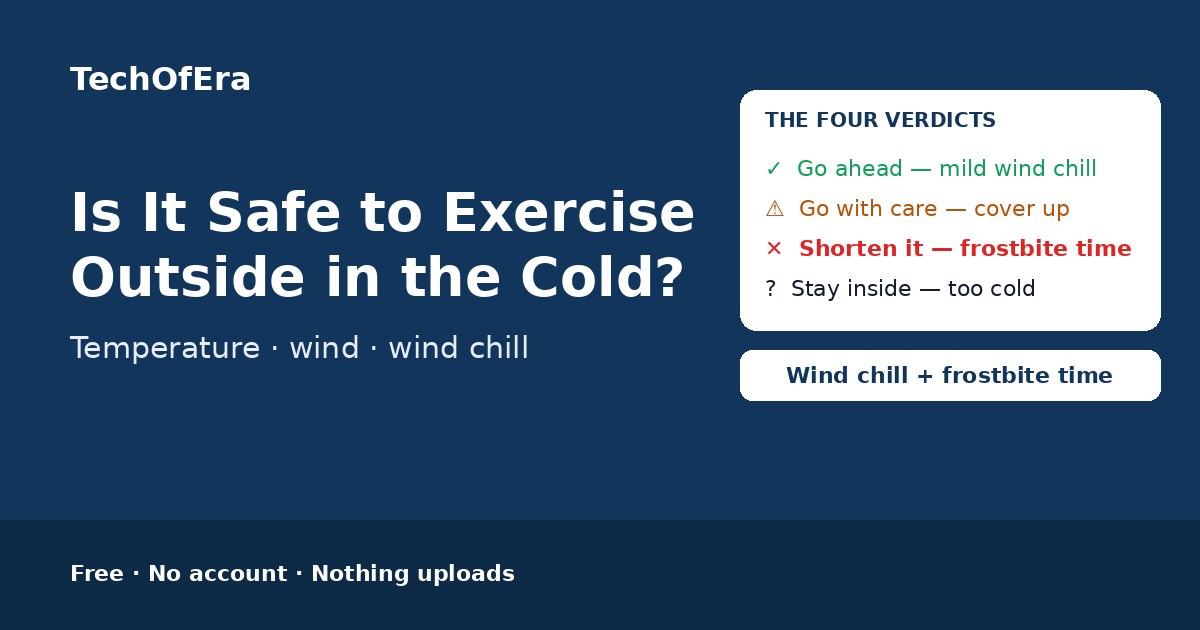
How to decide whether to exercise outside in the cold
The temperature on the thermometer is only half the story — the wind is the other half. Wind strips heat away from exposed skin, so a −5°C day with a 40 km/h wind feels like about −14°C, and your skin freezes on that feels-like number, not the thermometer one. The official wind-chill formula, adopted jointly by the US National Weather Service and Environment and Climate Change Canada in 2001, combines the two into one number — the temperature your exposed skin actually feels — and the National Weather Service chart then turns that number into a frostbite time: about 30 minutes at wind chills of −1 to −19°F, about 10 minutes at −20 to −34°F, and about 5 minutes or less at −35°F and below. Mayo Clinic adds the practical line: air temperatures below 0°F (−18°C) or extreme wind chill may prohibit safe activity outside, even in proper clothing, and frostbite risk rises sharply below 5°F (−15°C). This checker asks exactly what decides it.
To use it:
- Enter the temperature and wind speed. Use the forecast for the time you will actually be out, where you will actually be — not an indoor reading, and not the morning low if you train at midday. If either is missing, the checker says it cannot tell yet, rather than guessing.
- Read the wind chill and frostbite time. The verdict shows both. Compare the frostbite time with how long you plan to be out: if your session is longer than the frostbite time for exposed skin, either shorten it or cover every bit of skin — face, ears, fingers and toes.
- Dress in layers, not one thick coat. A moisture-wicking base layer, an insulating mid-layer and a windproof outer, with a hat and gloves. Avoid cotton — it holds sweat, and wet clothing loses its insulation. The checker scores what you wear: layers without a hat or gloves leave the parts that freeze first exposed.
- Warm up indoors, cool down indoors. Cold makes muscles, tendons and ligaments tighter and thickens joint fluid, so warm up inside for 10 to 15 minutes with dynamic movements, then start easy outside for 5 to 10 minutes before picking up the pace. Do not stand around sweating in the cold when you finish — change out of damp clothes as soon as you are back.
- Know the warning signs. Numbness, tingling, or white or grey skin on fingers, toes, nose or ears are the first signs of frostbite — go inside and warm the area slowly with body heat or warm (not hot) water, and do not rub it. Shivering that stops, confusion, or slurred speech are signs of hypothermia — a medical emergency. Call your local emergency number.
- Be honest about your health. Cold air narrows blood vessels, raising blood pressure and making the heart work harder, and it narrows the airways too — so asthma and heart conditions change the answer at the same wind chill. If you are not sure whether one applies to you, say so: the checker assumes the worst case rather than guessing.
Conditions and what to do at a glance
The table below is built from the same rules as the checker, so it can never disagree with your verdict. The wind chill decides, together with clothing, wetness and health.
| Condition | Verdict | What to know |
|---|
What makes this checker different
The pages that rank for this search are guides — thorough explanations of wind chill, the Mayo Clinic 0°F line, and the frostbite chart — but they leave you to do the maths yourself: to look up the wind-chill formula, work out what −8°C with a 25 km/h wind actually feels like, compare it with the frostbite chart, and then judge whether your layers, your session length and your asthma change the answer. The wind-chill calculators that do exist stop at the number: they tell you the feels-like temperature and the frostbite risk, but not whether you should run, how long for, or what to wear. This page is that answer: the temperature and wind speed in, the real wind chill and frostbite time worked out, and a verdict for the exact session you plan — with clothing, duration, wetness and health scored alongside the weather, and the reason named. It is a self-assessment, so it says plainly what it cannot know: a web page cannot measure the weather where you are or examine you, so anything you mark “Not sure” stays on the list until you confirm it.
When is this the right check?
Whenever you are about to train outside in winter and the weather makes you hesitate: the −8°C morning with a biting wind, the run you planned on a day the forecast calls “feels like −20°C”, the cycling session when the wind is up, the first cold snap of the season when you have not trained outside in the cold for months. Also whenever the conditions are borderline and the decision turns on something specific — whether your layers are enough, whether an hour is too long at this wind chill, or whether asthma or a heart condition changes a day that would be fine for someone else. And whenever you are new to cold-weather exercise and want a straight answer instead of a table to interpret.
Honest limitations
A self-assessment, not a diagnosis
This checker works only from the temperature, wind speed and answers you enter. It cannot diagnose you — no web page can measure the weather where you are, take your temperature, or know your medical history. If an answer is wrong, the verdict is wrong. When in doubt, stay inside — or ask a clinician.
The wind chill is a population average
The NWS formula is calibrated on heat loss from an average adult face walking at 3 mph. Your own heat loss differs with body size, fitness, clothing and how hard you work — which is why the checker scores clothing, activity and health alongside the weather, and why it is stricter when an answer is unknown.
Frostbite times assume exposed skin
The National Weather Service times are for bare skin. Proper layers, a hat, gloves and a face cover cut the real risk well below the chart — and wet or thin clothing raises it. The checker scores what you wear, but it cannot see how well your gloves actually fit.
Wet changes everything
Rain, wet snow and heavy sweat all strip insulation from clothing. Hypothermia can develop even above freezing when you are wet, tired or inadequately dressed — so a mild-looking day can still be a stay-inside day if you will be soaked.
Warning signs override the verdict
Numbness, tingling, or white or grey skin mean frostbite is starting, whatever the checker said. Shivering that stops, confusion or slurred speech mean hypothermia — a medical emergency. Go inside and get help; do not try to finish the session.
Rules from public-health sources
The rules here follow the National Weather Service wind-chill formula and frostbite chart, Mayo Clinic cold-weather exercise guidance, NHS guidance, CDC/NIOSH cold-stress guidance and American Heart Association advice, as they read in November 2026. Guidance can be revised, so re-check if a new edition appears.