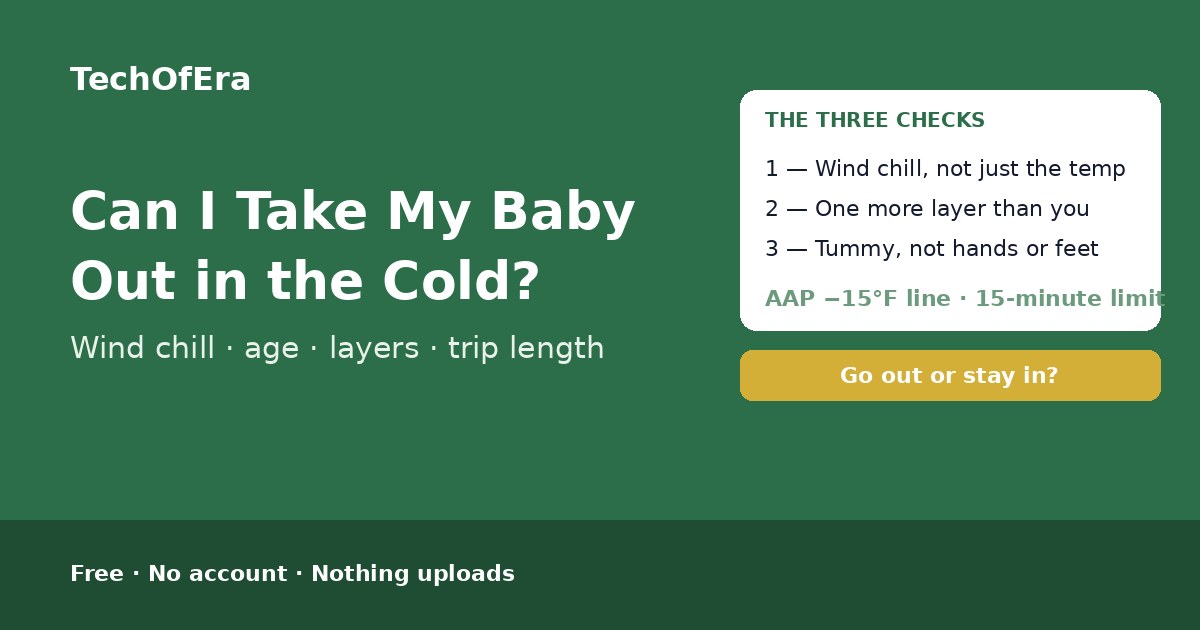
Can I take my baby out in the cold?

It is −3°C, the wind is picking up, and the pram is by the door. The guides all say the same thing — dress them in one more layer than you, keep it short — but none of them answers your question: is this temperature, with this wind, for this baby, for this long, safe? Enter the ten answers, get the verdict in seconds — free, in your browser, nothing uploads.

  • AAP −15°F stay-inside line
  • Wind chill, not just the thermometer
  • Dressing checklist included
  • Free, no account, nothing uploads
Can I take my baby out in the cold?

Check whether you can take your baby out in the cold

Try a preset:
0 of 12 answered

Your result

Answer the questions Your verdict appears here as you answer.
What this trip calls for

Enter the outside temperature above and the dressing list this trip calls for will appear here.

Blockers

Things that do not fit

Things to check

Still to confirm

What to do next

    Your result summary


    Answer the questions above — the verdict updates live.

    Privacy you can verify, not just trust

    Checking whether your baby can go out in the cold by uploading your baby’s details to a website would be backwards — the check should never be the leak. This one can't: your answers are checked with plain JavaScript on your device, and they never leave the device — the only third-party requests are the site's own analytics, which count page views. Don't take our word for it:

    New cross-origin requests during use: 0
    1. Press F12 to open developer tools, then the Network tab.
    2. Answer a question above. Watch: apart from the site's analytics, nothing new is requested — no uploads, and no data ever leaves your device.
    3. Extra credit: disconnect your internet after this page loads — the checker still works.

    How the take-your-baby-out-in-the-cold check works

    The American Academy of Pediatrics says that, in general, playing outside in temperatures or wind chills below −15°F (about −26°C) should be avoided, because at that point exposed skin begins to freeze within minutes. The NHS says to dress your baby in one more layer than you are wearing, in thin layers you can take off one at a time, and to check warmth by feeling the tummy or the back of the neck — not the hands or feet, which are often cool. But no agency sets a temperature cutoff for babies in a pram or carrier, and a single number on a weather app is not a verdict: a still −5°C day can feel milder than a windy +2°C day, a baby in a pram is not moving to make heat the way you are, and a 45-minute walk is a different trip from a 10-minute dash to the shops. This checker combines the ten things that actually decide it — your baby’s age, the temperature, the wind, the layers, the trip length, how your baby travels, their health, the weather, any puffy coat, and how the tummy feels — and gives you a verdict for this trip: go out, short trip only, or stay inside, with the dressing list the trip calls for.

    To use it:

    1. Enter your baby’s age in months. The wind chill bands are strictest under 3 months, and a toddler can move around to keep warm and tell you they are cold. The checker covers birth to 24 months.
    2. Enter the outside temperature. Check a weather app for where you are, in °C or °F. The wind chill is worked out from this number.
    3. Enter the wind speed. Wind cools skin faster than the temperature alone, and the AAP counts wind chill in the same breath as air temperature. Leave it blank if it is calm.
    4. Say how many layers your baby is wearing, compared to you. The rule is one more layer than you are wearing, in thin layers you can take off one at a time.
    5. Say how long you will be out. Door to door, including the walk back — the wind chill sets a time limit, and a trip longer than the limit is a different verdict.
    6. Say how your baby travels. A pram, a carrier, a car seat or your arms all change how cold your baby gets — a still baby in a pram cools fastest, and a car seat has its own rule about puffy coats.
    7. Say how your baby’s health is. A baby born early, or under 3 months old, gets the strictest bands. An unwell baby should not be out in the cold for long.
    8. Say what the weather is doing. Wet and windy weather cools a baby much faster than dry cold.
    9. Say whether there is a puffy coat. Fine outside the car — but never under car-seat straps.
    10. Feel your baby’s tummy. Slip two fingers onto the tummy or the back of the neck — warm and dry is right, cool means add a layer or head in, hot or sweaty means take a layer off. Do not judge by the hands or feet.

    What makes this checker different

    The pages that rank for this search are guides — Healthline’s babies-in-winter guide, MedicineNet’s newborn-temperature guide, thebabylog’s cold-weather guide, Seattle’s Child’s cold-weather safety tips, and REI’s guide to keeping babies warm outdoors — and every one of them gives you a rule of thumb and leaves you to do the sums at the front door. The nearest interactive rival is SitterRank’s wind chill calculator, which works out the wind chill and the frostbite risk for children’s outdoor play — but it knows nothing about babies: no age, no layers, no trip length, no pram or carrier or car seat, no health, and no dressing list. There is no free, standalone checker that takes your baby’s exact age, the temperature and the wind, the layers, the trip length, how your baby travels, their health and the weather — and gives you a verdict: go out, short trip only, or stay inside, with the dressing list the trip calls for and every fix named. This page is that answer: ten questions, an instant verdict for your exact baby and your exact trip, the blockers named, and the next steps. It is a self-assessment, so it says plainly what it cannot know: it cannot feel your baby or read your thermometer, and where the clues disagree it says so instead of guessing.

    When is this the right check?

    Every winter morning before the pram goes out the door — because the temperature that was fine yesterday can be a different trip today once the wind picks up. When you are new to winter with a baby and every number on the weather app feels like a guess. When someone else takes your baby out — grandparents, babysitters, nursery — because a puffy coat left on under car-seat straps is the most common way a safe trip stops being safe. When your baby was born early or is unwell, and the generic advice does not fit. And whenever the thermometer and the tummy disagree — because that is when a guide leaves you guessing and a checker earns its keep.

    Honest limitations

    A self-assessment, not medical advice

    This checker cannot feel your baby or read your thermometer. It cannot check the temperature outside or how warm your baby’s tummy actually is. If you are worried about your baby, talk to your paediatrician.

    No agency sets a baby cutoff

    The AAP’s −15°F line was written for children playing outside, not for babies in a pram. No agency publishes a temperature cutoff or a duration table for babies — so the bands and time limits here are the checker’s own estimates, built from that line and the 15-minute cold-weather limit, and they are labelled as estimates wherever they appear.

    A fever is not a layering problem

    A baby who still feels hot after you remove layers, or whose temperature is 38°C (100.4°F) or more, has a fever — not too many clothes. Call your paediatrician instead of taking more layers off.

    Wet cold is worse than dry cold

    Damp clothes in temperatures even above 4°C can lead to hypothermia in a newborn. A waterproof outer layer and a pram rain cover matter as much as the layers underneath — and any wet clothes come off as soon as you are in.

    Cold hands and feet are normal

    A baby’s hands and feet are often cool because their circulation is still maturing. The NHS says not to worry about it. The check that counts is the tummy or the back of the neck.

    Rules from official sources, dated November 2026

    The rules here are the AAP’s winter guidance and the NHS cold-weather advice, as they read in November 2026. Guidance changes: recheck with your paediatrician if anything about your baby changes.

    Frequently asked questions

    How cold is too cold to take a baby outside?

    No agency sets a temperature cutoff for babies in a pram or carrier. The American Academy of Pediatrics says that, in general, playing outside in temperatures or wind chills below −15°F (about −26°C) should be avoided, because at that point exposed skin begins to freeze within minutes — and that line was written for children playing outside, so this checker treats it as the stay-inside line and is stricter for newborns and premature babies. Paediatric advice for newborns is to avoid real cold below about −10°C wind chill and to keep any outing short. The wind chill matters as much as the thermometer: a still −5°C day can feel milder than a windy +2°C day, and the AAP counts wind chill in the same breath as air temperature. The conditions decide, not just the thermometer — wind, wet, your baby’s age and health, and how fast you can get back somewhere warm.

    How should I dress my baby for a cold walk?

    Dress your baby in one more layer than you are wearing, in several thin layers rather than one thick one, so you can take one off. A long-sleeve bodysuit, a mid layer, and a warm outer layer or snowsuit, plus a hat, mittens and warm booties, is the usual outfit — with a footmuff or a blanket tucked around the pram in real cold. Never drape a blanket or muslin over a pram to block the wind: the NHS warns that it can make a baby overheat. Take the hat and the extra layers off as soon as you are indoors or in a warm car, even if taking them off wakes your baby. This checker works out the dressing list your trip calls for from the temperature and wind you enter.

    Can I take a newborn outside in winter?

    Yes, for most healthy babies born at full term. Many UK paediatricians and health visitors are comfortable with short walks a few days after discharge from hospital, as long as the outing is short, the baby is dressed in layers, and you keep an eye on the wind and the rain. In cooler weather around 5–15°C a short walk is fine with warm clothing; in winter at 0°C and below, be more cautious, keep outings short, avoid strong wind, and avoid extreme cold below about −10°C. If your baby was born early or has any medical issues, check with your midwife, health visitor or GP before that first longer outing. A newborn cannot move around to keep warm or tell you they are cold, so keep the trip short and check the tummy partway through.

    Can my baby wear a puffy coat in the car seat?

    No. The American Academy of Pediatrics says not to buckle a baby into a car seat in a puffy coat or snowsuit: the padding compresses in a crash and leaves the straps too loose to hold your baby. Use thin, snug layers instead — tights or leggings and a long-sleeve bodysuit — and put a blanket over the straps once your baby is buckled in if more warmth is needed. Put the coat on when you leave the car, and take it off again before you buckle in. A puffy coat is fine outside the car; it is only under car-seat straps that it is unsafe.

    How do I tell if my baby is too cold outside?

    Feel your baby’s tummy or the back of their neck with two fingers — not their hands or feet, which are often cool in a comfortable baby and are not a sign of being cold. Warm and dry is right. Cool means add a layer or head in. Pale, grey or blotchy skin, shivering, unusual sleepiness or being hard to wake, and very red cheeks are warning signs: head inside and warm your baby gradually, skin-to-skin or in a warm room. If your baby is pale, unusually sleepy or hard to wake, call your paediatrician. Check the tummy partway through every cold walk, not just at the end.

    How long can a baby stay outside in the cold?

    There is no official duration table for babies, so the time limits in this checker are the checker’s own estimates, built from the AAP’s −15°F stay-inside line and the paediatric guidance to keep outdoor trips to 15 minutes or less in real cold. As a rough guide: in mild weather above 0°C wind chill, up to an hour is fine for a healthy baby dressed right; from −10°C to 0°C, about 30 minutes; from −15°C to −10°C, about 15 minutes; and below −15°F (about −26°C) wind chill, stay inside. Newborns and babies born early get shorter limits at every step, and wet and windy weather shortens the trip further — damp clothes can lead to hypothermia even above 4°C. Plan a warm stop halfway, and check the tummy partway through.

    Does this checker give medical advice?

    No. This checker is a self-assessment: it runs your answers against the AAP’s winter guidance and the NHS cold-weather advice as they read in November 2026, entirely in your browser, and nothing you enter leaves your device. A web page cannot feel your baby or read your thermometer — it cannot check the temperature outside or how warm your baby’s tummy actually is — so it says plainly what still needs checking, and where the clues disagree it says so instead of guessing. The only third-party requests are the site’s own analytics, which count page views. If you are worried about your baby, talk to your paediatrician.