How to decide whether you need gloves today
The temperature on the thermometer is only half the story — the wind is the other half. Wind strips heat away from your hands, so a 2°C day with a 40 km/h wind feels like about −6°C, and your fingers go numb on that feels-like number, not the thermometer one. The official wind-chill formula, adopted jointly by the US National Weather Service and Environment and Climate Change Canada in 2001, combines the two into one number — the temperature your exposed skin actually feels — and the National Weather Service chart then turns that number into a frostbite time: about 30 minutes at wind chills of −1 to −19°F, about 10 minutes at −20 to −34°F, and about 5 minutes or less at −35°F and below. The Canadian Centre for Occupational Health and Safety adds the practical lines: wear gloves below 4°C for light work, below −7°C for moderate work, and switch to mittens below about −17°C. This checker asks exactly what decides it.
To use it:
- Enter the temperature and wind speed. Use the forecast for the time you will actually be out, where you will actually be — not an indoor reading, and not the morning low if you go out at midday. If either is missing, the checker says it cannot tell yet, rather than guessing.
- Read the wind chill and frostbite time. The verdict shows both. Compare the frostbite time with how long you plan to be out: if your outing is longer than the frostbite time for exposed fingers, cover every finger for the whole outing — not just most of it.
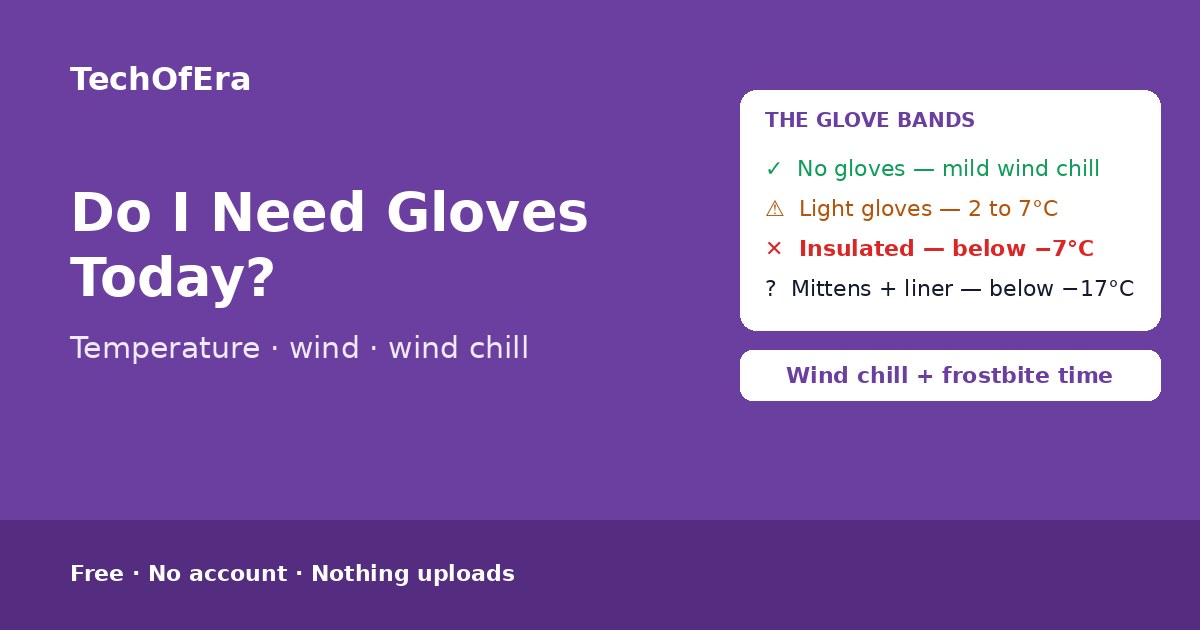
- Match the gloves to the wind chill, not the season. Light gloves at 2 to 7°C, insulated gloves at −7 to 2°C, insulated gloves or mittens at −17 to −7°C, and mittens with a liner below −17°C. A thin liner under the outer pair means you still have a usable hand when the outer layer comes off.
- Warm your hands before you go out. Cold hands put into cold gloves stay cold. Rub them together or run them under warm water first, and put the gloves on before the door, not after — if your fingers are already stiff before you leave, the gloves cannot catch up.
- Keep them dry, and keep a spare pair. Rain and wet snow soak gloves, and wet gloves lose their insulation. Choose waterproof gloves with a cuff that seals, and take a dry spare pair if you will be out for hours — gloves damp from sweat lose their insulation too.
- Know the warning signs. Numbness, tingling, or white or grey fingers are the first signs of frostbite — go inside and warm them slowly with body heat or warm (not hot) water, and do not rub them. Shivering that stops, confusion, or slurred speech are signs of hypothermia — a medical emergency. Call your local emergency number.
Conditions and what to do at a glance
The table below is built from the same rules as the checker, so it can never disagree with your verdict. The wind chill decides, together with activity, duration, wetness and circulation.
| Condition | Verdict | What to know |
|---|
What makes this checker different
The pages that rank for this search are guides — thorough explanations of wind chill, the CCOHS glove thresholds, and the frostbite chart — but they leave you to do the maths yourself: to look up the wind-chill formula, work out what 2°C with a 25 km/h wind actually feels like, compare it with the glove thresholds, and then judge whether cycling, an hour outside, rain, or Raynaud’s changes the answer. The general what-to-wear tools that do exist answer the whole outfit in one line — gloves as an afterthought, with no frostbite time, no glove type, and no account of whether your hands run cold. This page is the gloves answer: the temperature and wind speed in, the real wind chill and frostbite time worked out, and a verdict for the exact outing you plan — which gloves, waterproof or not, and why, with activity, duration, wetness and circulation scored alongside the weather. It is a self-assessment, so it says plainly what it cannot know: a web page cannot measure the weather where you are or feel your hands, so anything you mark “Not sure” stays on the list until you confirm it.
When is this the right check?
Whenever you are about to go out in winter and the weather makes you hesitate over your hands: the 5°C morning with a biting wind, the day the forecast calls “feels like −10°C”, the cycle commute when the wind is up, the first cold snap of the season when you have not needed gloves for months. Also whenever the conditions are borderline and the decision turns on something specific — whether a ten-minute walk needs gloves at all, whether standing at a bus stop changes a day that would be fine walking, whether rain means waterproof gloves, or whether Raynaud’s means mittens on a day most people go bare-handed. And whenever your hands go numb faster than other people’s and you want a straight answer instead of a table to interpret.
Honest limitations
A self-assessment, not a diagnosis
This checker works only from the temperature, wind speed and answers you enter. It cannot diagnose you — no web page can measure the weather where you are, feel your hands, or know your medical history. If an answer is wrong, the verdict is wrong. When in doubt, wear the warmer pair — or ask a clinician.
The wind chill is a population average
The NWS formula is calibrated on heat loss from an average adult face walking at 3 mph. Your own heat loss differs with body size, fitness, clothing and how hard you work — which is why the checker scores activity, duration and circulation alongside the weather, and why it is stricter when an answer is unknown.
Frostbite times assume exposed skin
The National Weather Service times are for bare skin. Proper gloves cut the real risk well below the chart — and wet or thin gloves raise it. The checker scores the glove type, but it cannot see how well your gloves actually fit or how worn they are.
Wet changes everything
Rain, wet snow and heavy sweat all strip insulation from gloves. Hands can go numb well above freezing when they are wet — so a mild-looking rainy day can still be a gloves day, and a cold wet day can be a mittens day.
Warning signs override the verdict
Numbness, tingling, or white or grey fingers mean frostbite is starting, whatever the checker said. Shivering that stops, confusion or slurred speech mean hypothermia — a medical emergency. Go inside and get help; do not try to finish the outing.
Rules from public-health sources
The rules here follow the National Weather Service wind-chill formula and frostbite chart, the Canadian Centre for Occupational Health and Safety cold-weather hand guidance, Mayo Clinic cold-weather guidance and City of Toronto wind-chill risk levels, as they read in November 2026. Guidance can be revised, so re-check if a new edition appears.